




















Search
History Of Science

For decades, theorists have been cooking up "theories of everything" to explain our Universe. Are all of them completely off-track?

Not everyone accepts the scientific consensus; some even make careers out of challenging it. But only a select few do it the right way.
7mins
30 years ago, we didn’t know other stars had planets orbiting them. Now, we may be on the verge of finding Earth’s Twin. Sara Seager explains.

7mins
Members
We tend to trust our intuitions about consciousness because they feel immediate and personal, but feeling convinced is not the same as being right. Annaka Harris explores what happens when […]

The highest-energy particles could be a sign of new, unexpected physics. But the simplest, most mundane explanation is particularly iron-ic.
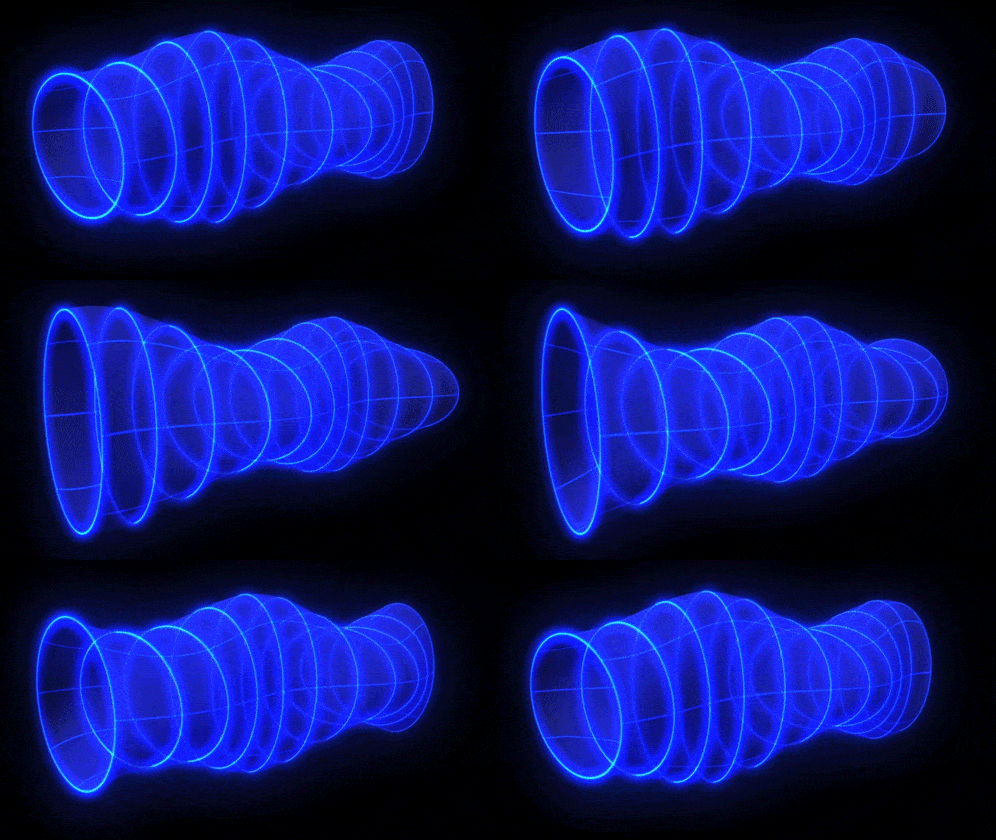
We've now detected hundreds of gravitational waves with LIGO, Virgo, and KAGRA. What if we tried Weber's original method in the modern day?

16mins
“The messy reality of it is that all of these very smart people, including Isaac Newton, were talking to other people.”

23mins
"Could black holes be the key to a quantum theory of gravity, a deeper theory of how reality, of how space and time works? Well, I think so."

Neuroscientist Rachel Barr shares her favorite books on the brain and how they shaped her approach to the field.

In this excerpt from "Facing Infinity," Jonas Enander examines how John Michell conceived of "dark stars," or massive bodies with enough gravity to trap light, all the way back in 1783.

The Holy Grail of physics is a Theory of Everything: where a single equation describes the whole Universe. But maybe there simply isn't one?

1hr 26mins
“I like to say that physics is hard because physics is easy, by which I mean we actually think about physics as students.”

A paradigm should be elastic enough to accommodate new data and broad enough to explain the world. For Rupert Sheldrake, ours does neither.

18mins
"There's a long history of people claiming planets which look Earth-like, Earth 2.0, Earth twins."

22mins
"Quantum mechanics and quantum entanglement are becoming very real. We're beginning to be able to access this tremendously complicated configuration space to do useful things."

For centuries, even after we knew the Sun was a star like any other, we still didn't know what it was made of. Cecilia Payne changed that.

DESI, by mapping galaxies, has claimed they see evidence for dark energy evolving by getting weaker. But that's only one interpretation.

Fears of celestial collisions — and calculations of their likelihood — go back to the very origins of modern science itself.

First discovered in the mid-1960s, no cosmic signal has taught us more about the Universe, or spurred more controversy, than the CMB.

Physicist Don Lincoln explains why mathematics is a powerful tool for scientific modeling, but is not a science itself.

One alchemist's search for a whiz-bang method to produce gold unlocked the central science instead.

If atoms are mostly empty space, then why can't two objects made of atoms simply pass through each other? Quantum physics explains why.

Most waves need a medium to travel through. But the way that light and gravitational waves travel shows that space can't be a medium at all.

For nearly 60 years, the hot Big Bang has been accepted as the best story of our cosmic origin. Could the Steady-State theory be possible?

"I was stunned. Here in front of me was the original apparatus through which a new vision of the world was slowly and painfully brought to light."

How did life on Earth begin? Is there life on other worlds? An answer to either question will reflect heavily on the other.

Why hasn’t matter fallen apart over billions of years? The mystery might start with protons.

Almost everyone asserts that the Big Bang was the beginning of everything, followed by inflation. Has everyone gotten the order wrong?

Many mavericks look to Einstein as a unique figure, whose lone genius revolutionized the Universe. The big problem? It isn't true.

Are breakthroughs really a matter of chance, or are they simply waiting to be uncovered by the right person at the right time?