
















History and Society

History and Society

Two hands, one light and one dark, each holding a contrastingly colored molecular structure against a gradient background.
The fear of unleashing forces beyond control has haunted science for centuries.
Two large Martian rocks with circular drill holes and light-colored dust are shown on a sandy, rocky surface. Part of a rover’s equipment, searching for traces of organics or signs of Mars life, is visible at the bottom of the image.
The red planet, Mars, may once have been teeming with life, just as Earth is today. Finding "organics" on Mars, however, doesn't mean life.
A drawing of a group of people soaring in a plane, embodying cosmism.
In revolutionary Russia, a group of forward-thinking philosophers offered an alternative to both futurism and communism.
The word "liberalism" in white lowercase text is centered on a black background, surrounded by rough red circles drawn with a crayon effect, visually emphasizing the ongoing discourse on liberalism.
In “On Liberalism," Cass Sunstein argues that liberalism can only endure if we reclaim its core commitments and revive its spirit of freedom and hope for the future.
It's the origin of our entire observable Universe, but it's still not the very beginning of everything.
Angus Fletcher, wearing a plaid shirt, smiles at the camera as he stands in front of a blue, patterned background.
A dialogue with Angus Fletcher — author of the bestseller "Primal Intelligence" — exploring the unique engines of human progress.
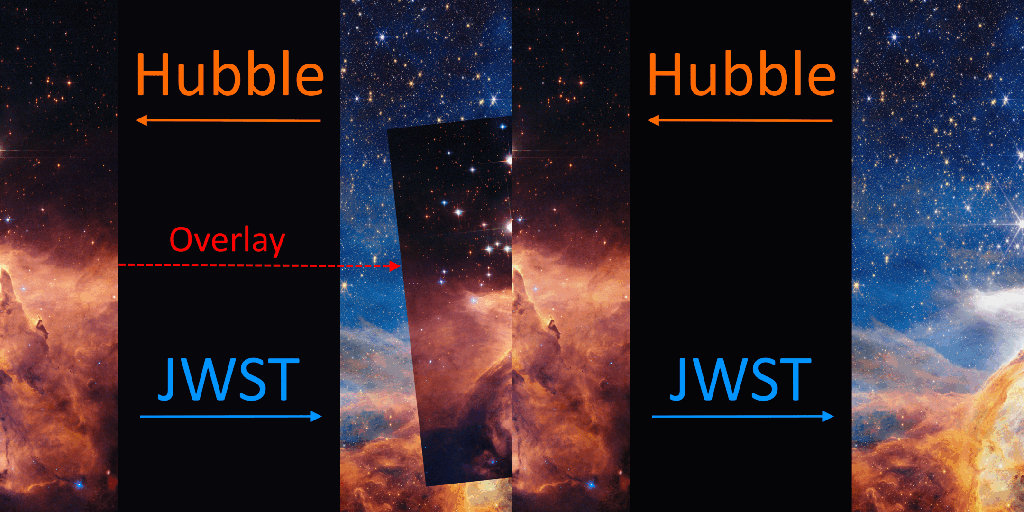
Side-by-side comparison of the Pismis 24 nebula as seen by Hubble (top left) and JWST (bottom right), with an overlay highlighting image differences.
JWST isn't the first telescope to peer into this factory of star-birth some 5500 light-years away, but its views are the most educational.
a diagram of the ocean floor.
About six million years ago, the Mediterranean was sealed off from the Atlantic, and over centuries it ran dry. One megaflood reversed that.
A collage features people using phones, a vintage courtroom scene, and a close-up of mechanical watch parts under tweezers, exploring ancestral bonds, with the title "THE NIGHTCRAWLER" at the top.
Welcome to The Nightcrawler — a weekly newsletter from Eric Markowitz covering tech, innovation, and long-term thinking.
A world map comparing landmass outlines of the Equal Earth projection in pink and Mercator projection in green, with grid lines overlaid.
The African Union argues that the Mercator projection distorts the continent, both in size and global attention.
An open book, symbolizing dangerous books, burns with flames rising from its pages against a black background, its fiery reflection shimmering on a glossy surface.
In "That Book Is Dangerous," author Adam Szetela examines the rise of the “Sensitivity Era” in publishing and how outrage campaigns try to control what books authors can write and readers can read.
Book cover for "The Contemplative Leader" by Patrick Boland, featuring blue abstract art and Patrick Boland’s name alongside the subtitle "Uncover the Power of Presence and Connection.
A contemplative approach to leading others can help us accept the tension of not always knowing how things will play out.
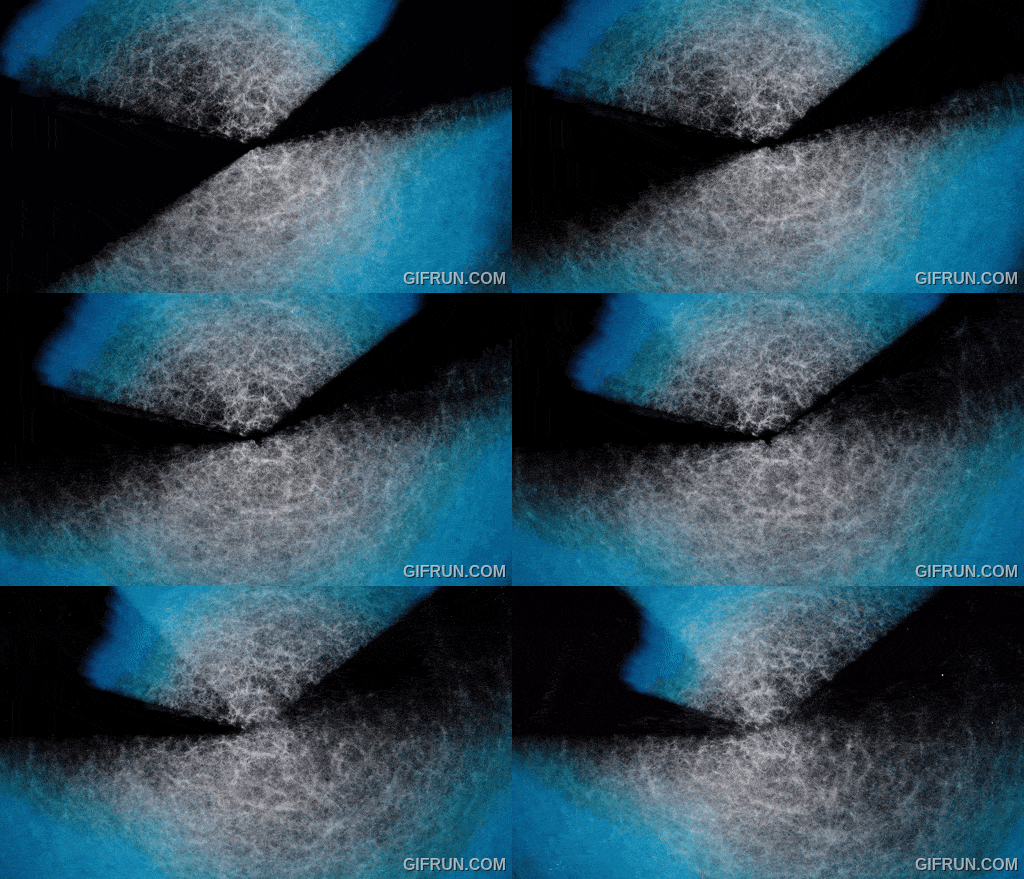
An abstract animation of white, textured patterns symmetrically forming on a blue and black background evokes the mysterious dance of dark energy, subtly hinting at its weakening presence as if guided by the precision of DESI.
The Universe isn't just expanding; the expansion is accelerating. If different methods yield incompatible results, is dark energy evolving?
Collage featuring "THE NIGHTCRAWLER" text, a black-and-white photo of a person, tree roots reminiscent of smart forests, and code fragments, all overlaid on a gray grid background.
Welcome to The Nightcrawler — a weekly newsletter from Eric Markowitz covering tech, innovation, and long-term thinking.
Two diagrams: the left shows a complex, circular, multicolored network; the right displays a theoretical physics diagram with labeled axes and colored particle symbols, capturing the intricate nature of physics hard concepts.
When you don't have enough clues to bring your detective story to a close, you should expect that your educated guesses will all be wrong.
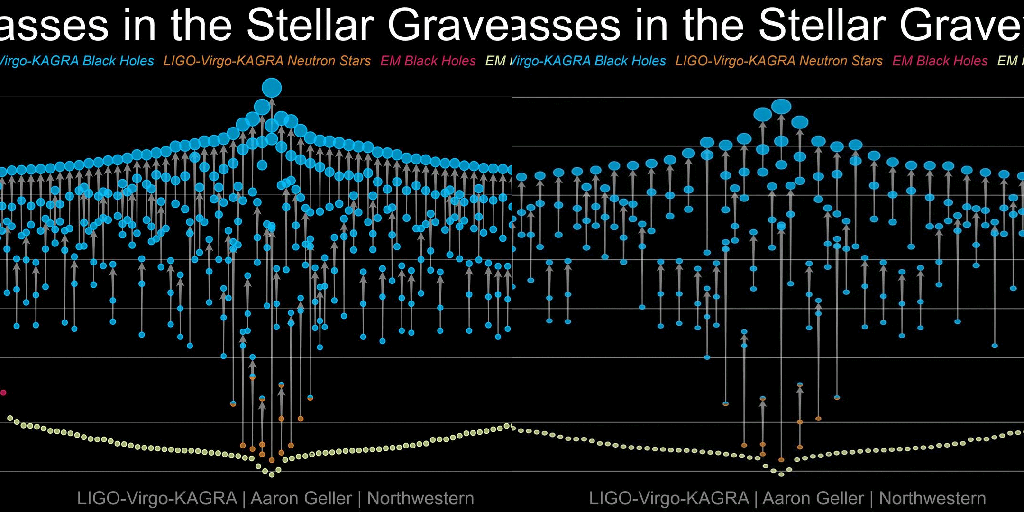
A chart titled "Masses in the Stellar Graveyard" shows the black holes and neutron stars detected by LIGO-Virgo-KAGRA, plotted on a logarithmic scale in solar masses, highlighting how LIGO triples black hole haul with each new discovery.
10 years ago, LIGO saw its first gravitational wave. After 218 detections, our view of black holes has changed forever. Can this era endure?
Illustrated map showing streets, parks, and landmarks of a coastal city bordered by Hob's River and Delaware Bay, with a compass rose in the lower right corner.
The latest "Superman" film sets Metropolis in the First State.
A 3D potential energy surface with a central peak and surrounding valley illustrates zero-point energy power; two blue spheres indicate positions atop the peak and within the valley. Axes labeled Re(φ), Im(φ), and V(φ).
Throughout history, "free energy" has been a scammer's game, such as perpetual motion. But with zero-point energy, is it actually possible?
A small, irregular brown stone with holes—possibly linked to Denisovans—is shown next to a 1990 U.S. dime for size comparison.
In “The Secret History of Denisovans,” Silvana Condemi and François Savatier trace the story of our mysterious hominin ancestor.
A storytelling collage featuring a man inspecting barrels, a person holding a skull mask, another man observing the mask, and the text "THE NIGHTCRAWLER" in bold black and orange.
Welcome to The Nightcrawler — a weekly newsletter from Eric Markowitz covering tech, innovation, and long-term thinking.
There could be variables beyond the ones we've identified and know how to measure. But they can't get rid of quantum weirdness.
Pencil drawing of an adult hand holding a child's hand, surrounded by colorful, illustrated borders with various faces and map elements.
Sikh American scholar and historian Simran Jeet Singh on helping kids imagine — and create — a more empathetic world.
John Templeton Foundation
Abstract collage with a butterfly, brain sketches, graphs, and scientific diagrams overlaid with red, black, and beige shapes and textured patterns.
A conversation with neuroscientist Erik Hoel about the future of consciousness research.
Diagram showing a galaxy, zooming in to highlight a small area labeled "Human Experience" within a grid mapping time and space on logarithmic scales.
Science helps us imagine the vastness of space and time — and our small but meaningful place within it.
Three circles show, from left to right, an oyster shell, a Vitruvian-style human figure, and a swirling spiral, linked together on a textured lavender background.
Philosophers once prophesied that evolution would lead to minds far greater — and stranger — than our own.
Abstract illustration of a human figure with glowing neural-like lines and bright light concentrated around the head, set against a red and orange gradient background.
Introducing Big Think's Consciousness Issue.
Black and white illustration of a ship at shore, with people unloading goods and interacting on land; orange arc marks part of the scene.
In the Embers series, historian M.G. Sheftall shares the stories of Hiroshima and Nagasaki’s last survivors and reveals why their testimony must endure.