
















History and Society

History and Society

Collage with a man in a suit, stacked mugs, an upside-down creature, dice, and the text "THE NIGHTCRAWLER" at the top on a dark grid background—hinting at the power of intuition amid surreal imagery.
Welcome to The Nightcrawler — a weekly newsletter from Eric Markowitz covering tech, innovation, and long-term thinking.
A man looking at a meteorite.
19mins
“So many things could have happened in a different way that we wouldn't be here at all, both individually, for sure, and certainly as a species.”
A person wearing a wide-brim hat and vest crouches beside a tree stump covered with various fungi, gazing in wonder at the fascinating growths in the green forested area.
Wonder is like a guest you haven’t planned for.
Two tall, rectangular scientific instruments, including a NASA nuclear reactor prototype, stand on the rocky lunar surface with Earth visible in the background against the blackness of space.
There are real concerns with long-term power generation on the Moon; nuclear could be the answer. But for NASA, will the cost be too high?
An older man with white hair and a suit receives a document from another man in a robe during an event, as several people look on in the background. In the age of viral misquotes, capturing such moments accurately becomes ever more crucial.
From Einstein to Twain, Garson O’Toole investigates the truth behind your favorite — and often misattributed — quotes.
Bogumil Baranowski, dressed in a dark suit, white shirt, and patterned tie, stands and smiles in front of a plain light blue background.
The investment advisor and host of the Talking Billions podcast explores childhood curiosity, building networks through kindness, and more.
A hexagonal telescope with a gold exterior and an open, black interior is shown against a black background, highlighting NASA habitable worlds observatory science.
At the end of July, hundreds of scientists convened to plan NASA's upcoming astrophysics flagship mission. Will the US allow it to happen?
Map showing Copenhagen, Denmark’s projected 2080 climate as similar to Demigny, France today, with a red arrow connecting the two cities and climate details listed in pop-up boxes.
“Climate analog mapping” finds the place that is currently as warm as your city might be in 60 years.
Five World War I soldiers in uniform stand and sit near sandbags in a trench, with a sign reading "Surrey Lane" visible in the background—evoking camaraderie amid the Ring of Fire on the front lines.
Historians Alexandra Churchill and Nicolai Eberholst reexamine the pivotal conflict from a grassroots perspective.
A digital collage with overlapping purple-tinted images, including a traditional building and a sculpture, explores panpsychism under the title "The Nightcrawler" on a black grid background.
Welcome to The Nightcrawler — a weekly newsletter from Eric Markowitz covering tech, innovation, and long-term thinking.
Pixelated grayscale close-up of an AI prince's face with strong contrast and visible mosaic-like squares.
Author and geopolitical strategist Paulo Cardoso do Amaral urges us to ask: Will we shape AI with wisdom, or will AI reshape us with strategy?
A man with a bald head and gray goatee smiles at the camera. Above his head, a thought bubble filled with red scribbles hints at the inner thoughts of John Amaechi.
The psychologist, educator, and former NBA player discusses the professional volumes and childhood stories that shaped his life and his approach to it.
5000 exoplanets
Somewhere, at some point in the history of our Universe, life arose. We're evidence of that here on Earth, but many big puzzles remain.
Full moon over a city skyline at night, high-rise buildings aglow and lights reflecting on the calm water—a scene that inspires 5 science lessons about the moon's impact on our world.
Even just by examining the Moon with the unaided eye, we can learn an incredible amount about the Moon, Earth, and more.
A woman with curly hair sits in a chair holding an open book, looking to the side, surrounded by strange books, drawn white pentagrams, and a lit candle nearby.
Some books are remembered for their lyrical prose or engaging stories. Others are remembered for simply being weird.
A painting of a praying woman with clasped hands and an upward gaze appears through the outline of a keyhole, set against a black background, evoking an air of mysticism.
It makes no sense to talk about a “religious life” and a “public life” — there is just life.
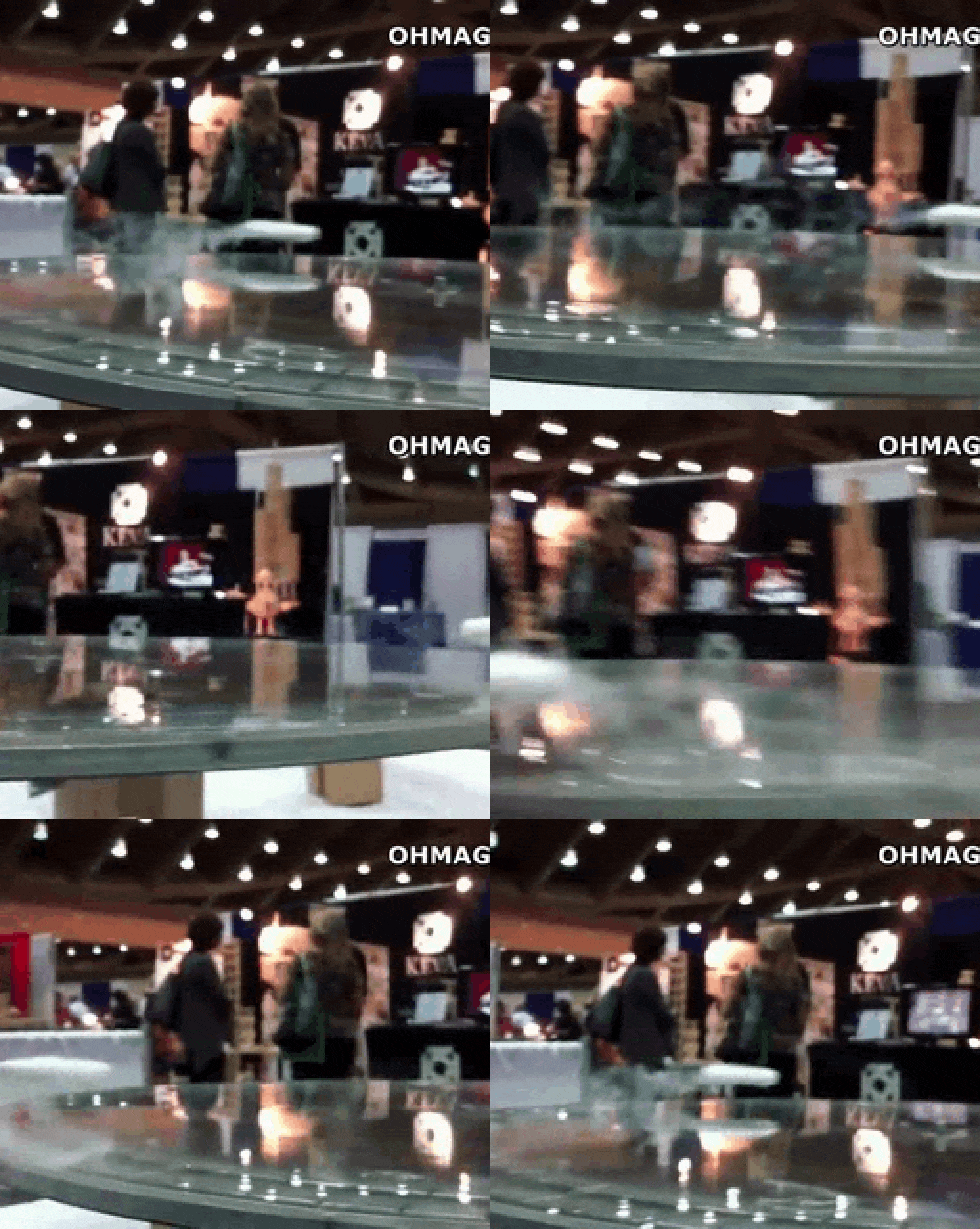
levitation
With the right material at the right temperature and a magnetic track, physics really does allow perpetual motion without energy loss.
A man slumps in a chair, eyes closed, as small monkey-like creatures torment him with various objects in a room near a fireplace and table.
In "The Headache," Tom Zeller Jr. explores one of the human brain's most enduring, and painful, enigmas.
Granite memorial stone for John F. Kennedy, surrounded by trees and located on a paved area with steps. Inscription dedicates the site from the people of Britain to the United States.
The JFK Memorial at Runnymede provides a link between America's and Britain's founding documents.
Green abstract image with floating, glowing funnel-shaped objects and spherical wireframe shapes evokes a black hole universe, all set against a misty green background with ethereal light streaks.
Once you cross a black hole's event horizon, there's no going back. But inside, could creating a singularity give birth to a new Universe?
Union soldiers in blue uniforms escort prisoners past a burning building with a large hole in the wall while smoke and flames rise, during the American Civil War.
Before becoming America’s most infamous assassin, John Wilkes Booth was a magnetic actor who was beloved by audiences and courted by critics.
A collage featuring an open book, a light source, and images of the moon captures post-AI wisdom, with the title "The Night Crawler" at the top.
Welcome to The Nightcrawler — a weekly newsletter from Eric Markowitz covering tech, innovation, and long-term thinking.
F = ma fall up
From high school through the professional ranks, physicists still take incredible lessons away from Newton's second law.
Diagram showing human evolutionary relationships and gene flow among Khoisan, West Africans, Non-Africans, Neanderthals, and Denisovans over time, with percentages of genetic admixture indicated.
After more than a million years of separation, two branches of humanity reunited around 300,000 years ago, suggests new research.
A pyramid stands in a desert with three people in front, evoking experimental archeology; a modern McDonald's restaurant is visible in the background on the right.
In "Dinner with King Tut," Sam Kean examines how a burgeoning field is recreating ancient tasks to uncover historical truths.
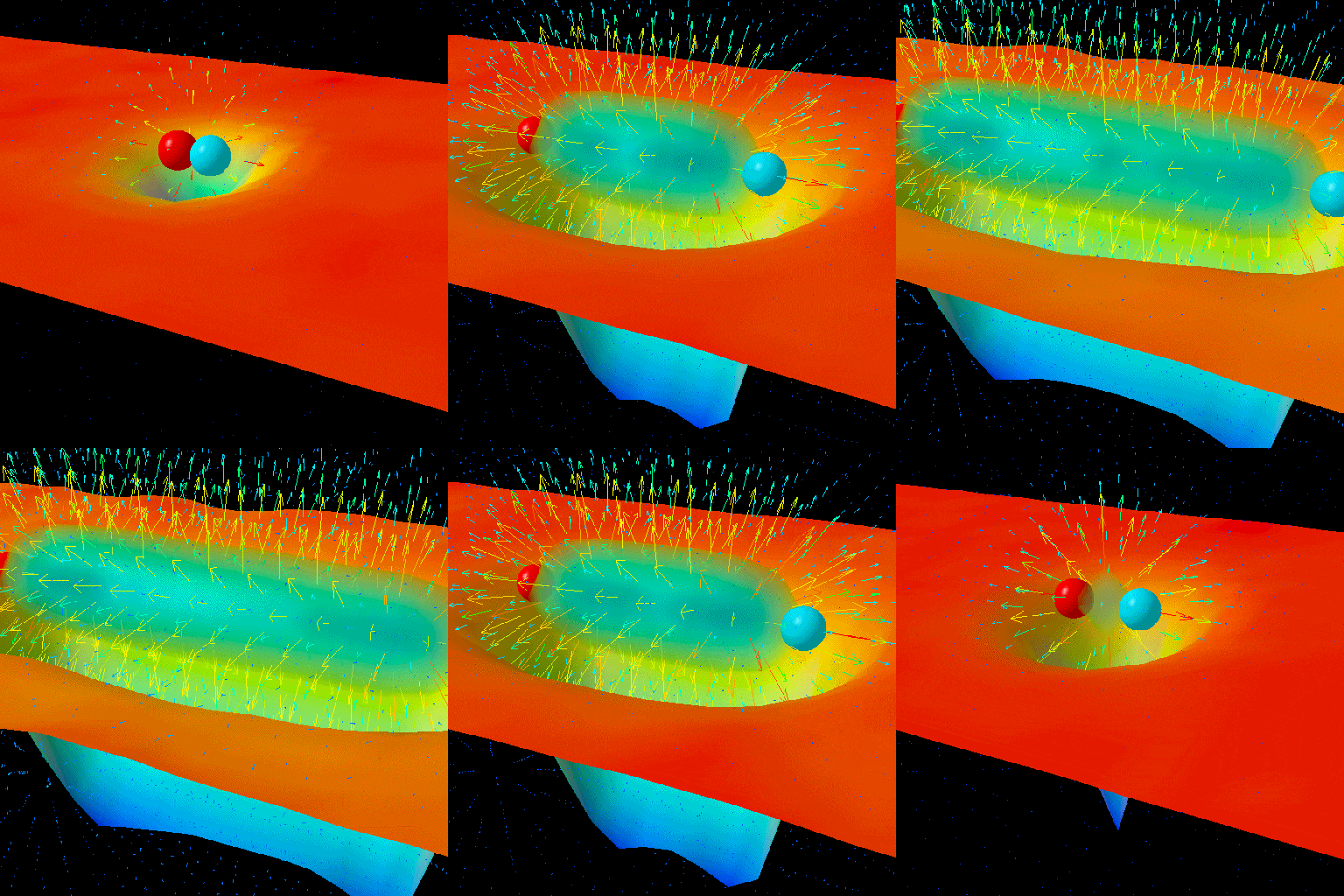
A visual simulation of two objects orbiting and merging, distorting a red-orange grid representing spacetime—illustrating gravitational waves once thought to be the worst prediction in science.
The measured value of the cosmological constant is 120 orders of magnitude smaller than what's predicted. How can this paradox be resolved?
Collage featuring photos of wildlife, ancient stone carvings, and a camel, with the text "THE NIGHTCRAWLER" at the top on a gray grid background—an homage to Sean B. Carroll’s explorations of nature and history.
Welcome to The Nightcrawler — a weekly newsletter from Eric Markowitz covering tech, innovation, and long-term thinking.
Two colorful, semi-transparent spheres, one blue and one red, represent a possible top quark bound state, toponium, surrounded by small particles inside a cloudy, circular enclosure.
Can the top quark, the shortest-lived particle of all, bind with anything else? Yes it can! New results at the LHC demonstrate toponium exists.
Painting of a man with red hair and a mustache wearing a white cap, resting his head on his hand, set against a swirling blue background with touches of van Gogh yellow paint highlighting the scene.
In "Human History on Drugs," Sam Kelly explores what the research can tell us about one of history’s most brilliant — and troubled — artists.