




















Search
Infectious Disease

From global DNA screening standards to safeguards for benchtop synthesizers and AI tools, a new biosecurity playbook is taking shape.

21mins
"By keeping people biologically younger, we can enjoy a longer health span, a longer period of healthy life where we're active, where we're happy, where we can engage in our hobbies, and play with our grandkids and great grandkids."

Scientific truths remain true regardless of belief. These 10, despite contrary claims, remain vitally important as 2025 draws to a close.

In "The Microbiome Master Key," Brett and Jessica Finlay argue that we need to stop waging war on all germs and start working with the microbes that make us who we are.

Here in 2025, many of us claim to come to our own conclusions by doing our own research. Here's why we're mostly deluding ourselves.

John Green opens up about his struggle to remain hopeful while writing about suffering and injustice.

1hr 11mins
“It's a remarkable series of events that were required for us to be here, and that so many things could have happened in a different way that we wouldn't be here at all, both individually, and as a species.”

For centuries, vaccines have been the top life-saving, expert medical intervention known to humans. How can individuals make the right call?

In theory, scientists could've produced a deadly virus that accidentally infected lab workers. In practice, we know that didn't happen.

In his new book, the popular science writer tells the story of how scientists discovered the “gaseous ocean” we all swim in — and the trillions of invisible life forms we share it with.
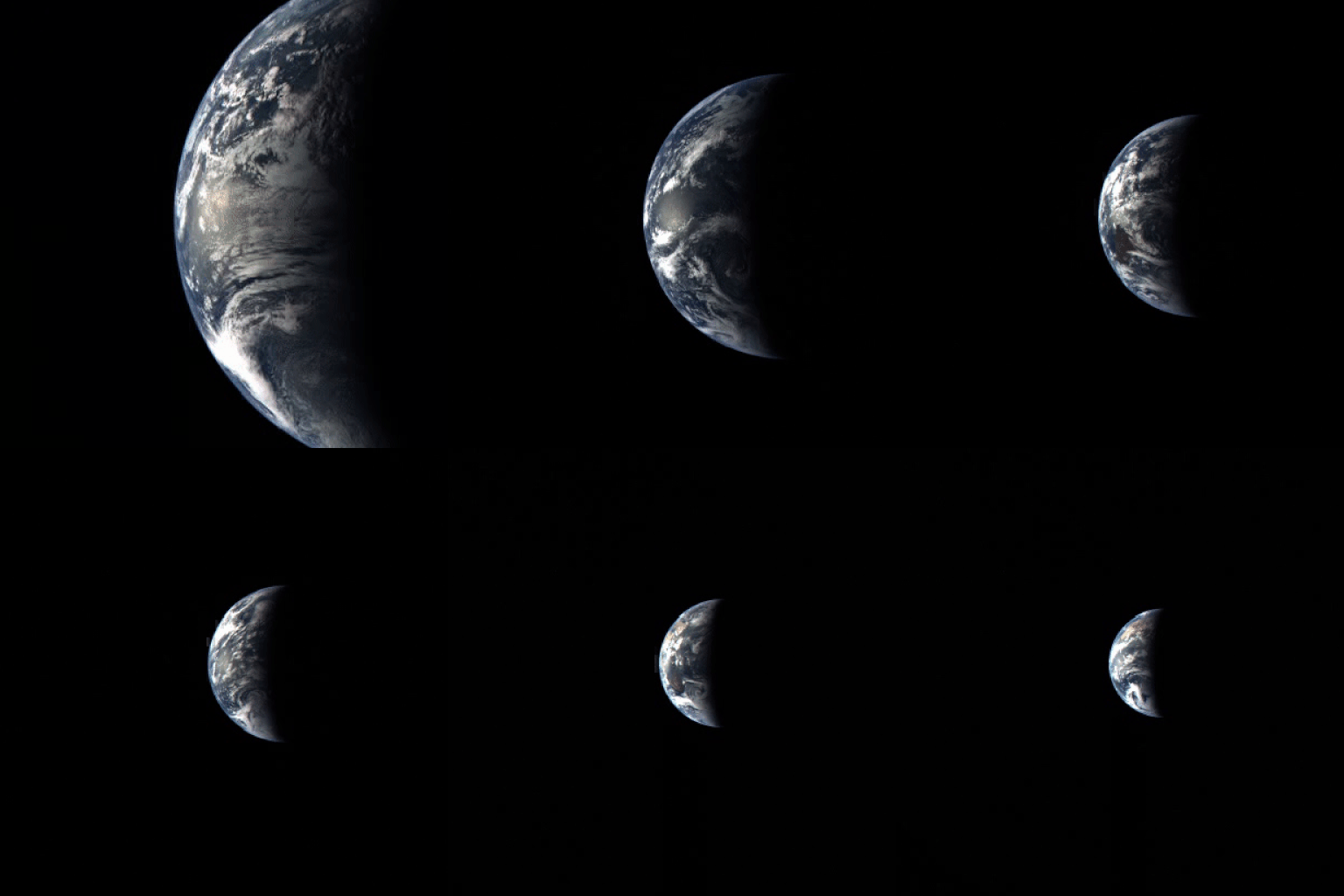
All scientific theories are limited in scope, power, and application, being mere approximations of reality. That's why consensus is vital.

A new bill introduced into the US Senate claims to make us safer. Instead, it would destroy all virology research, and for no real cause.

We're all entitled to our own opinions, no matter how ill-informed they are. But facts are facts; we can't just choose the ones we prefer.

Caitlin Rivers wants to tell the story of epidemiology and the public health heroes who keep the world safe and healthy.

Some go gently into the night. Others die less prettily in freak accidents or deadly invasions, or after a showy display.

Differences in certain avian and mammalian proteins explain why avian influenza doesn't (typically) infect humans.

8mins
Biological evolution in humans has slowed. Can AI, culture wars, and modern tech explain why?

SARS-CoV-2 first emerged in humans in 2019. Despite much noise generated by lab leak proponents, the evidence indicates a natural origin.

More than 90% of sexually active men will be infected with human papillomavirus in their lifetime. The virus may reduce fertility.

More than 90% of ticks that bit treated volunteers were dead within 24 hours.

We don’t yet know if these strange “obelisks” are helpful or harmful.

New DNA analyses raise questions over the theory that Christopher Columbus and his men brought syphilis to Europe.

Western societies seem to be getting inflammation achingly wrong.

The FDA approved a single-dose, long-acting injection to protect babies and toddlers from RSV over the fall and winter.

People with higher immune resilience live longer, resist diseases, and are more likely to survive diseases when they do develop.

Artificial intelligence can forecast the behavior of viruses and quickly make vaccines to thwart them.

EBT-101 is not the only candidate for an HIV cure. Stem cell transplants, medications, and other CRISPR therapies are being researched.

AI was key to making Moderna's COVID mRNA vaccine. Its role in mRNA therapeutics will rapidly grow in the coming years.

The young and healthy were not just as likely to die as the old and frail, according to a new analysis.

It temporarily puts the immune system on high alert to prevent MRSA, pneumonia, and other infections in the hospital.