




















Search
Innovation

When AI eats its own product, it gets sick.

Welcome to The Nightcrawler — a weekly newsletter from Eric Markowitz covering tech, innovation, and long-term thinking.

Just eight of Etched’s Sohu chips could replace 160 Nvidia GPUs.

Welcome to The Nightcrawler — a weekly newsletter from Eric Markowitz covering tech, innovation, and long-term thinking.

As creatures and machines meld together in increasingly advanced forms, ethicists are starting to take note.

For extraordinary long-term success in business we can look to insights from British Olympic cycling, Roger Federer and neuroeconomics.
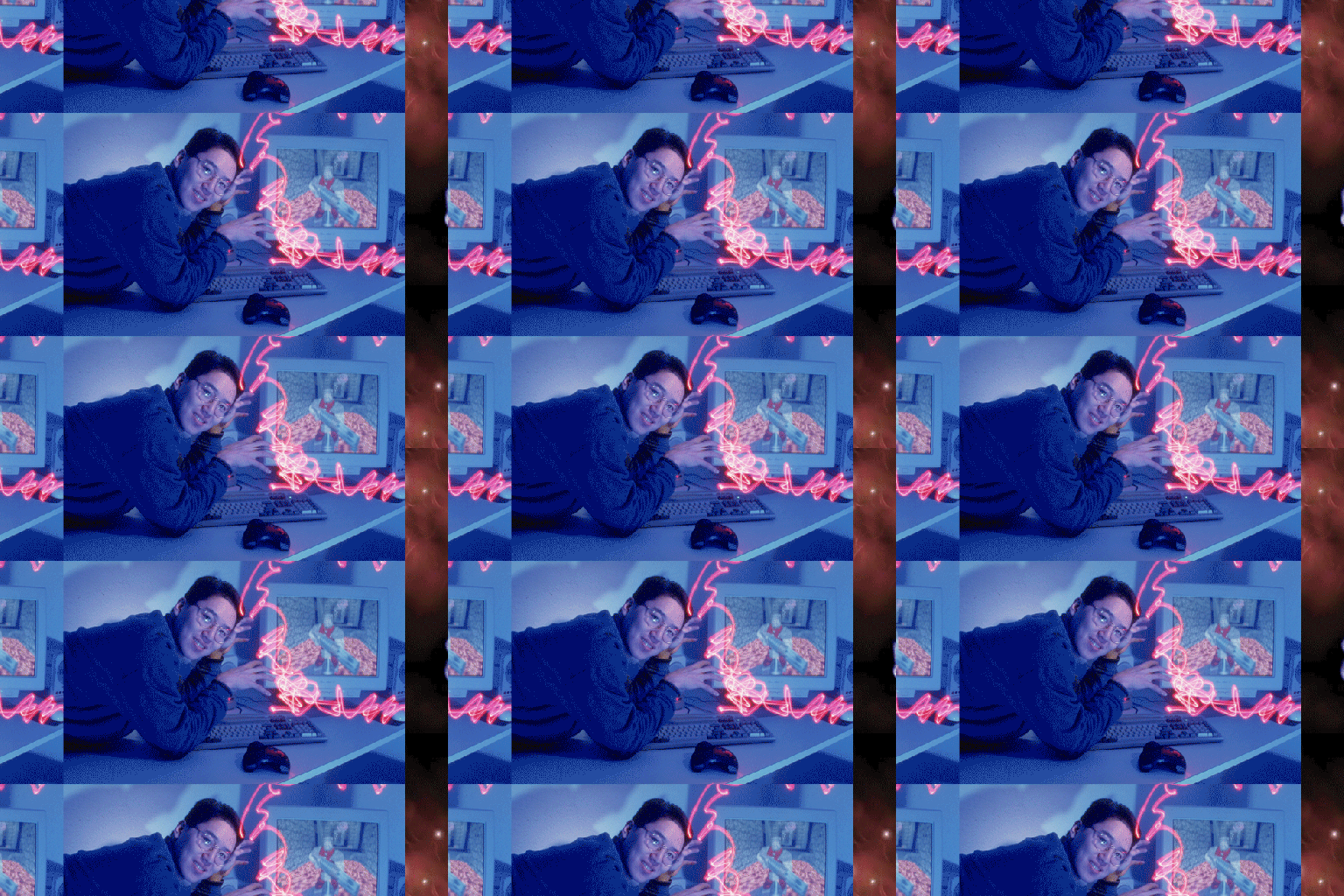
Dennis “Thresh” Fong talks to us about battling Elon Musk in Quake in the ‘90s, his undefeated record as a pro gamer, and using AI to detoxify gaming.

Welcome to The Nightcrawler — a weekly newsletter from Eric Markowitz covering tech, innovation, and long-term thinking.

Evidence shows that “centaurs” — human–AI teaming — produce better performance than either people or software can achieve alone.

We need more data centers for AI. Developers are getting creative about where to build them.

There is one obstacle that reliably blocks innovative ideas: how we fund science.

He peppers his sentences with words like “neat” and “cool,” he’s not great at working the room after dinner — oh, and he's a peerless visionary.

Like ultra-hardy plants that thrive in harsh conditions, businesses that see crises as opportunities are likely to win in the long run.

Vijay Tella — CEO of enterprise orchestration unicorn Workato — joins Big Think Business for an exploration of our “agentic” future.

These missions will put us one step closer to the ultimate goal: crewed trips to Mars.

Welcome to the Big Think debut of The Nightcrawler — a weekly newsletter from Eric Markowitz covering tech, innovation, and long-term thinking.

How has tennis changed in recent decades? The wear and tear on Wimbledon’s Centre Court may tell the tale.

More accurate uncertainty estimates could help users decide about how and when to use machine-learning models in the real world.

Today, the Large Hadron Collider is the most powerful particle physics experiment in history. What would a new, successor collider teach us?

The lithium-ion alternatives could help create a safer, greener future.

Four startup founders explain how to derive lessons from the past while still looking ahead to what’s possible.

The rise and fall of Josh Harris — the genius who anticipated the digital revolution just a little too soon.

AI researcher and author Ken Stanley wonders how our rear-view perspective on success fits into a serendipitous mode of innovation.

"Business Adventures" by John Brooks was first published in 1969 and remains a must-read for all CEOs.

Why the best entrepreneurs should be more Obi-Wan Kenobi than Luke Skywalker.

Big Think asks startup legend and VC heavyweight Ben Horowitz to reflect on his bestseller "The Hard Thing About Hard Things."

The new corporate landscape demands an approach to leadership based on empowering the “inner CEO.”
Can AI-powered “answer engines” replace the 10 blue links model?

Alan Turing and Christopher Strachey created a ground-breaking computer program that allowed them to express affection vicariously when so doing publicly, as gay men, was criminal.

Hypersonic aircraft can fly at least five times the speed of sound. They would make for terrifying weapons.