




















Search
Machine Learning

Artificial intelligence is much more than image generation and smart-sounding chatbots; it's also a Nobel-worthy endeavor rooted in physics!

8mins
Eric Siegel, Co-Founder & CEO, Gooder AI, argues machine learning (ML) projects go astray because their stakeholders focus too often on the technological fireworks — the “rocket science” of predictive models.

When AI eats its own product, it gets sick.

6mins
Algorithms dictate a lot more than your social media feeds. Here’s how to win back your agency.

8mins
Eric Siegel has been in the AI field since 1991. He’s “horrified” by the AI hype bubble, but not for the reason you think.

More accurate uncertainty estimates could help users decide about how and when to use machine-learning models in the real world.

Such discoveries help researchers better understand the development of molecular complexity in space during star formation.

It's knowledgeable, confident, and behaves human-like in many ways. But it's not magic that powers AI though; it's just math and data.

"How long someone thinks about [a] problem is a really good proxy of how humans behave."

8mins
Wharton professor Ethan Mollick explains why “co-intelligence may be the future of AI.

A new technique that can automatically classify phases of physical systems could help scientists investigate novel materials.

Finally, an AI that can drive a digital car as a goat.

Google’s “Genie” could be used to create a wide range of interactive environments for more than just games.

Big Think talks to Konrad Feldman — founder of advertising tech innovator Quantcast.

Twin Health lets patients with diabetes see what’s happening inside their own body and can model each patient’s unique metabolism.
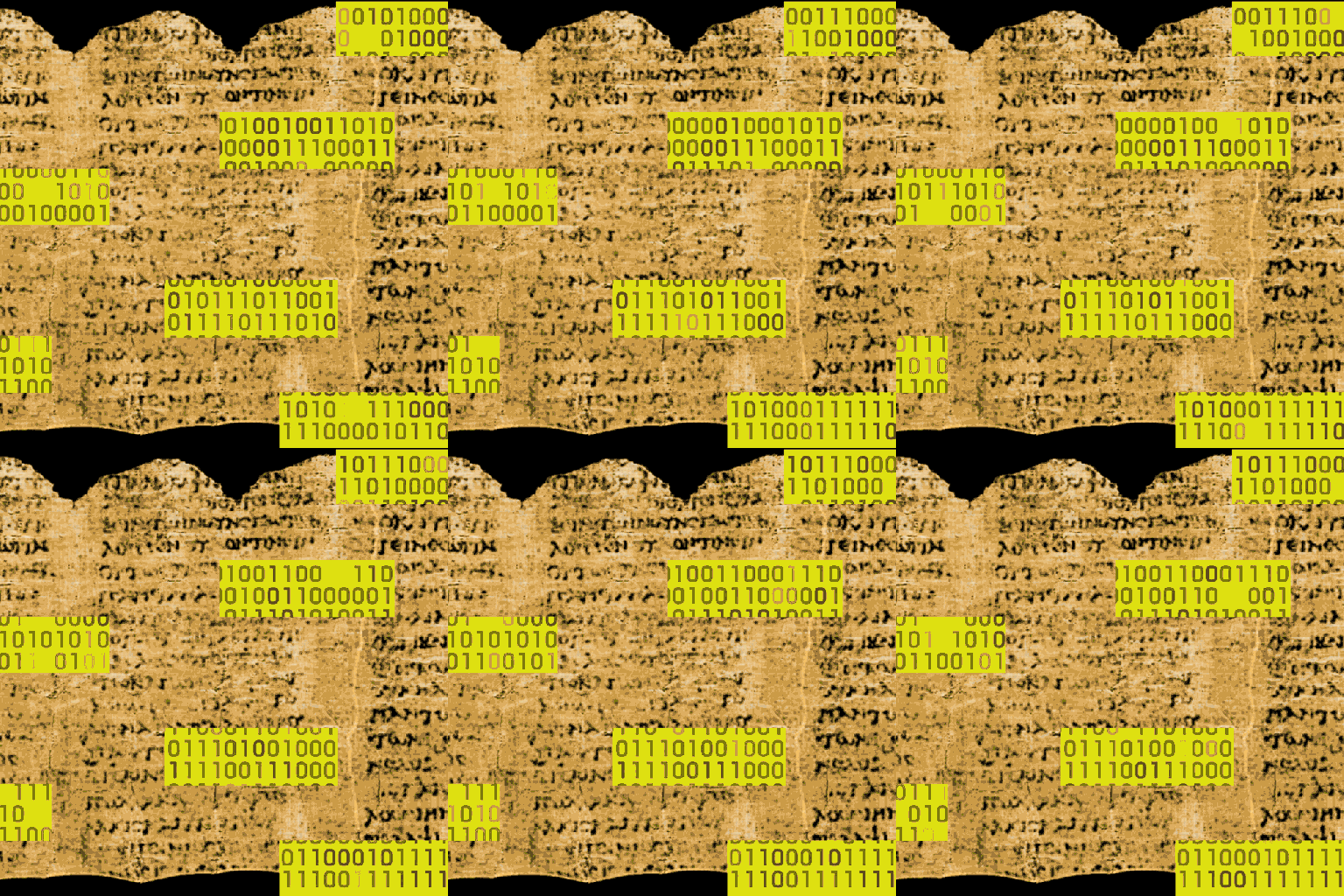
These scrolls are the only remaining intact library of ancient Rome — and they will crumble at a touch.


Meta and NYU’s robot can navigate and clean rooms it’s never seen before.

Practical ML can radically improve business operations, but there’s a deployment issue.

Cognitive psychologist and poet Keith Holyoak explores whether artificial intelligence could ever achieve poetic authenticity.

IBM veteran Daniel Sabbah learned from experience how to lead through the challenges of demand and innovation.

4mins
What if AI could tell us we have cancer before we show a single symptom? Steve Quake, head of science at the Chan Zuckerberg Initiative, explains how AI can revolutionize science.
Chan Zuckerberg Initiative

Frontier, the ORNL supercomputer, used machine learning to perform 9.95 quintillion calculations per second.

The volcano’s historic eruption preserved an ancient library, but rendered its content illegible. A public competition aims to change that.

A game that challenges pedestrians to avoid detection by an AI could help train tomorrow’s self-driving cars.

Analog could serve as "always-on" computing, while digital is turned on only when necessary.

In December 2022, a company called BioAge Labs published findings on a drug that worked to prevent muscular atrophy, or the loss of muscle strength and mass, in older people.

AI was key to making Moderna's COVID mRNA vaccine. Its role in mRNA therapeutics will rapidly grow in the coming years.

Sophisticated rovers have found the conditions for Martian life, as well as the building blocks of life, but never life itself. AI can help.

Artificial general intelligence will not arise in systems that only passively receive data. They need to be able to act back on the world.