




















Search
Mars Exploration

Mars was warmer and wetter long ago. If anything was alive there, what came next was either a tragedy or a masterclass in survival.

Instead of hauling heavy building materials across space, future astronauts may grow fungal shelters from spores, waste, and local regolith.

Science fiction romanticized Mars as a place of adventure and future settlement; science tells a very different story.

The unanswered questions about sex, love, and pregnancy in space could shape the future of humanity more than we think.

What if the first search for life beyond Earth actually succeeded?

The first world beyond Earth for human habitability should be the Moon, not Mars. This is why we should terraform our lunar neighbor first.

Organic compounds can form through simple chemistry alone — making the search for true biosignatures trickier than it seems.

The red planet, Mars, may once have been teeming with life, just as Earth is today. Finding "organics" on Mars, however, doesn't mean life.

Life may have arisen far earlier — and more rapidly — than previously thought.

Motility was suggested as a promising "biosignature" as early as the 1960s, but the technology was insufficient — until now.

Featuring SpaceX's "Mechazilla," a first-of-its-kind spacewalk, and more.

Mars and Earth were sister planets in many ways, with early similar conditions. Why did Mars die? The leading explanation isn't universal.

Caption:“At this time in Mars’ history, we think CO2 is everywhere, in every nook and cranny, and water percolating through the rocks is full of CO2 too,” Joshua Murray says.

Scientists might be looking for Martian life in the wrong place.

"When you feel the isolation setting in at times, you have to reframe your mindset."

The recent discovery of a large cave on the Moon highlights the importance of caves not just for future space explorers but astrobiology as well.

A long view of biological survival might point us to new possibilities for finding life elsewhere in the Universe.

3mins
“I study the mineral kingdom — and its secrets could lead us to alien life.”

To know how to protect its astronauts, NASA needs to first understand the threat.

The threats Mars astronauts face — and how NASA is working to solve them.

If the past is any guide, things are going to take off quickly.

Well-preserved ancient plants and other finds at the Clarkia fossil beds hint at what kind of evidence any Martian life may have left behind.

The case for why NASA should pivot to searching for current — not ancient — signs of life.

Valles Marineris is the Solar System's grandest canyon, many times longer, wider, and deeper than the Grand Canyon. What scarred Mars so?

Freethink's weekly countdown of the biggest space news, featuring a stranded space factory, Jeff Bezos' new moon lander, and more.
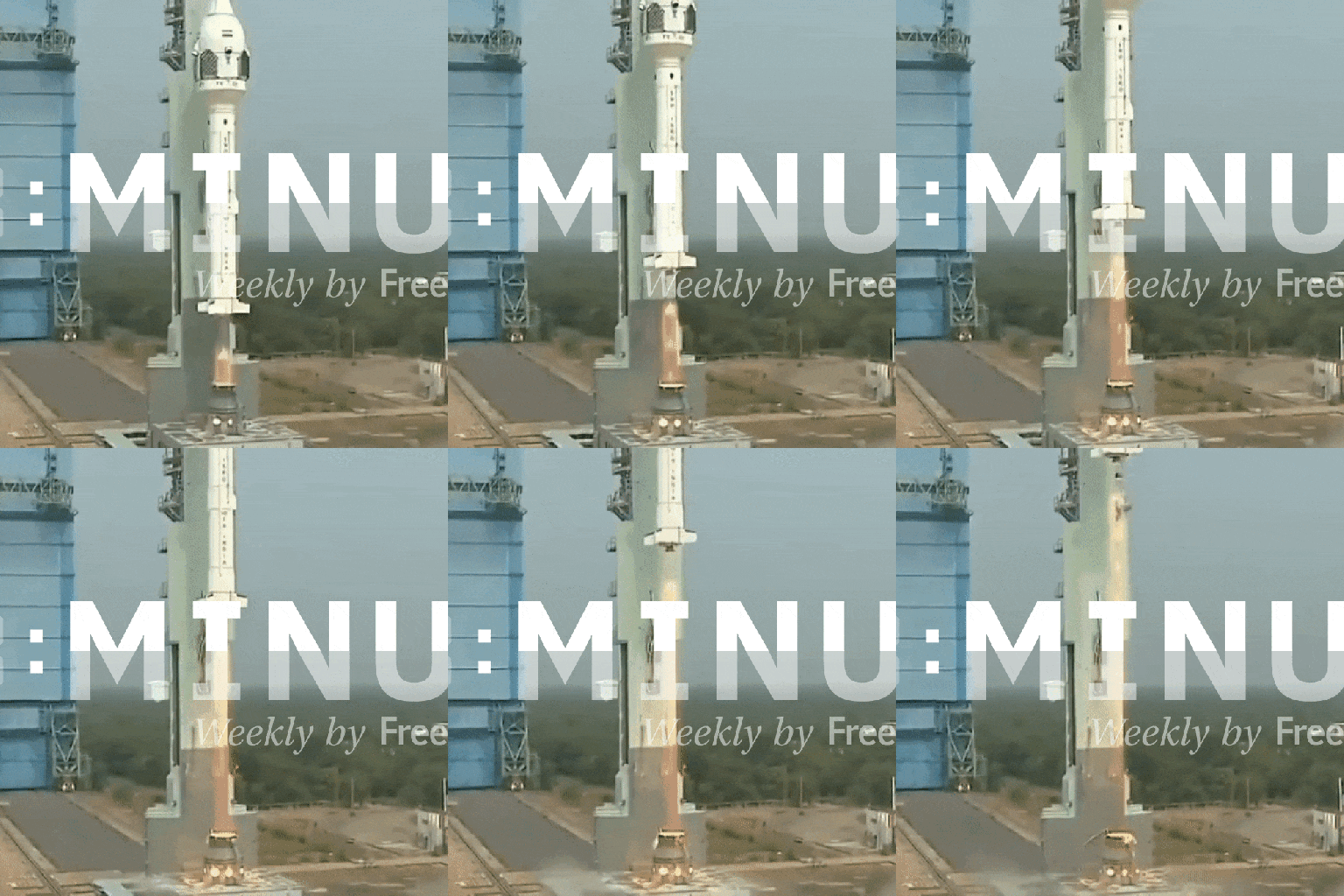
See the 3 biggest space stories from October 16-22, 2023.

Sophisticated rovers have found the conditions for Martian life, as well as the building blocks of life, but never life itself. AI can help.

Chemical changes inside Mars' core caused it to lose its magnetic field. This, in turn, caused it to lose its oceans. But how?

In one experiment, the Viking landers added water to Martian soil samples. That might have been a very bad idea.

A next-generation instrument on a delayed rover may be the key to answering the question of life on Mars.