With the latest detection of organic compounds by the Curiosity rover, the case for past life on Mars becomes stronger than ever, as suggested in a recent paper by Alexander Pavlov in the journal Astrobiology. And that lends additional credence to an even more exciting idea — that living organisms may still exist on Mars today.
If that’s true, what form should we expect them to take? And where should we search for them? The planet’s surface is a brutal environment for any known type of organism, with huge temperature swings (from approximately -150 °C to 25 °C), virtually no water, and high doses of radiation. Yet we know from our own planet how resilient and adaptive life can be. Besides, this hostile environment didn’t always exist on Mars.
So if life once thrived on the Red Planet, where did it go?
Option 1: Retreat!
We know from half a century of robotic Mars exploration that the planet once had watery environments similar to those on Earth’s surface, probably including shallow lakes, streams, and deeper-water seas. It may even have had hydrothermal vents similar to those found in our deep oceans, which may have been where life originated on Earth. With all that water, microbial life could have become well established before climate change made the surface uninhabitable. As the planet got colder and drier, any microbes might have retreated into isolated niches, such as groundwater beneath the permafrost or underground lava tubes, fractures, fissures, and caves. Or they may have migrated to areas where the ground was warmer, like the volcanic provinces of Arabia Terra.
Option 2: Go dormant
While the evolutionary history of Mars is still to some degree uncertain, it seems clear that the planet has had long dry and cold stretches interspersed with warmer and wetter periods that extended almost up to the present era. On Earth, a common adaptive strategy for surviving temporarily inhospitable conditions is dormancy. Dormant microbial states, such as the spores or cysts we find in cold environments like Antarctica, may have allowed Martian organisms to tough it out through harsh conditions until the environment became hospitable again. The big question here is whether evolution on Mars would have progressed far enough to develop dormancy as a strategy. It’s unknown when spores first appeared on Earth — fossilized spores are notoriously difficult to identify, so the fossil record isn’t much help.
Life could potentially bloom and reproduce at a high rate during periods when liquid water reappears on the surface.
Because early Earth environments could also have been inhospitable, it seems likely that dormancy developed early in our planet’s history. On the other hand, spores and similar dormancy states are quite complex to achieve. They require a complex genetic development program, and so would not be expected to be among the first adaptations that life tried in order to survive environmental change.

Let’s imagine that dormant life has persisted on Mars up until modern times. It could potentially bloom and reproduce at a high rate during periods when liquid water reappears on the surface, not unlike what happens in hyperarid deserts on Earth. Wetter periods could result from flooding triggered by episodic volcanism and meteor bombardment, or from snow or ice melt. Even so, Martian organisms would still be expected to spend most of their lives in the spore state, as inhospitable conditions would last for very long stretches of time.
Option 3: Hide under a rock
Based on the ecological adaptations we see in desert ecosystems on Earth, there is a pattern of changes that comes with increasing dryness. The last refuge for surface life in places like the Atacama Desert of Chile is inside salt crusts that are hygroscopic, meaning they draw water directly from the atmosphere. (Think how salt gets clumpy if you leave it in humid air for too long.) This effect becomes very pronounced in hyperarid environments like the Atacama, and could also work for life on Mars. Some microbes on Earth don’t need any other source of water to persist and grow. If the salty rock absorbs so much moisture that some of it dissolves and forms a solution, the process is called deliquescence. This is how terrestrial microbes survive in places where it may rain only once in a decade, like in the Atacama. In theory, the same thing could happen on Mars.
Option 4: Some strategy unknown to us
Data from radar sounding experiments on Mars orbital missions suggest that underground lakes or pockets of groundwater may exist tens of meters below the surface of Mars. If true, these would likely be concentrated mixtures of water with chloride or perchlorate, given the temperature-depth profile. The question then arises whether life could thrive in these types of very concentrated brines. Experiments done with Debaryomyces hansenii, a microbe known to be very tolerant of perchlorate, showed that it could still grow at concentrations of 2.5 mol/kilogram. That’s high, but still far from the nearly saturated solution we might expect in the Martian subsurface. Salt solutions that stay liquid under those conditions, like magnesium chloride or calcium perchloride, are toxic to life. Could Martian organisms, if they exist, adapt to this kind of environment over many generations of evolutionary change?
They’d also need to be able to thrive in places much drier than any known on Earth — or, to use a more technical criterion, environments with very low “water activity.” The absolute lowest level of water activity for life on Earth to thrive seems to be somewhere between 0.5 and 0.6. However, while the overall water activity measured at any particular location might be unacceptably low, water may still be available on a microscopic level. For example, a study led by Rainer Meckenstock discovered minuscule water droplets in a lake of liquid asphalt that, surprisingly, contained bacterial communities — even when water activity in the lake as a whole measured 0.49. On Mars, if water activity were to fluctuate over the daily cycle, microbes could go dormant when it falls below a certain threshold level, then become active again when it rises.
Or maybe Martian organisms can thrive at much lower water activity levels than we find on Earth. We don’t know. The problem is that they’d have to be able to survive in highly changeable conditions in Earth’s deserts, from bone-dry to drenched. Even in the most arid deserts on Earth, there are extreme rain events when a lot of water suddenly becomes available. In one reported case, a downpour in the Atacama killed off more than 80% of bacterial species that were perfectly happy under normal dry conditions. The rain effectively drowned them.
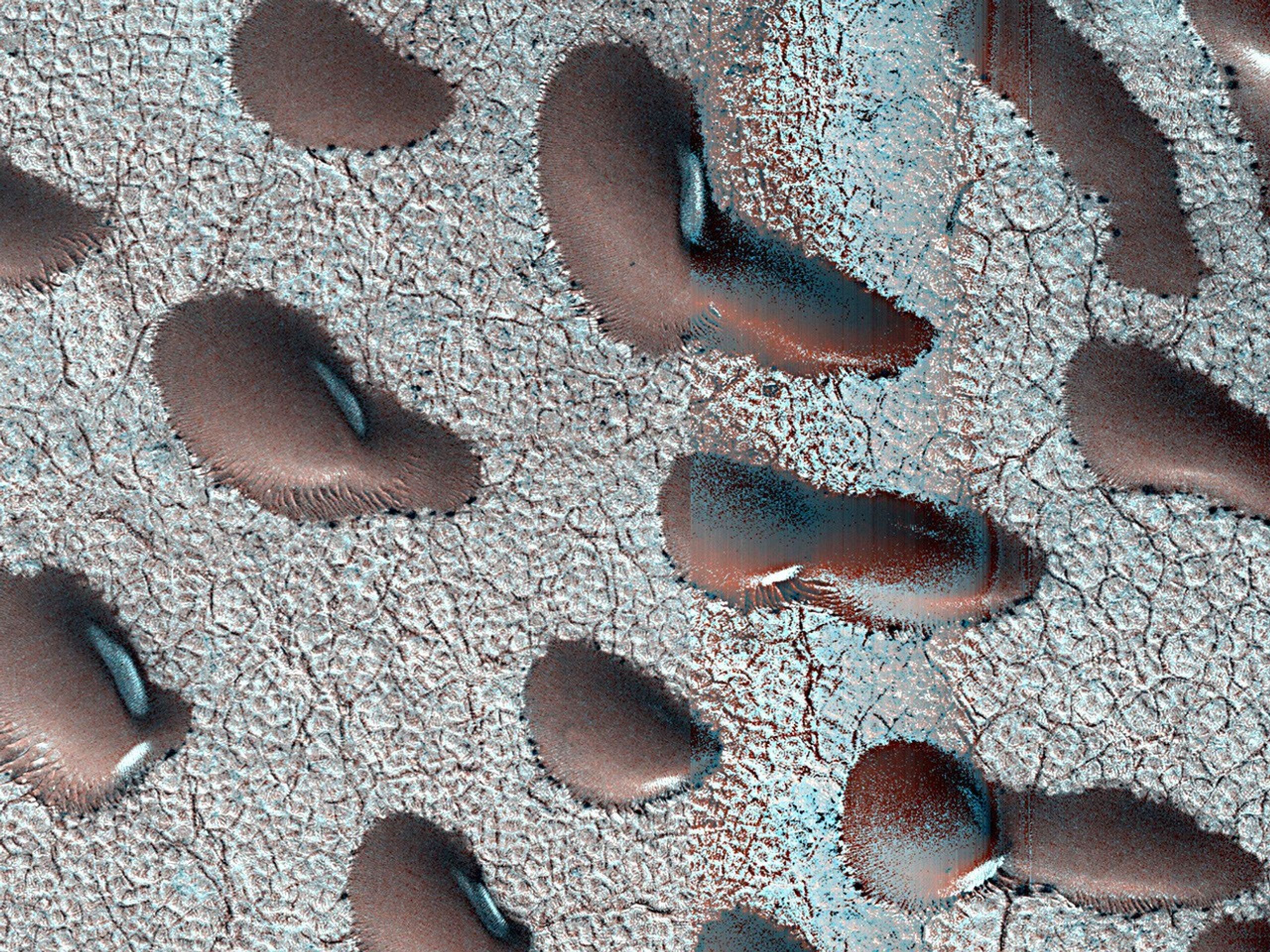
Natural selection on Mars may not have had to contend with such wild swings, and “double adaptation” may only be a problem on Earth, according to Janusz Petrowski at the Wrocław University of Science and Technology in Poland. On planets that are always reliably dry, things may go easier, evolutionarily speaking. Recent experiments show that minute amounts of water are clearly sufficient for some microbial species. Even with no standing water, they may be able to use groundwater-derived water vapor, hydrated minerals, or water capture during metabolism.
On Earth, water serves another important biological purpose. Microbes use salt water as their intracellular fluid, while humans use a compound with similar properties — blood — for a variety of purposes (which explains why we get IVs with salt water). On Mars, with its extremely low temperatures, a mixture of hydrogen peroxide and water may be more useful than saltwater.
In fact, as Joop Houtkooper and I pointed out in a 2007 paper, hydrogen peroxide has several advantages on Mars: mixed with water, it can stay liquid at temperatures down to -56 oC. It doesn’t form ice crystals when turning solid (which could pierce cell membranes), and is hygroscopic. The idea of hydrogen peroxide inside cells may sound preposterous at first, since that’s the stuff we use as cleaning agents to sterilize surfaces. Not so fast, though: Certain microbes are known to produce hydrogen peroxide in our mouths, and the Bombardier beetle has a 25% hydrogen peroxide-water mixture in its posterior chamber. In other words, hydrogen peroxide can be consistent with biology, which, incidentally, relates to why the Viking life detection experiments of the 1970s were so puzzling.
In trying to imagine how life on Mars could have developed and survived, it’s time to take full advantage of the last half-century of progress in biological and planetary science. As Mars exploration advances — a planned Chinese Mars sample return mission may be the next major step, as NASA’s own plans for a sample return mission have faltered — we might get a new understanding of all that biochemistry can do.


The Energy Transition