




















Search
Nuclear Fusion

Many facts are well-known to professionals, but are unappreciated or even rejected outright by the public. "How stars work" takes the cake.

Many reactions emit energy, often in large amounts, but cosmic efficiency is another metric altogether. Here's how to maximize your output.

All stars shine due to an internal source of energy. Usually, it's nuclear fusion: converting mass into energy. What makes them most bright?

In around 7 billion years, we expect the Sun to run out of fuel, dying in a planetary nebula/white dwarf combination. Is that for certain?

For centuries, even after we knew the Sun was a star like any other, we still didn't know what it was made of. Cecilia Payne changed that.

Matter is made up largely of atoms, where atomic nuclei can contain up to 100 protons or more. But how were the heaviest elements made?

Despite the Sun's high core temperatures, atomic nuclei repel each other too strongly to fuse together. Good thing for quantum physics!

As the Sun ages, it loses mass, causing Earth to spiral outward in its orbit. Will that cool the Earth down, or will other effects win out?

Tech designed to fuse atoms might be able to clean up space, too.

In the early stages of the hot Big Bang, there were only free protons and neutrons: no atomic nuclei. How did the first elements form from them?

It could cut the time needed to reach Mars in half.

The National Ignition Facility just repeated, and improved upon, their earlier demonstration of nuclear fusion. Now, the true race begins.

The biggest nuclear blast in history came courtesy of Tsar Bomba. We could make something at least 100 times more powerful.

Capacitors, acid batteries, and other methods of storing electric charges all lose energy over time. These gravity-fed batteries won't.

Its implications go well beyond the Earth itself, affecting even the future of space travel.

Nuclear fusion has long been seen as the future of energy. As the NIF now passes the breakeven point, how close are we to our ultimate goal?

It could one day fuel nuclear fusion reactors.

In Sun-like stars, hydrogen gets fused into helium. In the Big Bang, hydrogen fusion also makes helium. But they aren't close to the same.

The closest star system to Earth, just over 4 light-years away, has three stars and at least one Earth-sized planet. Is it time to go there?

Why power generated through nuclear fusion will be the future, but not the present, solution to humanity's energy needs.

A single lifetime is more than enough to take you to the limits of the Universe. Right now, there are only three things limiting how far our spacecrafts can take […]
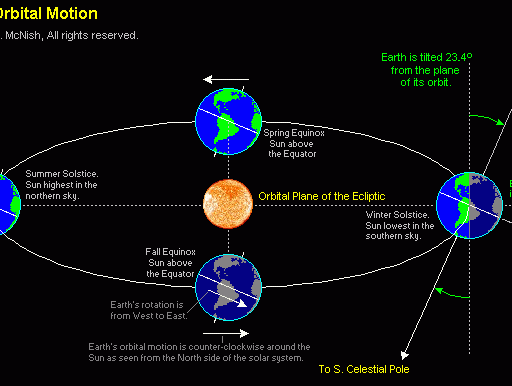
If we’re migrating slowly away, is our speed changing, too? Every year, planet Earth completes one revolution around the Sun while spinning on its axis. On a year-to-year basis, our […]

The Twin Jet nebula, shown here, is a stunning example of a bipolar preplanetary nebula. At the center, a dying star is in the final stages of life where it […]

It doesn’t have to be a science-fiction dream. For as long as human beings have been watching the night sky, we’ve dreamed of visiting other worlds and truly seeing what’s […]

How can we save humanity from ourselves? In this life and this Universe, there will always be questions beyond the capabilities of humanity to answer. There’s so much that we’ve […]

Without quantum physics, the Sun wouldn’t shine at all. Earth, as we know it, is only teeming with life because of the influence of our Sun. Its light and heat provides […]

The origin of the 3rd element on the periodic table was one of the great cosmic mysteries. We just solved it. How did we form the elements that pervade the Universe […]
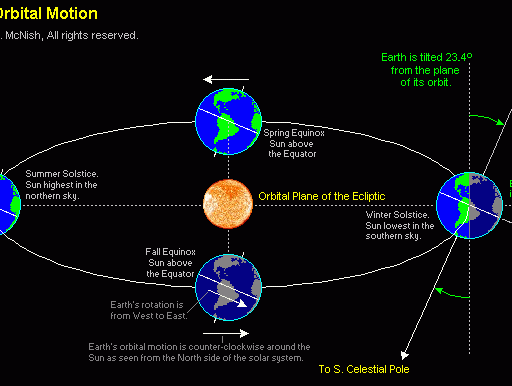
There are three factors all competing to determine the fate of the Earth, and the one that’s winning now won’t win in the end. If you could measure the average distance […]

The center of our Sun tops out at 15 million K, but nuclear bombs can get nearly 20 times hotter. Here’s how. In terms of raw energy output, nothing on our […]

Two of our biggest science-fiction dreams might not remain fiction for much longer. Here’s how 21st-century science could make it real. For as long as human beings have looked up at […]