Anytime you try and learn something beyond your current understanding, it isn’t as simple as pouring “new knowledge” into an otherwise empty vessel. We come into any new endeavor with a pre-existing foundation: things we’ve learned, been taught, or have put together for ourselves previously. When that new knowledge arrives, we inevitably attempt to integrate it into our pre-existing framework, and that isn’t always a smooth process. Sometimes, our foundation is riddled with misconceptions, misunderstandings, or prior teaching that were outright wrong; we have to correct and “unlearn” those ways of thinking before we can progress. At other times, that knowledge arrives in an incomplete fashion, and so our brains fill-in-the-blanks with whatever makes sense to us: with a story that’s often erroneous.
Oftentimes, we recognize that we need an expert — someone possessing bona fide expert-level knowledge — to help us separate fiction from reality. Frustratingly, sometimes the sources we turn to for expertise can even lead us astray. That’s happened to me, myself, many times along my journey as an astrophysicist, and that’s what made Susannah Bodman’s question to me so compelling, as she asked:
“has [anything about your work] thrilled or frustrated you? Any misconceptions you found that you’d like to clear up?”
While doing the work is often its own reward, misconceptions often abound: not just among the general public, but among the community of professionals researching physics and astronomy, including (although I am actively working to correct them) within myself. Let’s get started.
Before we get into the biggest misconception of all, let’s put forth some honorable mentions: about things that professionals have worked very hard to establish, but where many (both in the general public and in the professional field themselves) continue to cling to an outdated idea.
- The expanding Universe: where the space between individual objects stretches, causing particles to lose kinetic energy and massless quanta to redshift as they travel through it.
- The Big Bang: which is the hot, dense, rapidly expanding state that defined the early Universe, not a singularity as originally theorized.
- Cosmic inflation: which isn’t some speculative add-on to the Big Bang but rather is well-established science through a variety of observational tests,
- Dark matter: whose presence is well-established observationally, whereas alternatives are continually refuted by a suite of comparative tests, and yet is often presented as a speculative placeholder, and
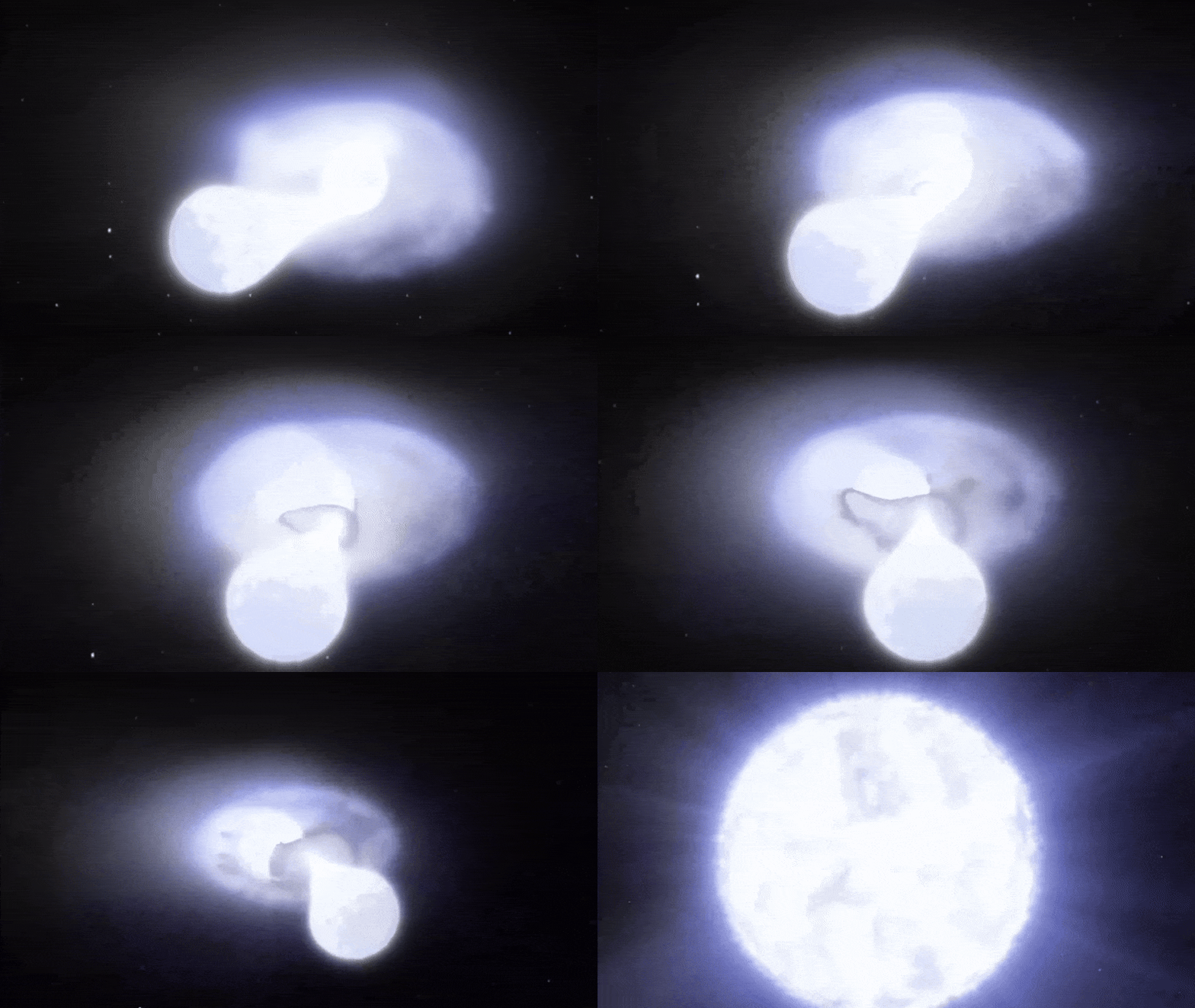
- Type Ia supernovae: which are still taught as “white dwarfs that accrete material from a companion until they pass the Chandrasekhar mass limit,” even though that story applies to literally zero known type Ia events.
However, these big concepts usually take a while to get to, and many educational resources exist to combat them. That’s why the biggest misconception is reserved for something far more basic in astronomy: how stars actually work.

If you ask the average person — or even, perhaps embarrassingly, the average astronomer — an answer you’re likely to hear about almost any question about “how stars work” is simply “nuclear fusion.”
- Why do the stars shine?
- What holds a star up against gravitational collapse?
- What sets the temperature and luminosity of a star?
- When do stars first “turn on,” officially?
Your instinct, even if you’re an astronomer, is probably going to invoke nuclear fusion at some point. Indeed, the internet would seem to confirm this: “nuclear fusion” is mentioned in several related Wikipedia articles about this topic, and every LLM I’ve asked about any of these questions always returns an answer that includes “nuclear fusion” playing a paramount role.

And it’s true that nuclear fusion does indeed occur in the interiors of stars, and that it plays a major role as the dominant energy source within stars during the majority of their lifetime. But nuclear fusion isn’t the entire story, and its role in stars has been greatly overemphasized for a historical reason: it was the last major piece of the puzzle for how stars work that was put into place, which was only recognized in the mid-20th century. In order to understand the actual answers to how stars shine, what holds them up, what sets their temperature and brightness, and when they actually turn on, let’s go back in history to before we even were aware of the subatomic world, and try and imagine what an astronomer living in the late 19th century would put together about stars.
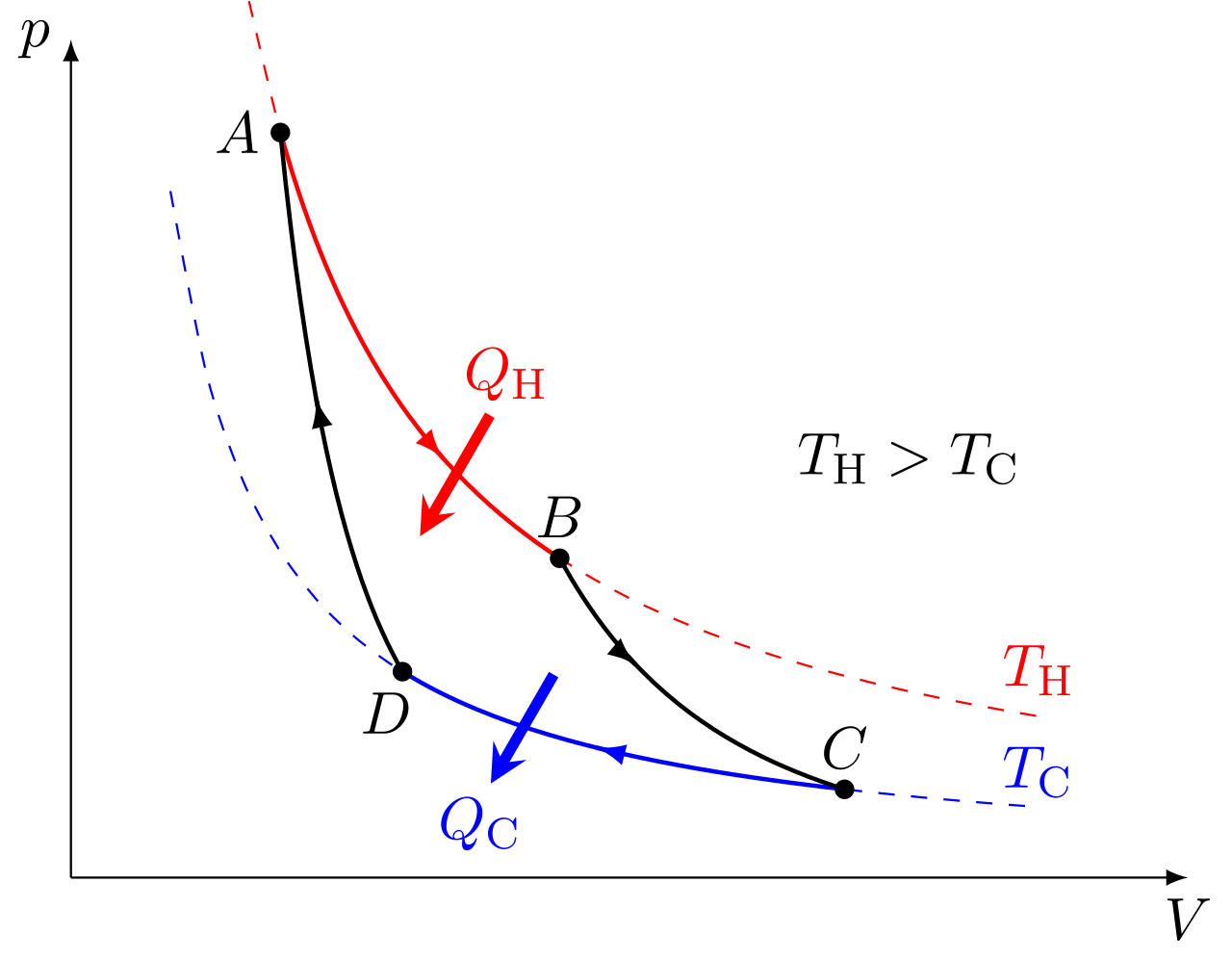
Although you may not realize it, astronomers and physicists were extraordinarily well-equipped to answer most questions about stars well over 100 years ago. Newtonian gravity had been around since the 1600s. Lagrangian mechanics, kinetic and potential energy, and the concept of “action” came along in the 1700s, as did the basics of electrostatics. Hamiltonian mechanics arose in the 1800s, along with concepts for the heat engine, thermodynamics, and entropy. Also in the 1800s, electricity and magnetism were unified, we discovered the atom, and we crafted and organized the periodic table of elements. From biology and geology, in addition, we knew that the Earth was billions of years old, and that life had thrived upon our world for a very long time indeed.
But astronomers had been studying and classifying stars for millennia: usually organizing them by color and brightness. Stellar parallax was first measured in the 1830s, giving us distances to (and separation distances between) the stars. And nebulae, with stars inside of them, had been known since the dawn of the telescope era.
When it came to the question of “what makes a star shine,” there was an obvious explanation:
- you begin with a cloud of gas,
- that gas begins to contract owing to the force of gravity,
- contraction converts gravitational potential energy into kinetic energy,
- collisions between those internal atoms converts kinetic energy into thermal (heat) energy,
- and that hot gas then exerts an outward pressure that balances the inward gravitational force.
Therefore, you wind up with stars: hot balls of gas that got their energy from gravitational contraction, and whose internally generated (gas) pressure makes an outward push, balancing the force of gravity.
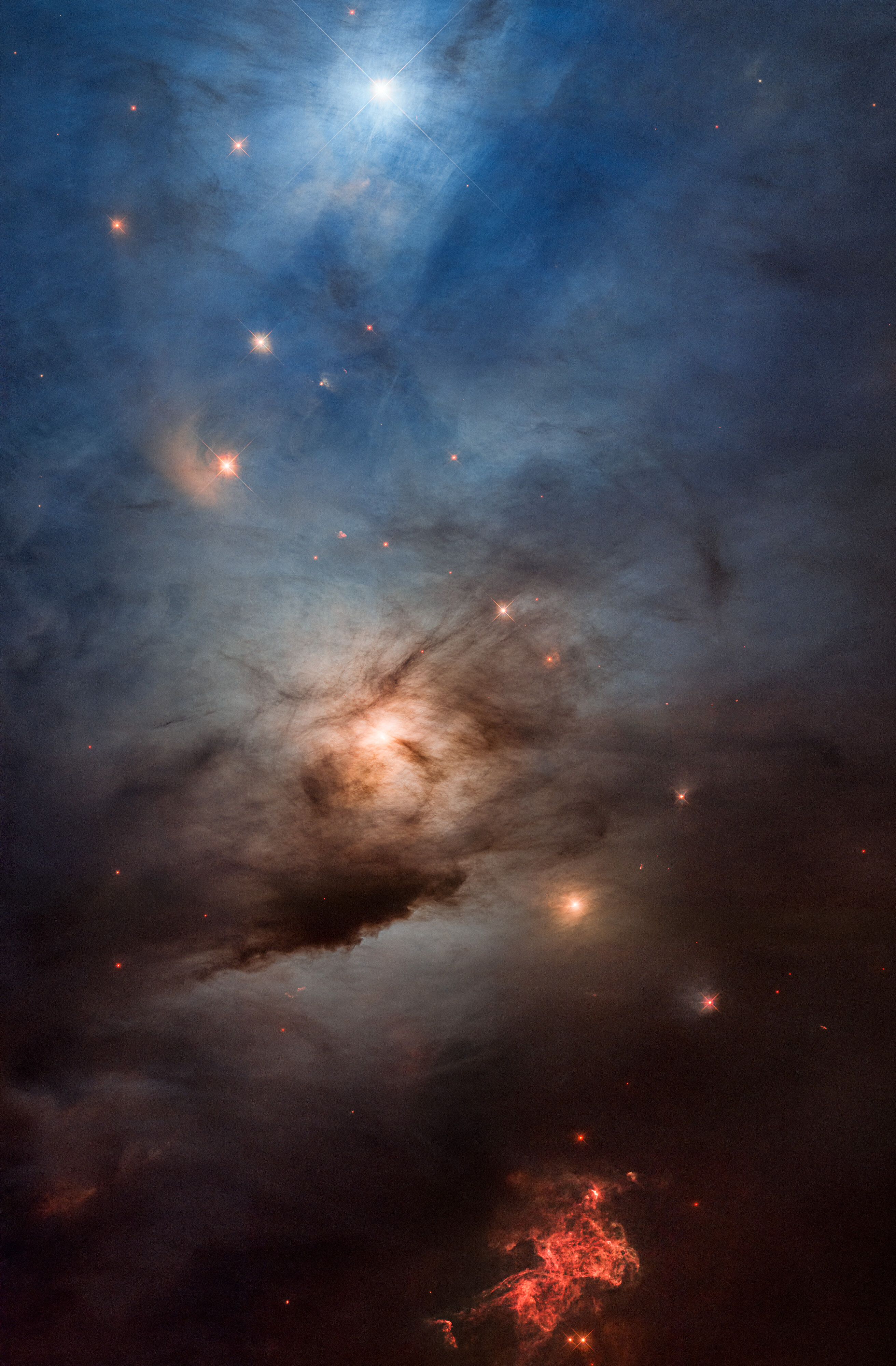
Note, in particular, that there is no mention of nuclear fusion in this story. Without it, you might think, “well, this story isn’t complete,” but it turns out to still be largely correct. 19th century physics didn’t cease to be true when we discovered quantum physics, relativity, subatomic particles, or nuclear fusion. Their discovery simply meant that there were additional reactions and effects that needed to be accounted for when modeling certain physical systems. Sure, some parts of the story for how reality works would need revision, but other parts would remain exactly the same. In this case, nuclear fusion will play a role in how stars work and shine, but the early stages of the story — the part we just told, from a 19th century perspective — are no different at all.
This still holds true when we begin asking questions about the temperature and luminosity (or intrinsic brightness) of a star as well. If you start with a given amount of mass, gravitational contraction will convert some of that (gravitational) potential energy into kinetic energy, and collisions convert that kinetic energy into heat energy. The more the mass contracts, the smaller it gets but also the hotter it gets: a thermodynamic consequence of adiabatic contraction. And as the cloud of gas contracts to a given radius, it will emit energy (i.e., have a luminosity) at a rate that’s proportional to its radius squared multiplied by its (surface) temperature to the fourth power:
L = 4πR²σT⁴.
Again, this is not some novel, quantum-based formula, but rather a 19th century one: the Stefan-Boltzmann law.
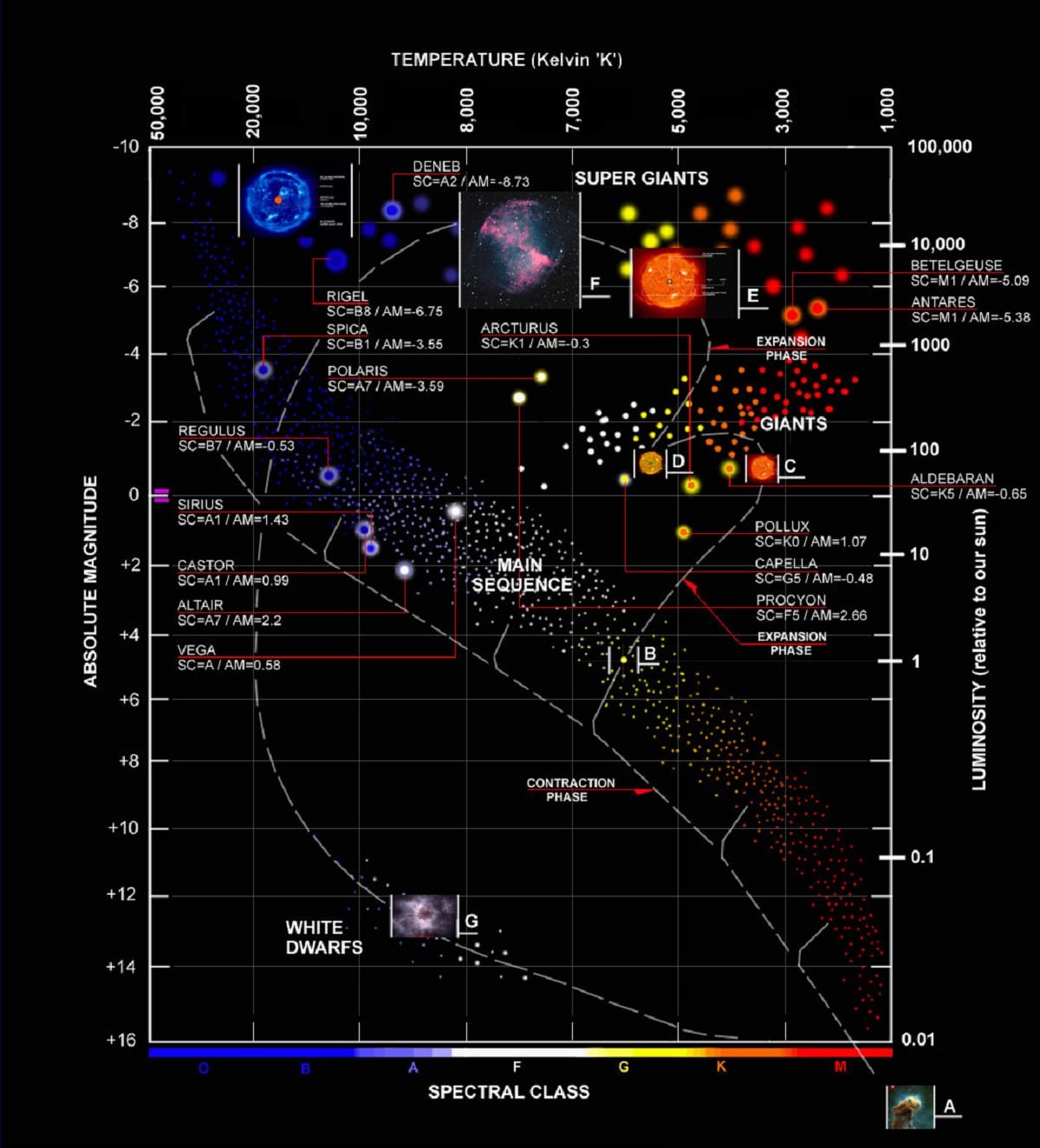
Let’s take stock of the various pieces of information we’ve just listed off about the formation of stars, noting that once again, we haven’t needed to bring up nuclear fusion at all in the story so far.
- An initially massive, cold cloud of gas (normally around 50 K or so) begins contracting under its own gravity.
- In many individual regions — but we can choose to focus on one in particular — a clump of matter begins growing relatively rapidly, drawing more and more of the surrounding matter onto it as contracts. (The more massive it is, the faster it grows and the faster it contracts.)
- As the matter contracts, individual particles collide with one another, causing this massive clump to heat up as it contracts.
- The more massive and concentrated this clump gets, the more heat gets trapped and the hotter it becomes: the density increases by a cumulative 18 orders of magnitude during this process.
- However, as the clump becomes smaller, there’s less surface area for that heat to escape through; the surface area of a sphere is how this clump allows heat to radiate away, and the smaller it is, the more slowly the heat escapes.
- And inside this clump of matter, gravitation pulls things inwards, but the heat of the moving particles provides an outward pressure (which is a force over an area), gas pressure, that works to counteract the effects of gravitation.
Now, add into that the law of radiation for any hot clump of matter that we’d established: L = 4πR²σT⁴.
This gives us a story for how protostars shine when they’re forming. They begin emitting a lot of energy at relatively low temperatures, as they begin with large surface areas and modest (a few thousand K) temperatures. As they contract, their radius shrinks but their temperatures rise (which happens during adiabatic contraction), leading their luminosities to first remain relatively constant, and then to decrease overall. The highest-mass protostars contract the fastest, while the lowest-mass ones take longer amounts of time to contract down to an equilibrium state: where the outward gas pressure at last balances the inward pull of gravitation.
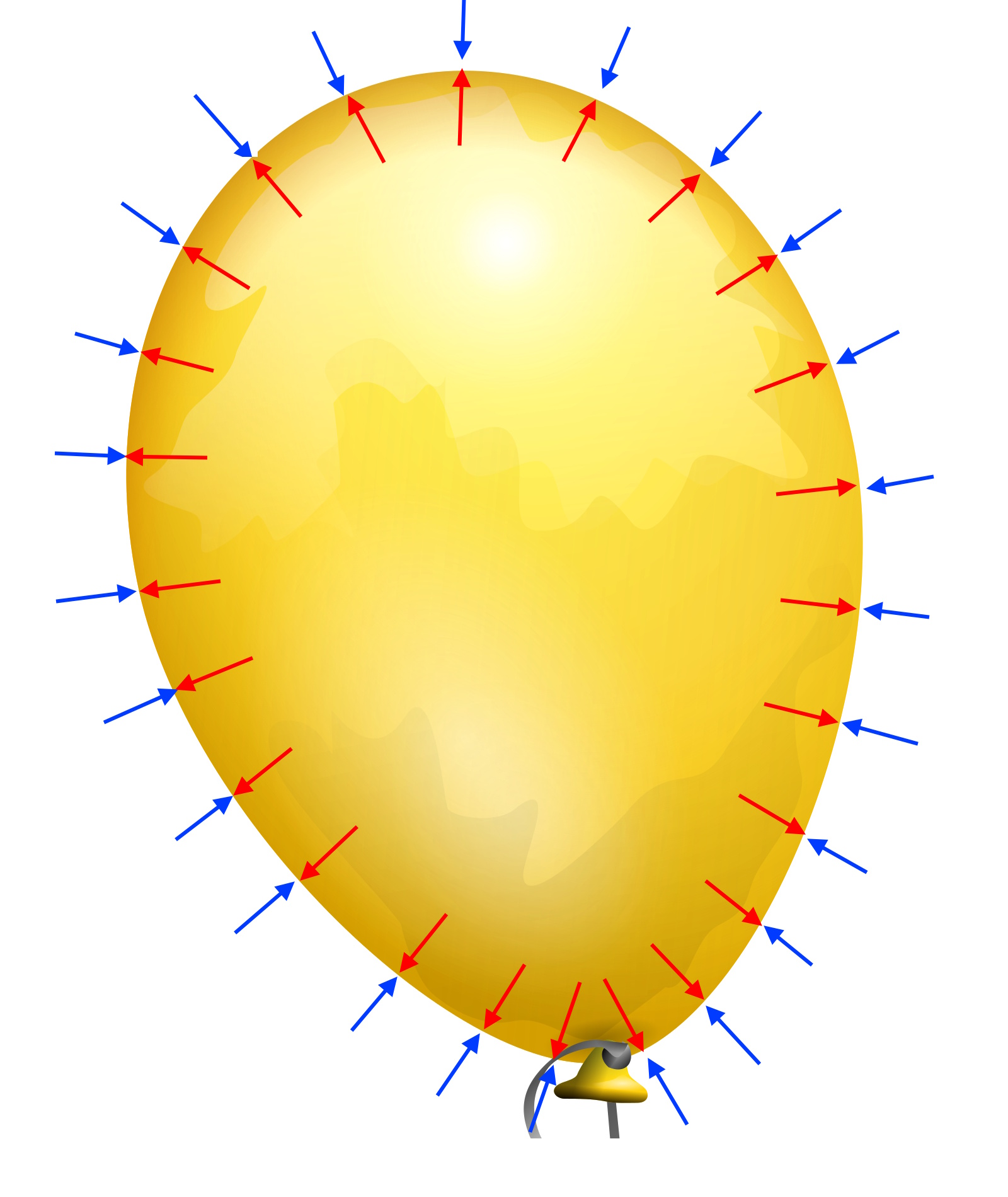
Once that balance is reached, that’s where the star stops contracting. That’s what sets the star’s brightness (its luminosity), its size, and its temperature: where the gas pressure balances out the inward pull of gravitation.
So where, then, does nuclear fusion even come into the story? The answer is, “only after everything we’ve already discussed has occurred.” We can look at it from two perspectives: historically or physically.
Historically, it came from attempting to understand the age of the Sun compared with the established (biological and geological; see point number 2 in this article) age of the Earth. Our Sun has a certain total power output — a rate at which it emits energy over time — and there’s only a finite amount of gravitational potential energy that the Sun possesses, even given its enormous mass. If you ask the question “how long could the Sun shine at its current brightness it if were powered by this gravitational energy alone,” the answer comes out to no more than about 40 million years. But the Earth (and life on it) was billions of years old, suggesting the need for a new energy source.
That source wasn’t known to humanity in the 19th century, however. It wasn’t until 1905 that Einstein put forth the idea that mass and energy were equivalent via E = mc², and it wasn’t until later that nuclear processes like fission and fusion were uncovered. It was only in 1930 that the neutrino was hypothesized as a product of nuclear reactions, and the first detection of neutrinos didn’t occur until 1956. (Solar neutrino detection came soon after.) Still, “something beyond gravitation” must have been at play to explain the longevity of the Sun’s energy output.
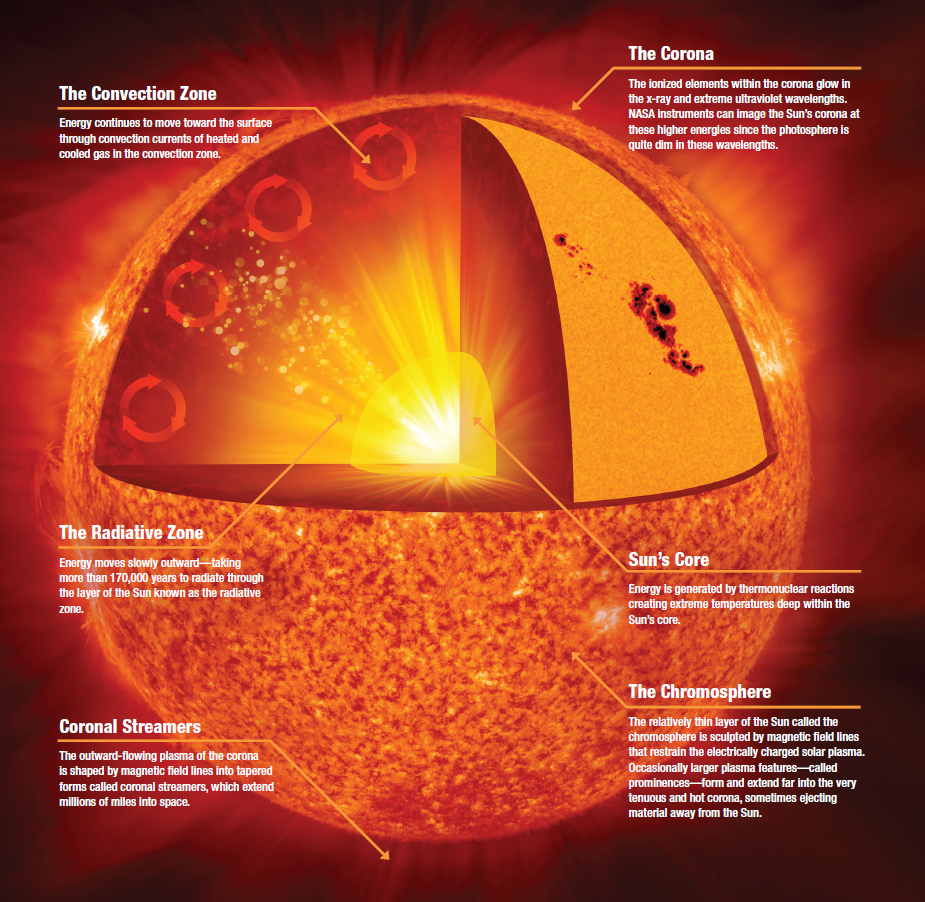
Physically, fusion only enters into the equation at all after the protostar has finished contracting: once this equilibrium state is reached. Only then do internal temperatures rise to very large values in the million-degree realm and up, which is the realm where fusion reactions begin to occur. Contrary to what you might expect, these reactions don’t change the temperature, size, or brightness of the star, but rather change only what happens within the star’s interior.
The first critical temperature threshold that gets crossed is the one that initiates deuterium (hydrogen nuclei with a proton and a neutron bound together) fusion: the fusion of deuterons with either protons or other deuterons. That produces negligible amounts of heat and pressure overall, and so the internal core continues to contract. Then another critical threshold is crossed, and lithium burning begins: where protons fuse onto lithium. Again, this produces negligible amounts of heat and pressure; the object is still just held up by gas pressure.
Then, when temperatures in the core rise to somewhere between 4 and 10 million K, the biggest critical threshold of all occurs: the initiation of hydrogen fusion through the proton-proton chain. It takes an object of at least 13 Jupiter masses (about 0.012% the mass of the Sun) to initiate deuterium fusion: the threshold for becoming a brown dwarf. It takes an object of approximately 60 Jupiter masses (about 0.057% the Sun’s mass) to initiate lithium fusion, and then of approximately 65 Jupiter masses (about 0.061% of the Sun’s mass) to initiate beryllium fusion. But it takes around 80 Jupiter masses (between 0.075-0.08% of the Sun’s mass) to initiate hydrogen fusion: the dominant process for energy production in most stars.
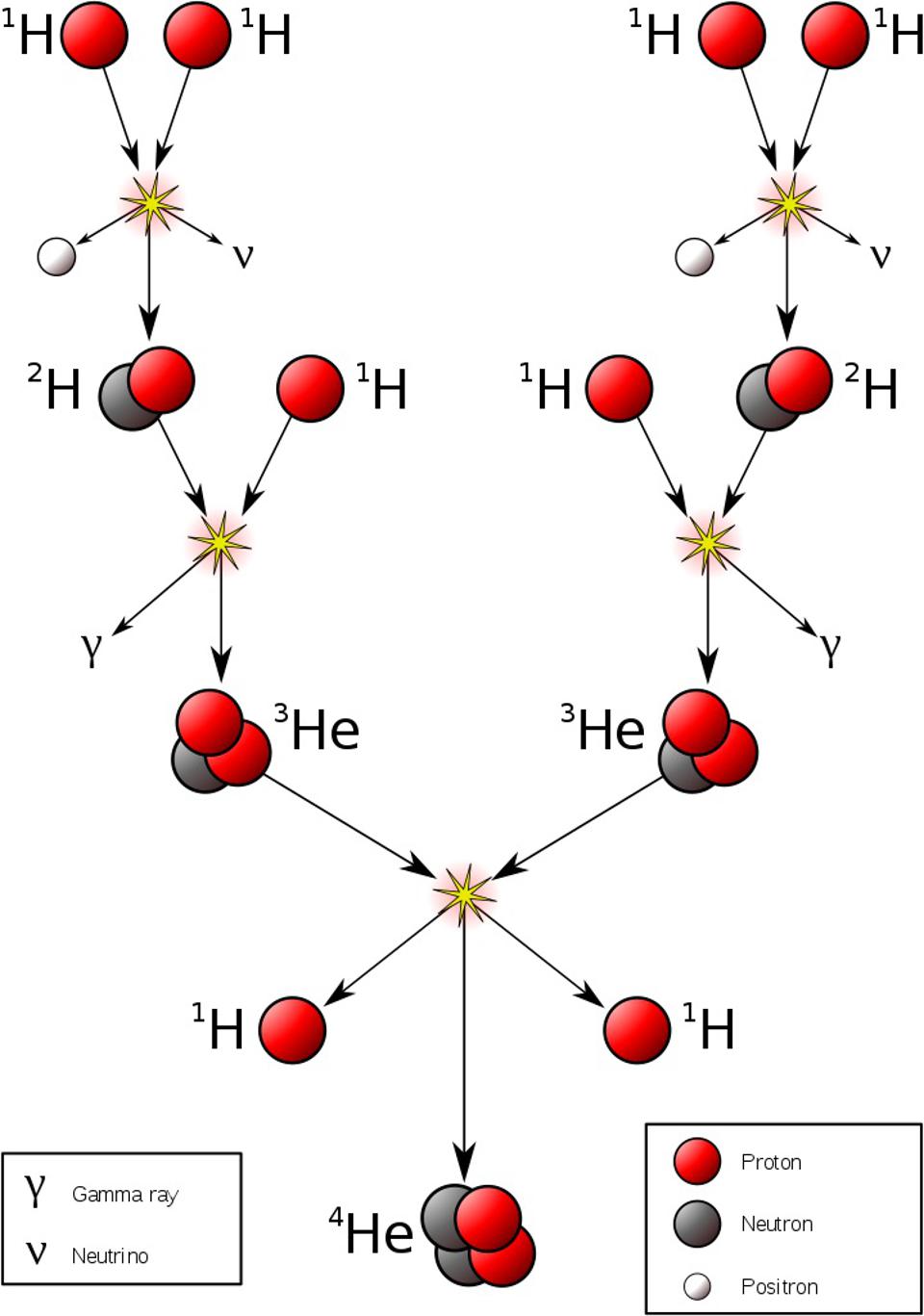
But achieving hydrogen fusion in the core does not mean your star has been officially “born” just yet; it is still a protostar when that begins. When nuclear fusion reactions begin, the protostar’s core is small, the pressure produced by nuclear fusion is negligible, and the rate of energy output from nuclear fusion is small compared to the rate of energy radiated away by the protostar at its surface. The protostar doesn’t contract, though, since it’s still held up by gas pressure.
What happens is that its internal density and temperature profile changes, so that greater densities and temperatures concentrate in the core, leading to a more differentiated star with a photosphere on the outside, a radiative zone internally, and then a fusion zone in the core. As the core region grows larger and becomes centrally hotter, the rate of fusion increases. Eventually — after tens of thousands of years for the most massive stars, but after tens-of-millions of years for Sun-like stars — fusion becomes the dominant energy source for this object, and gravitational contraction, which drove the growth of the star’s core even as its size and temperature remained constant, slows.
Only when fusion has grown sufficient to provide 100% of the energy needed to heat the internal gas of the star, which it must do to maintain the gas pressure that resists gravitational collapse, does the star “finish forming” and can it be considered born. All told, if you take the time required for a protostar to contract and reach its size and temperature, which varies tremendously based on the protostar’s mass, it takes about that much time again from when hydrogen fusion initiates to when hydrogen fusion supplies 100% of the star’s total energy: tens of thousands of years for a 20 solar mass star, but millions to tens-of-millions of years for a Sun-like star.
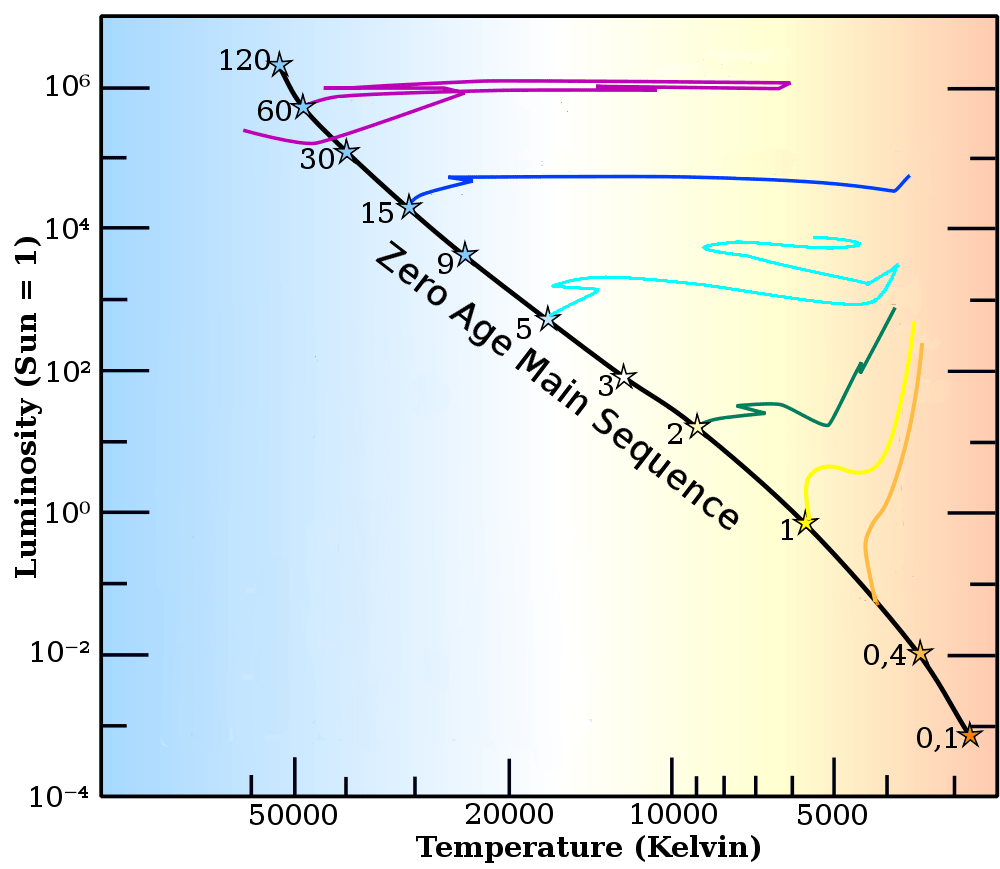
So nuclear fusion does play a major role in sustaining a star that begins to shine from its gravitational contraction, and it plays a major role in supplying the energy that enables stars to shine throughout their lifetime. Much later in a star’s evolution, when it runs out of hydrogen fuel in its core and expands into a red giant, the core will contract and heat up further, and if it can initiate helium fusion in that core, the helium flash stage, where helium fusion ignites, will provide a well-defined point in that star’s evolution in ways that are detectable from the outside: in the evolution of that star’s luminosity and radius.
But nuclear fusion doesn’t explain why stars have the temperatures that they do. It doesn’t explain why a star has the brightness it has. The “switch on” of fusion doesn’t have any immediate or obvious external consequences or signatures: not unless you’ve got an ultra-sensitive neutrino telescope nearby. Radiation pressure from the fusion reactions doesn’t hold the star up against further collapse (it contributes at the less-than 1% level in most stars, including the Sun!), but rather the star’s internal gas pressure does that job. And the official “birth” of a star happens when internal gravitational contraction ceases because fusion is providing 100% of the energy needed to match the star’s total energy output at its surface.
The myth that “nuclear fusion is responsible for everything you can measure about a star” is no doubt the biggest misconception in all of astronomy, among both amateurs and professionals alike. Hopefully, after reading this, you’ll understand the true story just a little bit better!
Send in your Ask Ethan questions to startswithabang at gmail dot com!

The Energy Transition