




















Search
Planetary Science

Oxygen isn't strictly necessary for combustion, but it is ideal. Any advanced (alien) civilization probably uses oxygen to burn things.

Not too hot, not too cold...

"You develop an instant global consciousness, a people orientation, an intense dissatisfaction with the state of the world, and a compulsion to do something about it."

On Earth, carbon can form millions of compounds, while silicon is largely stuck inside rocks. But elsewhere, silicon could form the basis of life.

There's a whole lotta shakin' goin' on beneath the single plate of Mars.

A new study of Martian dust gives insights into the ancient Martian climate. The findings hint at a wetter world.

The answer may lie in the particular way sand forms on Titan.

Data from the Zhurong rover suggests the Red Planet was wet more recently than we thought.

The high pitches from the flute and the harp would reach your ears before the notes from the tuba and the cello.

We have long thought that Pluto was completely frozen solid, but the discovery of cryovolcanoes challenges that assumption.

Europa may be difficult to access. But if a recent study is correct, its subsurface ocean would be more accessible than previously thought.

Was there ever life on Mars? Is there life on Mars now? Did it originate there or here, on Earth? All possibilities are fascinating.

Volcanic activity caused the end-Triassic mass extinction 200 million years ago. The dinosaurs survived and rose to dominance.

Ancient helium-3 from the dawn of time leaks from the Earth, offering clues to our planet’s formation. A key question is where it leaks from.

The story of how Jupiter, Saturn, Uranus and Neptune were made isn't a universal one. Some gas giants were built different.

Due to a crust of carbon, the absence of oxygen, and constant bombardment from meteorites, the planet Mercury may be littered with diamonds.

Knowing that technology would advance in the future, NASA put some moon rock samples into storage without opening them. Now, they have.

Our research on a Martian meteorite provides new clues about early surface conditions on the red planet.

Please stop calling our Sun an "average star." It is philosophically dubious and astronomically incorrect.

Shooting star or piece of space dust?

In 1990, we only knew of the ones in our Solar System. Today, we know of thousands, and that's just the tip of the iceberg.

The search for worlds outside our solar system has just turned up a planet, TOI-2257 b, with a truly extreme orbit.

Water on Mars is key for human survival on the Red Planet, not just for drinking but for growing food and making fuel and oxygen.

The boiling new world, which zips around its star at ultraclose range, is among the lightest exoplanets found to date.

A newly discovered “ultrahot Jupiter” has the shortest orbit of any known gas giant.

Every December, the Geminid meteor shower reaches its peak. Its 2021 show will be spectacular, but only if you do it right.

Purely physical and chemical processes can deceive us into thinking that life is present, when it actually is not.
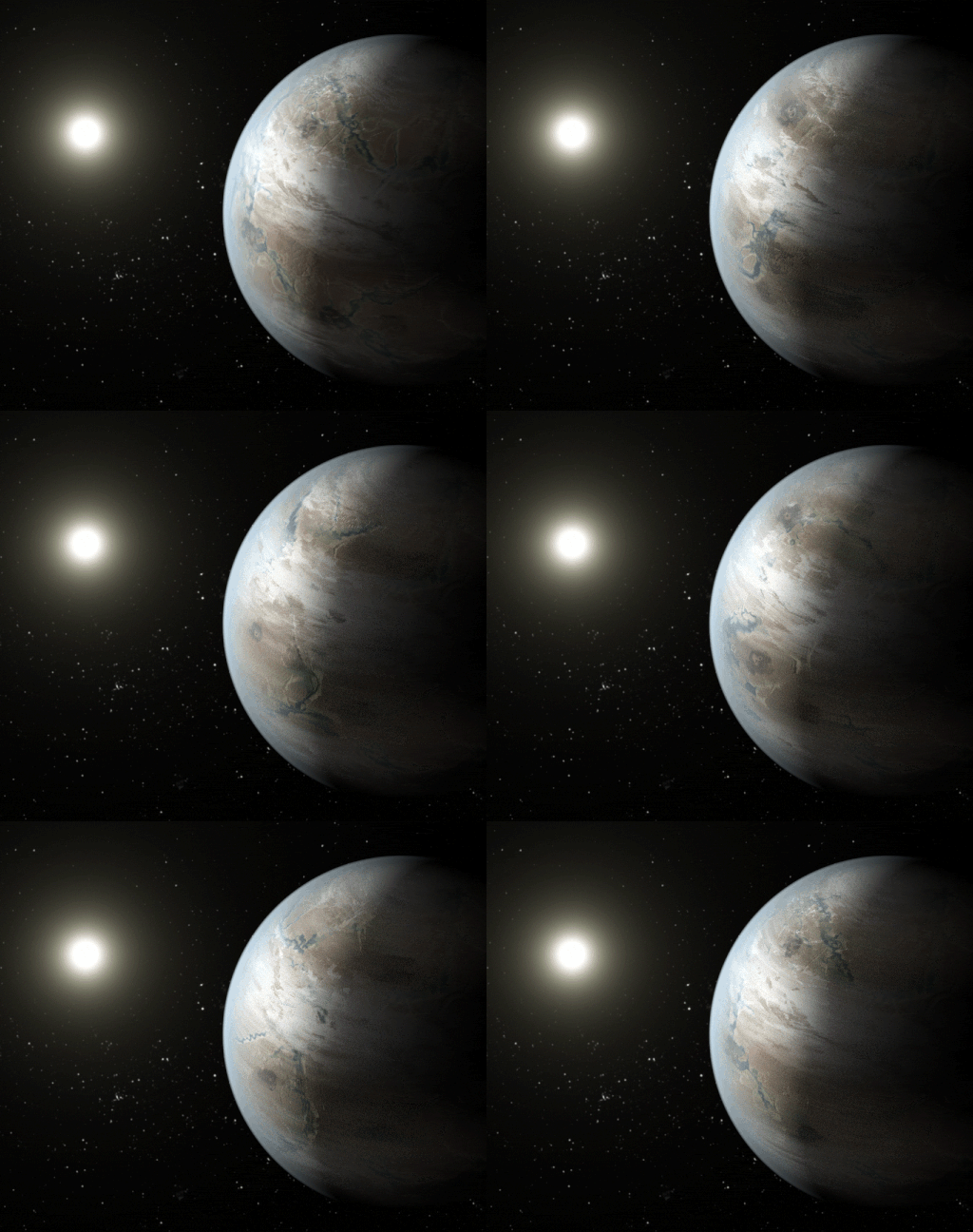
Finding out we're not alone in the Universe would fundamentally change everything. Here's how we could do it.

How the search for alien life is taking place right here in our own Solar System. If you want to understand the origin of life in the Universe, you have three […]

Theoretically, we know what happened on the red planet. Here’s how we’ll find out whether we’re right. When it comes to the worlds beyond Earth in our Solar System, it’s only […]