




















Search
Science and Tech

Peaking on the night of August 11/12, up to 100 bright meteors per hour will be visible. Here's how to make the most of it.

Hindsight can cloud our predictive abilities but big data can de-mist forecasting — now AI is sharpening that focus.

The rise and fall of Josh Harris — the genius who anticipated the digital revolution just a little too soon.

"Business Adventures" by John Brooks was first published in 1969 and remains a must-read for all CEOs.

Earth, the only rocky planet with a large, massive satellite, is greatly affected by the Moon. Destroying it would cause 7 major changes.

Could exercise be more effective than recently approved drugs?

Straddling the bounds of science and religion, Newton wondered who set the planets in motion. Astrophysics reveals the answer.

In the 1970s, James Lovelock proposed that the biosphere was not just green scruff quivering on Earth's surface. Instead, it managed to take over the geospheres.

How do normal matter and dark matter separate by so much when galaxy clusters collide? Astronomers find the surprising, unexpected answer.

“The brain is never the same from one moment to the next throughout life. Never ever.”

Such discoveries help researchers better understand the development of molecular complexity in space during star formation.

And, more importantly, what’s being done to get them online?

You will need determination, humility, and courage if you are to master anything.

Even in the very early Universe, there were heavy, supermassive black holes at the centers of galaxies. How did they get so big so fast?

Have you ever noticed how many things you interact with but can’t name? So did we.

The new corporate landscape demands an approach to leadership based on empowering the “inner CEO.”

Often viewed as a purely theoretical, calculational tool only, direct observation of the Lamb Shift proved their very real existence.

Researchers are working nest by nest to limit the threat while developing better eradication methods.

From surviving on wild plants and game to controlling our world with technology, humanity's journey of progress is a story of expanding human agency.
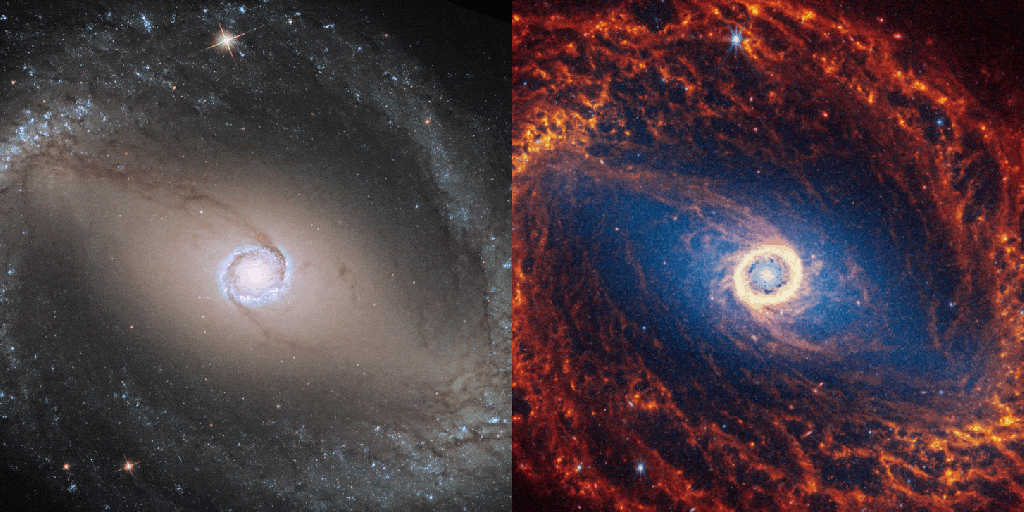
In July of 2022, the first science images from JWST were unveiled. Two years later, it's changed our view of the Universe.

A perfect map is as useless as it is impossible to create.

A longstanding mismatch between theory and experiment motivated an exquisite muon measurement. At last, a theoretical solution has arrived.

An analysis of Indonesian cave paintings is reframing the history of human art, though whether the paintings really were created by human hands remains an open question.

The all-time record is Usain Bolt's 9.58 seconds, set in 2009. What is the fastest time, ultimately, for an ideal human body?

Cats twist and snakes slide, exploiting and negotiating physical laws. Scientists are figuring out how.
Can AI-powered “answer engines” replace the 10 blue links model?

Alan Turing and Christopher Strachey created a ground-breaking computer program that allowed them to express affection vicariously when so doing publicly, as gay men, was criminal.

In "Not Born Yesterday," author and cognitive scientist Hugo Mercier makes the case that misinformation is overrated — and other human foibles are underrated.

"If you’re training an AI to optimize for a task, and deception is a good way for it to complete the task, then there’s a good chance that it will use deception."
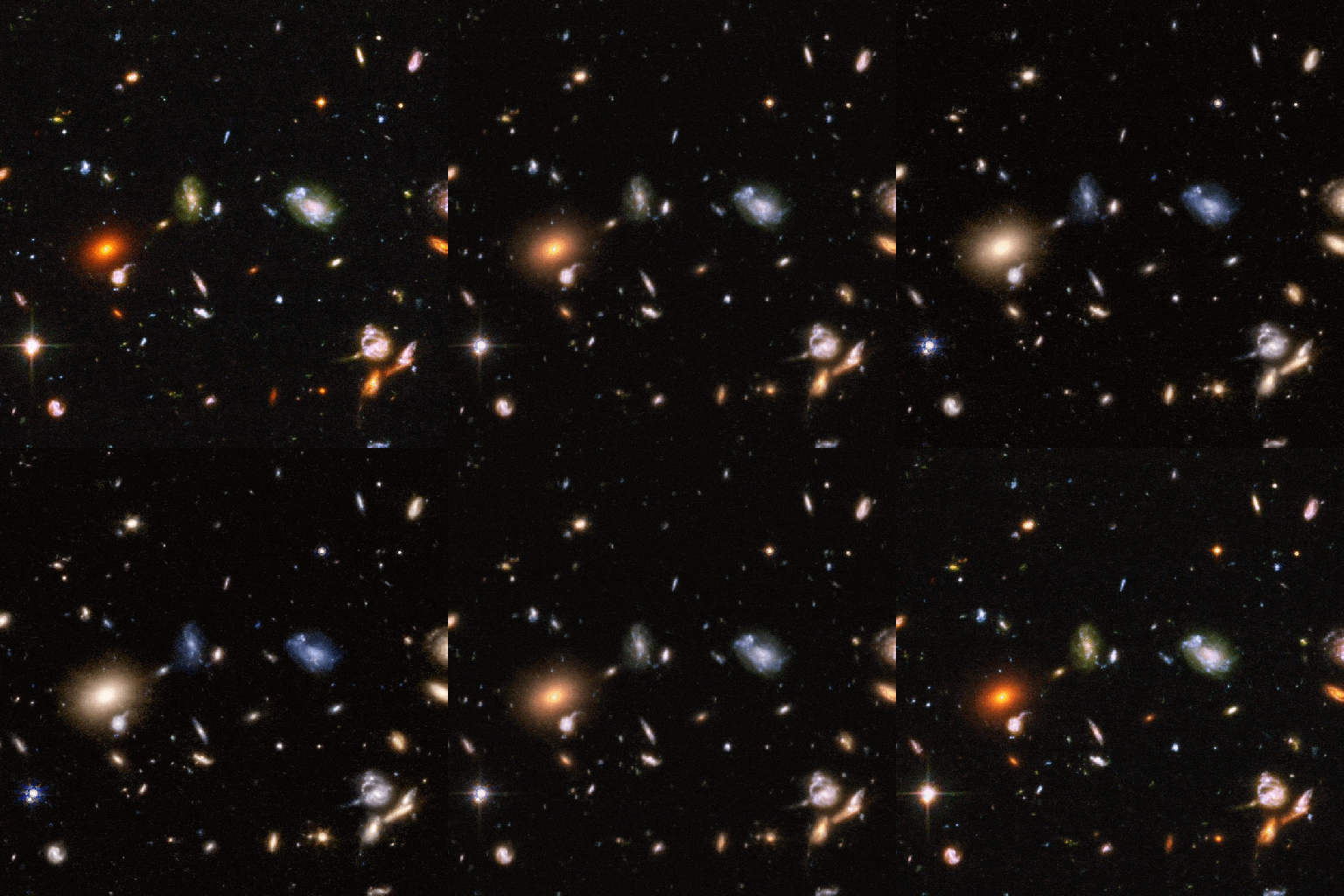
From inside our Solar System, zodiacal light prevents us from seeing true darkness. From billions of miles away, New Horizons finally can.