




















Search
Science and Tech
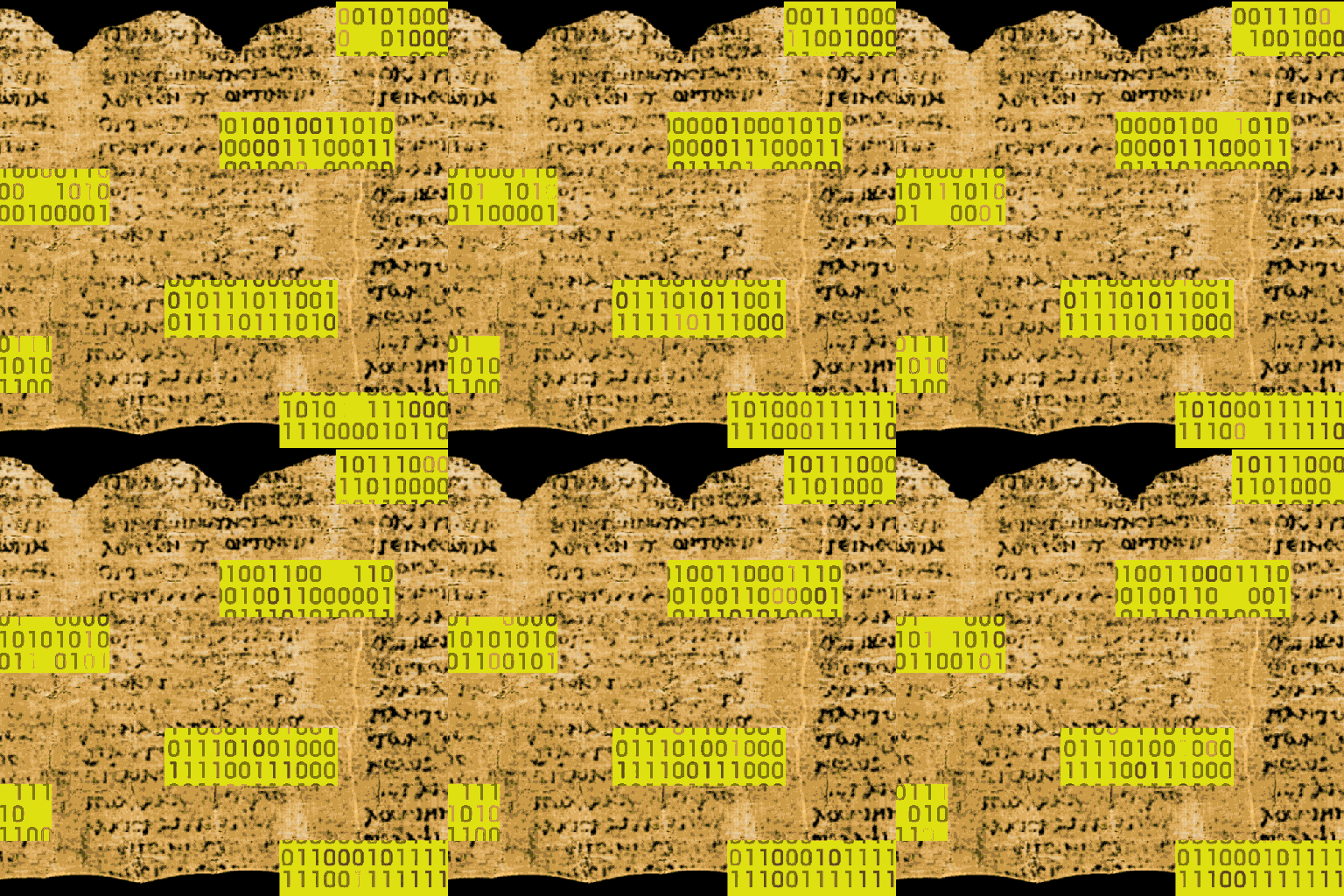
These scrolls are the only remaining intact library of ancient Rome — and they will crumble at a touch.

Police forces are choosing humans over algorithms to make some identifications.

Symmetries aren't just about folding or rotating a piece of paper, but have a profound array of applications when it comes to physics.

The National Defense Education Act of 1958 meshed with white anxiety about the desegregation of schools.

Here's the case for why science can't keep ignoring human experience.

Ground-based facilities enable the greatest scientific production in all of astronomy. The NSF needs to be ambitious, and it's now or never.

The Multiverse fuels some of the 21st century's best fiction stories. But its supporting pillars are on extremely stable scientific footing.

Save and group content to support your unique learning programs

Genes are sometimes called the “blueprint of life,” but that doesn't make them the behavioral playbook.

To Fred Hoyle, the Big Bang was nothing more than a creationist myth. 75 years later, it's cemented as the beginning of our Universe.

7mins
Is information intrinsic in our universe? NASA’s Michelle Thaller explains.

JWST has puzzled astronomers by revealing large, bright, massive early galaxies. But the littlest ones pack the greatest cosmic punch.

Tech designed to fuse atoms might be able to clean up space, too.

Former GitHub CEO Nat Friedman just invested $100 million into the company.

When cosmic inflation came to an end, the hot Big Bang ensued as a result. If our cosmic vacuum state decays, could it all happen again?

13.8 columnist Marcelo Gleiser reflects on his recent voyage to Earth's last wild continent.

In 1957, humanity launched our first satellite; today's number is nearly 10,000, with 500,000+ more planned. Space is no longer pristine.

Leap day only comes once every four years, including in 2024. But the reason we have it, including when we do and don't, may surprise you.

The detection of two celestial interlopers careening through our solar system has scientists eagerly anticipating more.

There are many problems with relying on SAT and ACT scores for college admissions. But removing them entirely creates less opportunity.

Its creators hope the technology will help people meaningfully connect with the external world.

Meanwhile meteorite hunters rushed to Berlin to find this most rare space rock.

NASA gave three robots plans for a moon shelter, and the robots figured out how to build it.


There are plenty of life-friendly stellar systems in the Universe today. But at some point in the far future, life's final extinction will occur.

Archaeologists have identified what may be Europe’s oldest human-made megastructure.

Everything acts like a wave while it propagates, but behaves like a particle whenever it interacts. The origins of this duality go way back.

What Shark Tank pitches, Sundance films, and unusual sandwiches show us about our choices.

So far, gravitational waves have revealed stellar mass black holes and neutron stars, plus a cosmic background. So much more is coming.

Discrepancies between observations and theory regarding subatomic particles called muons may force scientists to rethink the quantum world.