




















Search
Science

After listening to the same playlist, people from the United Kingdom, the United States, and China reported feeling nearly identical bodily sensations.

For now, our Solar System's eight planets are all safe, and relatively stable. Billions of years from now, everything will be different.

4mins
When one path is blocked, a new one must be paved. How Einstein, Heisenberg and Gödel used constraints to make life-changing discoveries:

The $21.5-billion project could involve tunneling hundreds of feet under Lake Geneva.

The Uros of Lake Titicaca live on floating islands made from reeds. How did they get there?

Beyond the planets, stars, and Milky Way lie ultra-distant objects: galaxies and quasars. Here's how far back we've seen throughout history.

New DNA analyses raise questions over the theory that Christopher Columbus and his men brought syphilis to Europe.

6mins
Science writer George Musser on the unsung role of friendship in science’s biggest discoveries.

If our Milky Way were located in the Virgo cluster instead of the Local Group, chances are we'd already be a "red and dead" galaxy.

Skilled hunters adapted to the changing landscape and left tantalizing clues to who they were.

Each time you fold a piece of paper, you double the paper's thickness. It doesn't take all that long to even reach the Moon.
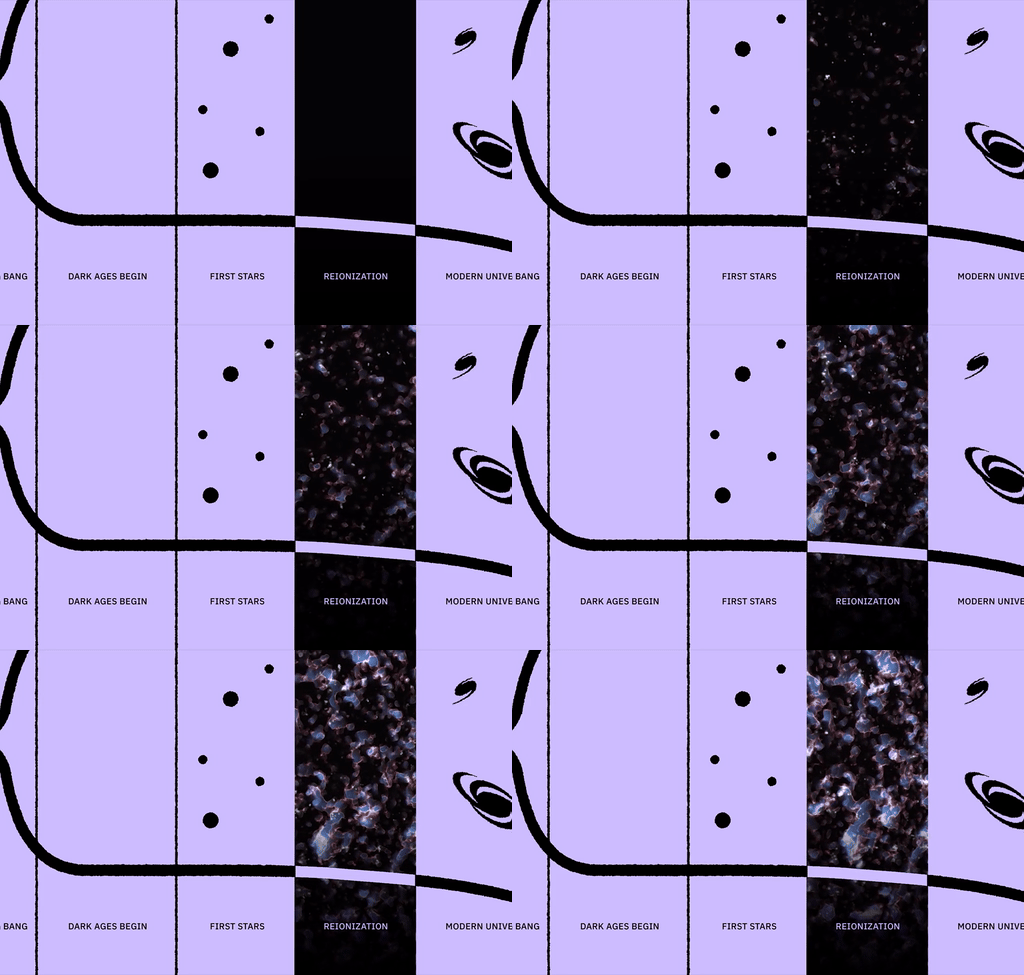
For 550 million years, neutral atoms blocked the light made in stars from traveling freely through the Universe. Here's how it then changed.

In pre-War Cambridge, students had to ace an interview with Ludwig Wittgenstein to attend his lectures — Alan Turing passed that test, and went on to create one of his own.

43mins
Consciousness isn’t just a problem for philosophers. On this episode of Dispatches, Kmele sat down with scientists, a mathematician, a spiritual leader, and an entrepreneur, all trying to get to the heart of “the feeling of life itself.”

Stem cells from a fetus can live within the mother for decades — and help her heal.

Visionaries from Socrates to Steve Jobs have touted curiosity as an essential quality. Here’s how to supercharge your spirit of inquiry.


Two of the answers add a dimension to physics that doesn’t belong there. Maybe we could call it "astrotheology."

When we look at our Sun, its properties are incredibly constant, varying by merely ~0.1% over time. But all stars don't play by those rules.

From ancient Greek cosmology to today's mysteries of dark matter and dark energy, explore the relentless quest to understand the Universe's invisible forces.

2023's Nobel Prize was awarded for studying physics on tiny, attosecond-level timescales. Too bad that particle physics happens even faster.

The perfectly accessible, perfectly knowable Universe of classical physics is gone forever, no matter what interpretation you choose.

If nature were perfectly deterministic, atoms would almost instantly all collapse. Here's how Heisenberg uncertainty saves the atom.

Science and technology were making early modern Europe a better place to live, but at what cost?

How can you maximize the amount of love and happiness in your life? One of history's greatest scientists found the answer: with math.

5mins
NASA’s Michelle Thaller explains what happens when the densest stars in the galaxy collide.

Neutrons can be stable when bound into an atomic nucleus, but free neutrons decay away in mere minutes. So how are neutron stars stable?

6mins
A physicist discusses the boundaries of reality and experimentation.

To this day, one cult believes that Lemuria was real, and that its people left us the sacred wisdom to revive their advanced civilization.

12mins
Quantum wormholes are mathematically possible — but might also be physically impossible. Physicist Janna Levin explains Hawking’s famous information paradox.