




















Search
Solar System Science

In a 13.8 billion year old Universe, a few seconds hardly seems like it matters. But these minuscule changes sure do add up over time.

No human has ever left the Solar System, and only six already-launched spacecraft will ever exit it. Will Voyager 1 remain the most distant?

Even at its faintest, Venus always outshines every other star and planet that's visible from Earth, and then some!

The Sun often produces solar flares and coronal mass ejections, but a rare solar radiation storm made the 2026's first great auroral show.

One side of the Moon always faces us: the near side. The "dark side" of the Moon began as a mere metaphor, but today, science can weigh in.

Since the time of Galileo, Saturn's rings have remained an unexplained mystery. A new idea may have finally solved the longstanding puzzle.

Across all wavelengths of light, the Sun is brighter than the Moon. Until we went to the highest energies and saw a gamma-ray surprise.

The Juno spacecraft, orbiting and imaging Jupiter since 2016, is still succeeding. Without a further extension, the mission now faces death.
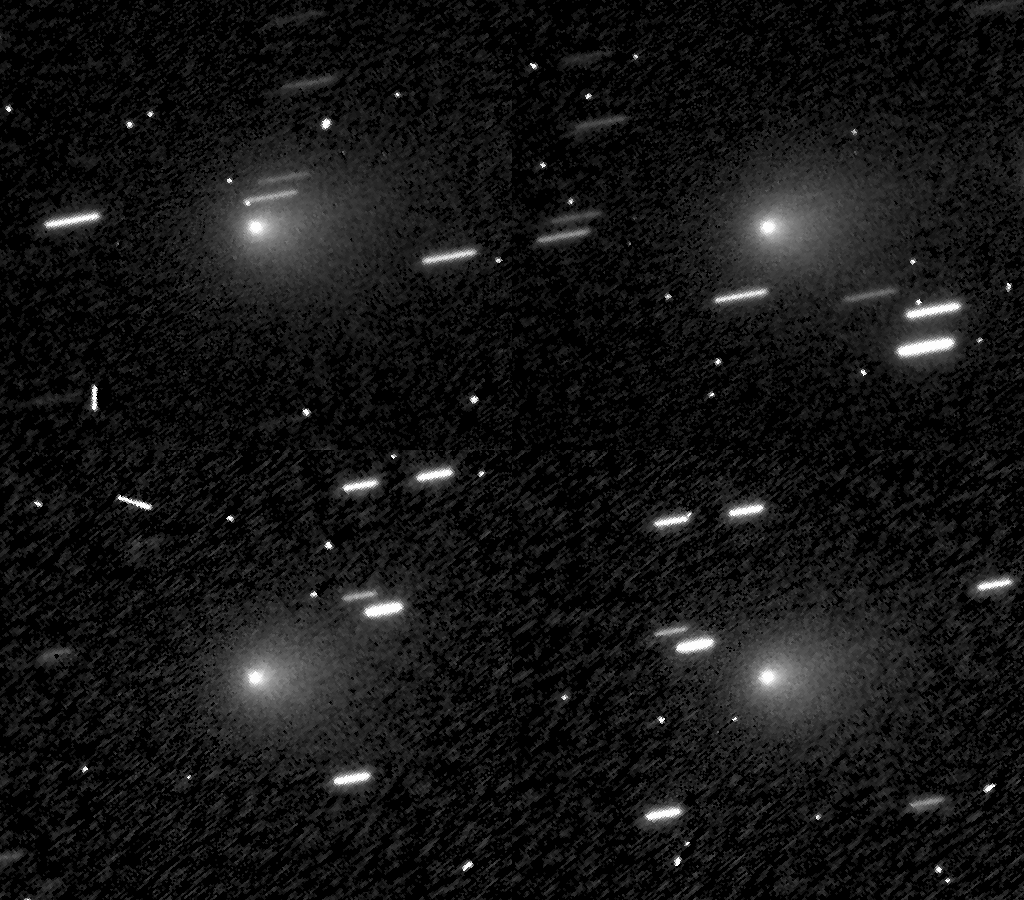
Designed to map galaxies, the SPHEREx mission's first science result is instead about interstellar interloper 3I/ATLAS. No, it's not aliens.

65 million years ago, a massive asteroid struck Earth. Not only did Jupiter not stop it, but it most likely caused the impact itself.

First 'Oumuamua, then Borisov, and now ATLAS have shown us that interstellar interlopers are real. Here's what the newest one teaches us.

Once every 12 years, Earth, Jupiter, Uranus, and Neptune all line up, opening a window for a joint mission. Our next chance arrives in 2034.
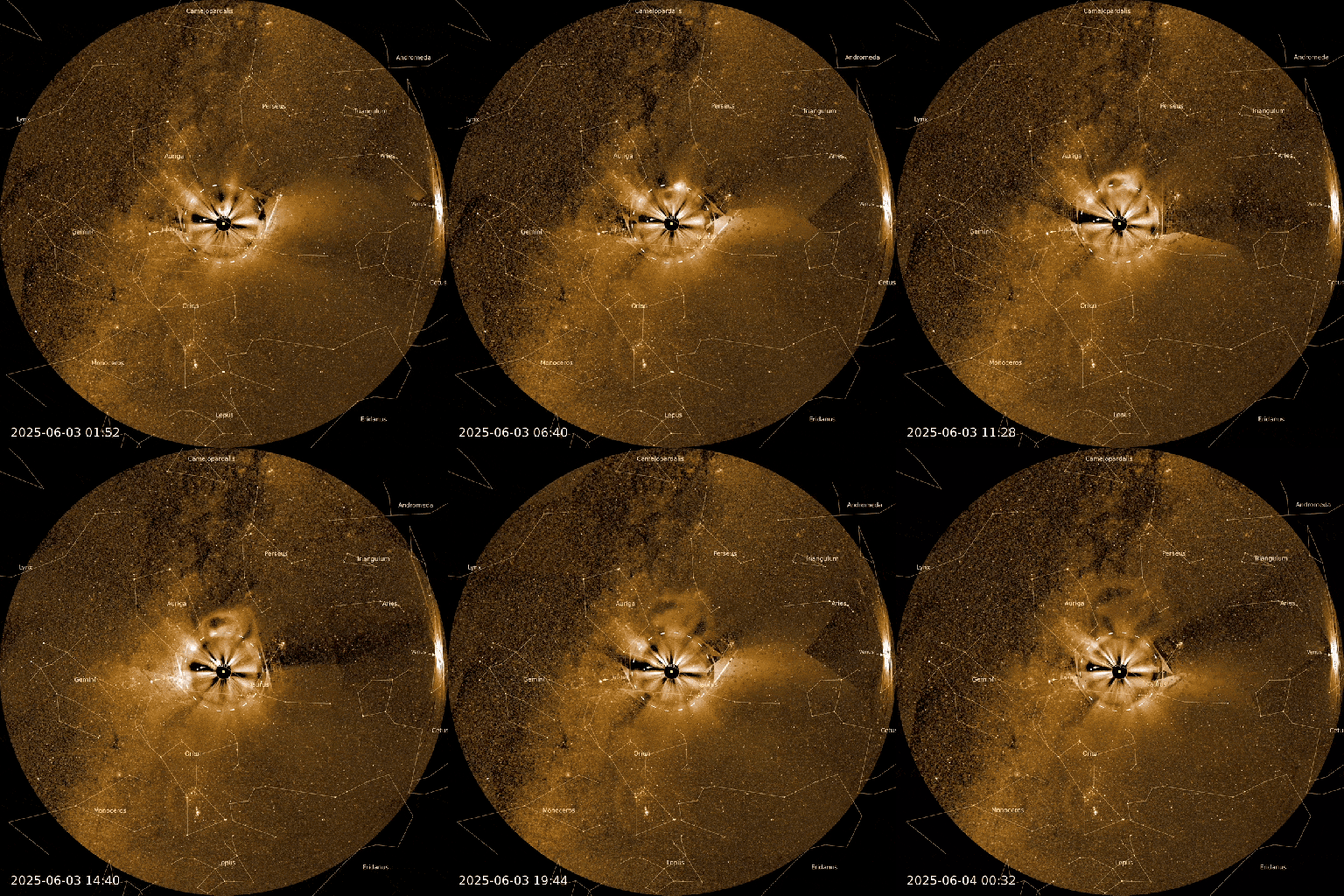
Launched in March, the PUNCH mission has viewed two incredible coronal mass ejections, tracking them farther from the Sun than ever before.

Viewing Uranus's largest moons with Hubble, astronomers hoped to find darkening on the trailing side. They found the exact opposite instead.

At extremely close distances to their stars, even rocky planets can be completely disintegrated. We've just caught our first one in action.

Here in our Solar System, terrestrial bodies get moons from gravitational capture or collisions. The Pluto-Charon system? It was both.

All the stars, stellar corpses, planets, and other large, massive objects take on spherical or spheroidal shapes. Why is that universal?

Mars and Earth were sister planets in many ways, with early similar conditions. Why did Mars die? The leading explanation isn't universal.

Comet A3, also known as Comet Tsuchinshan-ATLAS, has sprung to life since 2024's last equinox. Here's how to catch the show for yourself.

The existence of another watery world in the outer solar system may offer clues to how such seas form — and hope for another spot to search for life.

From size to mass to density and more, each world in our Solar System is unique. When we compare them, the results are truly shocking.

Earth, the only rocky planet with a large, massive satellite, is greatly affected by the Moon. Destroying it would cause 7 major changes.

As the Sun ages, it loses mass, causing Earth to spiral outward in its orbit. Will that cool the Earth down, or will other effects win out?

The structure of our Solar System has been known for centuries. When we finally started finding exoplanets, they surprised everyone.

Sure, there's less daylight during winter than summer, as your hemisphere is tilted away from the Sun. But darkness goes deeper than that.
From the coldest planets to spacecraft that have exited the Solar System, these little-known facts stump even many professional astronomers.

Northern lights in the American South, clusters of huge geomagnetic storms—the Sun is throwing a tantrum right on schedule.

Newborn stars are surrounded only by a featureless disk. Debris disks persist for hundreds of millions of years. So when do planets form?

Out beyond Neptune are some fascinating bodies left over from our Solar System's formation. Could one of them truly be spectacular?

To know how to protect its astronauts, NASA needs to first understand the threat.