




















Search
Space Exploration

At the end of July, hundreds of scientists convened to plan NASA's upcoming astrophysics flagship mission. Will the US allow it to happen?

Two supermassive black holes on an inevitable death spiral push the limits of Einstein's relativity. New observations reveal even more.

Even just by examining the Moon with the unaided eye, we can learn an incredible amount about the Moon, Earth, and more.

The Big Bang was hot, dense, uniform, and filled with matter and energy. Before that? There was nothing. Here's how that's possible.

When the Hubble Space Telescope first launched in 1990, there was so much we didn't know. Here's how far we've come.

From high school through the professional ranks, physicists still take incredible lessons away from Newton's second law.

65 million years ago, a massive asteroid struck Earth. Not only did Jupiter not stop it, but it most likely caused the impact itself.

First 'Oumuamua, then Borisov, and now ATLAS have shown us that interstellar interlopers are real. Here's what the newest one teaches us.

Our nearby Ring Nebula, with JWST's eyes, shows evidence for planet formation. Will the Sun eventually destroy, and then replace, the Earth?

Once every 12 years, Earth, Jupiter, Uranus, and Neptune all line up, opening a window for a joint mission. Our next chance arrives in 2034.

Originally, the abundance of bright, early galaxies shocked astronomers. After 3 years of JWST, we now know what's really going on.

In just its first 10 hours of observations, the Vera Rubin observatory discovered more than 2000 new asteroids. What else will it teach us?

For hundreds of millions of years, a cosmic fog blocked all signs of starlight. At last, JWST found the galaxies that cleared that fog away.

As the closest icy ocean world to
Earth, Ceres may be a promising candidate in the search for signs of ancient life.

Massive galaxy cluster Abell S1063, 4.5 billion light-years away, bends and distorts the space nearby. Here's what a JWST deep field shows.
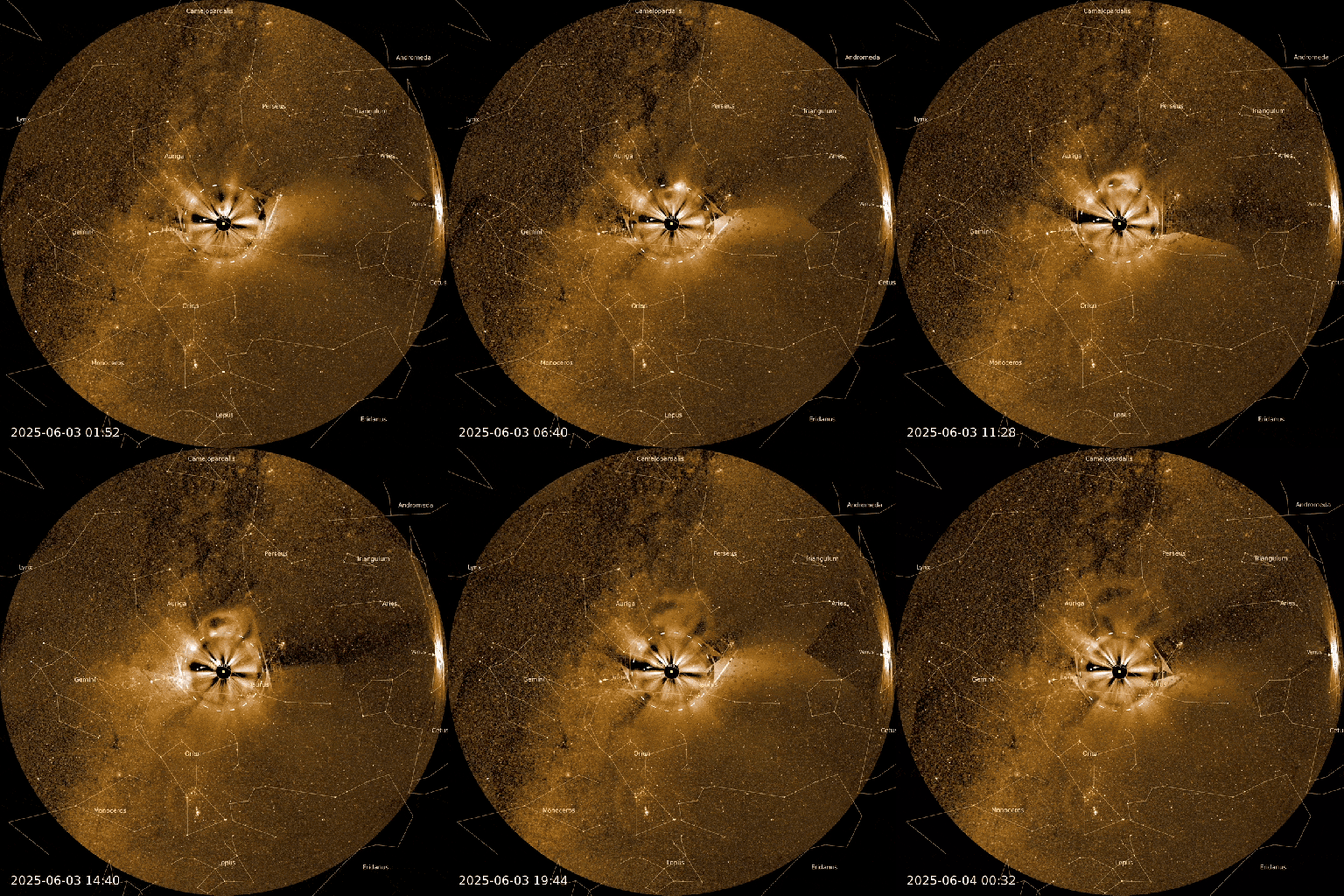
Launched in March, the PUNCH mission has viewed two incredible coronal mass ejections, tracking them farther from the Sun than ever before.

Viewing Uranus's largest moons with Hubble, astronomers hoped to find darkening on the trailing side. They found the exact opposite instead.

The first galaxies were irregular blobs of gas and stars. But modern features, like spiral arms and bars, appeared earlier than expected.

If the Universe is 13.8 billion years old today, but different ages the farther we look back, what does it mean for a star to be the first?

The Vera C. Rubin Observatory in Chile will image the southern sky using the largest digital camera ever built.

For decades, astronomers have claimed the Milky Way will merge with Andromeda in ~4 billion years. Here's why, in 2025, that seems unlikely.
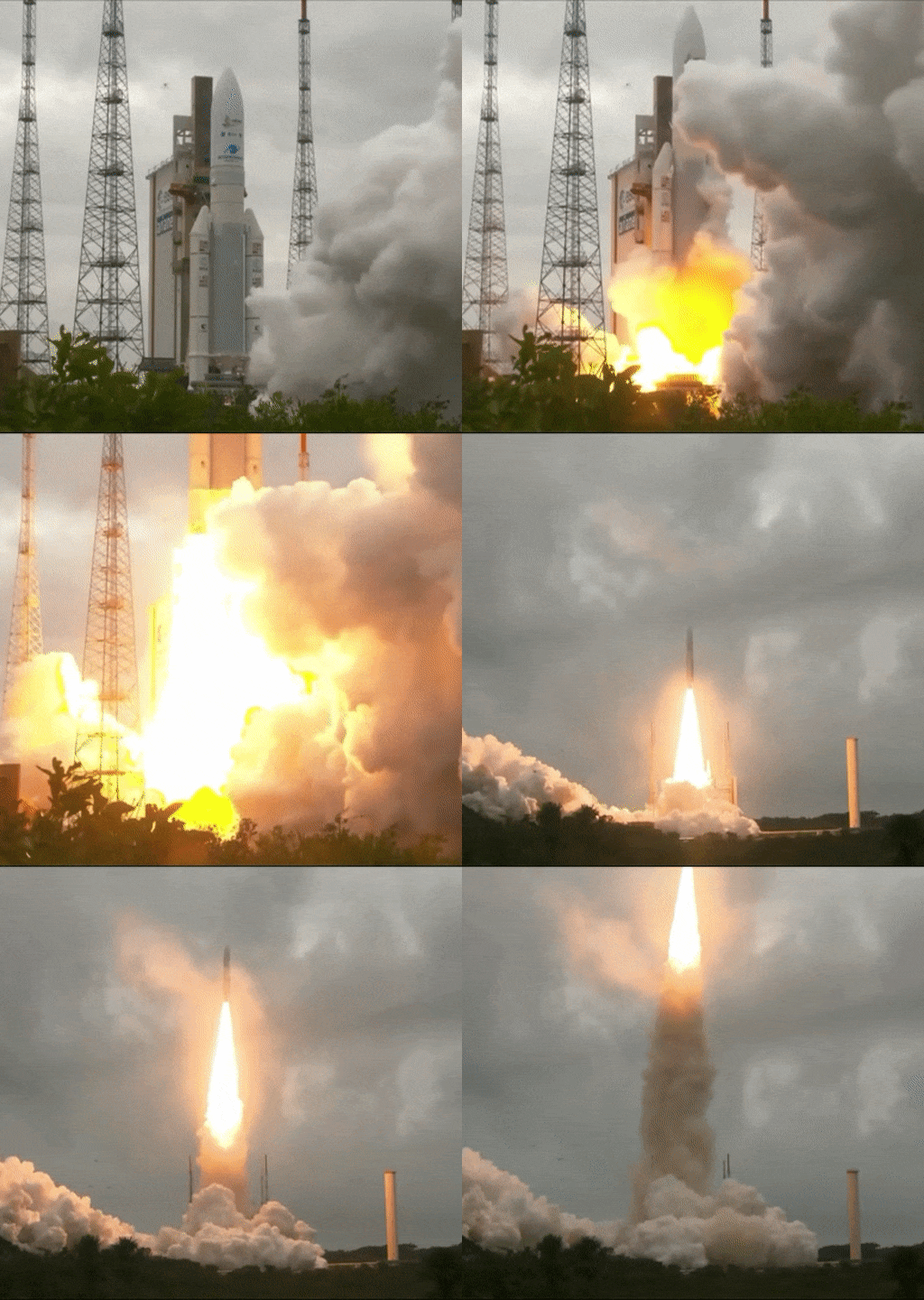
As US science faces record cuts to funding, jobs, and facilities, these 10 quotes help remind us how science brings value to us all.

It rotates on its axis, revolves around the Sun, moves throughout the Milky Way, and gets carried by our galaxy all throughout space.

Many were hoping that JWST would find the first stars of all. Despite many hopeful claims, it hasn't, and probably can't. Here's how we can.

Coming from just 280 million years after the Big Bang, or 98% of cosmic history ago, this new, massive galaxy is a puzzle, but not a mirage.

There's an old saying that "what you see is what you get." When it comes to the Universe, however, there's often more to the full story.

NASA astrophysics, which gave us Hubble, JWST, and so much more, faces its greatest budget cut in history. All future missions are at risk.

Just 10 years ago, humanity had never directly detected a single gravitational wave. We're closing in on 300 now, with so much more to come!

The COSMOS-Web survey is now complete, combining JWST and Hubble infrared data. Its spectacular views show us the Universe as never before.

Long before the search for biosignatures, scientists imagined a cosmos teeming with intelligent life.