




















Search
Space Policy

We’ve populated low-Earth orbit with satellites in record time — now we have to figure out how to keep it safe.

Science fiction romanticized Mars as a place of adventure and future settlement; science tells a very different story.

US science is worth fighting for, but so are the science projects and scientists denied opportunities. Here are 4 paths all worth exploring.

Real progress demands rules built for uncertainty — not for the few innovations dominating today’s tech landscape.

NASA’s Caleb Scharf talks with Big Think about life’s long experiment in expansion.

"Think of it like a transcontinental railroad — not the fastest way to move a lot of mass, but certainly the most efficient,” Jared Isaacman said about nuclear electric propulsion.

As October begins, thousands of longtime NASA employees are leaving the agency. 4000+ will exit by January 9, 2026, changing NASA forever.

The Juno spacecraft, orbiting and imaging Jupiter since 2016, is still succeeding. Without a further extension, the mission now faces death.

NASA's 1958 charter's top priority was, "the expansion of human knowledge of phenomena in the atmosphere and space." Is this how it ends?

There are real concerns with long-term power generation on the Moon; nuclear could be the answer. But for NASA, will the cost be too high?

65 million years ago, a massive asteroid struck Earth. Not only did Jupiter not stop it, but it most likely caused the impact itself.

8mins
"There is interesting ethical questions about how we should actually conduct ourselves in [a space colonization] exploration phase."

In all the known Universe, Earth is the only planet known to have native life. What should guide us in expanding humanity beyond our world?

Asteroid 2024 YR4, which could devastate a city's worth of humans, has gone from 1.2% to 2.3% to 2.6% to 3.1% chances of impact. Here's why.

New telescopes, radio dishes, and gravitational wave detectors are needed for next-generation science. Will the USA lead the way?

Experts answer 10 big questions about the nightmare scenario that could send us back to the pre-Space Age.

Sixty years ago, the Soviet Union was way ahead of the USA in the space race. Then one critical event changed everything.

These startups, space agencies, and aerospace giants are building humanity's next off-world homes.

The existence of another watery world in the outer solar system may offer clues to how such seas form — and hope for another spot to search for life.
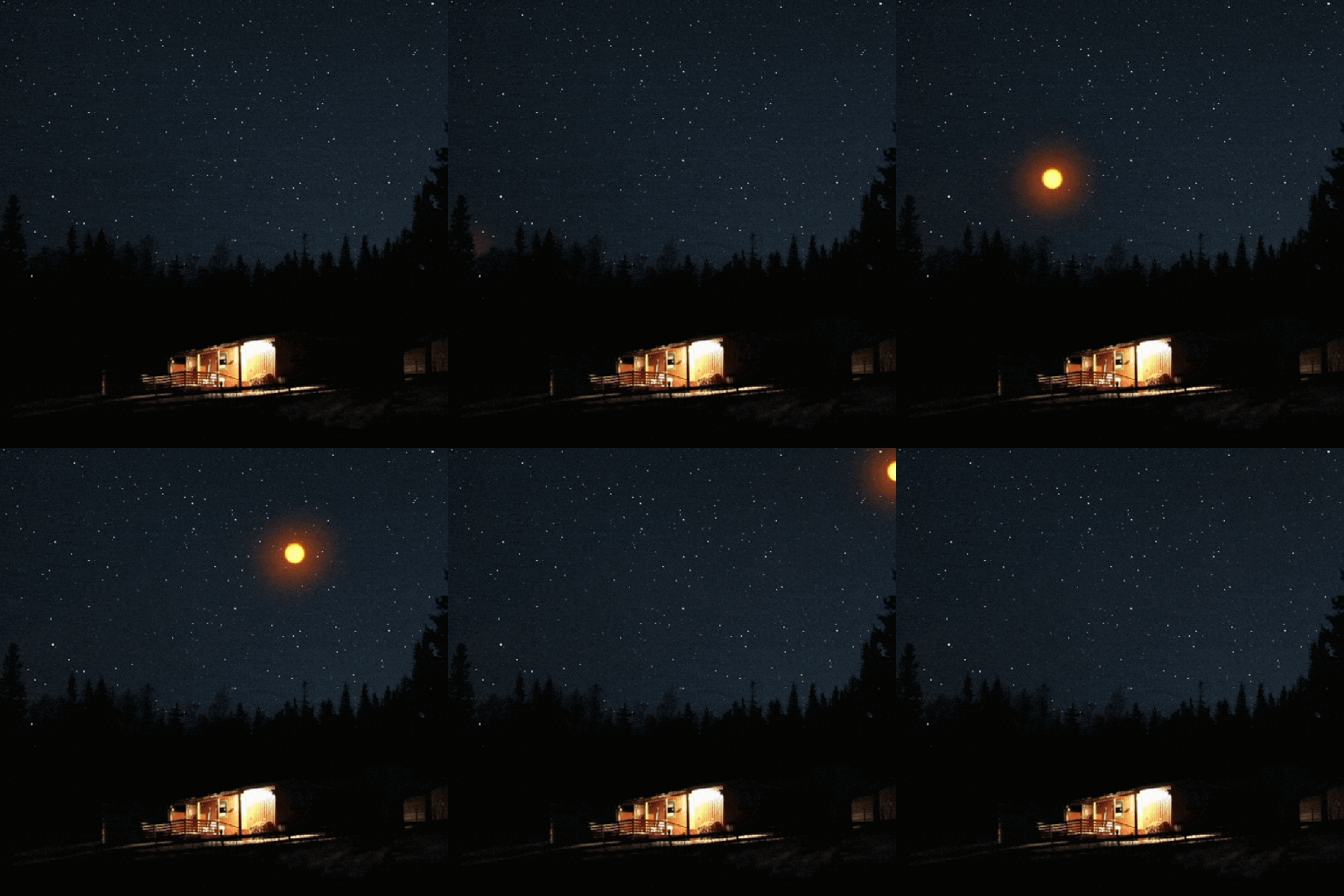
Although a great many unidentified sights have been seen in the skies, none have conclusively demonstrated the presence of aliens. So far.

Earth, the only rocky planet with a large, massive satellite, is greatly affected by the Moon. Destroying it would cause 7 major changes.

This research team is working out how to detect extraterrestrial cells in the liquid water ocean hidden beneath Enceladus’s icy crust.

Aliens are often portrayed in popular culture as humanoid. But in reality, intelligent extraterrestrials might take far stranger forms.

NASA's only flagship X-ray telescope ever, Chandra, still works and has no planned successor. So why does the President want to kill it?

No matter how you define the end, including the demise of humanity, all life, or even the planet itself, our ultimate destruction awaits.

In 1957, humanity launched our first satellite; today's number is nearly 10,000, with 500,000+ more planned. Space is no longer pristine.

Freethink's weekly countdown of the biggest space news, featuring a stranded space factory, Jeff Bezos' new moon lander, and more.

6mins
Humanity is a type 0 civilization. Here’s what types 1, 2, and 3 look like, according to physicist Michio Kaku.

12mins
There are a few theories as to why we’ve never found other intelligent life in our Universe. Physicist Brian Cox walks us through them.

Experts say it’s likely space junk—and there’s plenty more where that came from.