




















Search
Space Telescopes

Back in 1990, we hadn't discovered a single planet outside of our Solar System. Here are 10 facts that would've surprised every astronomer.

The nearby, bright star Fomalhaut had the first optically imaged planetary candidate. Using JWST's eyes, astronomers found so much more.

This oddball system of three stars might be our best chance at finding nearby life in the Universe.

Many planets will eventually be devoured by their parent star. For the first time, we caught a star in the act, eating its innermost planet!

With infrared capabilities and image sharpness far beyond Hubble's limits, JWST looked at Hubble's deepest field, revealing so much more.

Many galaxies really are ultra-distant, but some are just intrinsically red or dusty. Only with spectroscopy can JWST tell which is which.

JWST's revolutionary views arrive in high-resolution at infrared wavelengths. Without NASA's Spitzer first, it wouldn't have been possible.

The glorious sights that JWST keeps revealing are less than a millionth of the whole Universe. Just imagine what else is out there.

It is a story with nebulous beginnings and no discernible end.

NASA has finally chosen which flagship mission, like Hubble and JWST, will launch in ~2040. Detecting alien life is now a reachable goal.

Air currents in our atmosphere limit the resolving power of giant telescopes, but computers and artificial stars can sharpen the blur.

Along with gravitational lensing and ALMA's incredible long-wavelength spectroscopy, JWST is reshaping our view of the early Universe.

Humanity's newest, most powerful space telescope is performing even better than predicted. The reason why is unprecedented.

Individual space telescopes, like Hubble and JWST, revolutionized our knowledge of the Universe. What if we had an array of them, instead?

It's a radical but plausible idea.

JWST just found its first transiting exoplanet, and it's 99% the size of Earth. But with no atmosphere seen, perhaps air is truly rare.

Red dwarf stars were supposed to be inhospitable. But TOI-700, now with at least two potentially habitable worlds, is quite the exception.

2023 will see the launch of new rockets, the return of OSIRIS-REx, and a mission to Jupiter that could help us find extraterrestrial life.

Since dark matter eludes detection, the mission will target sources of light that are sensitive to it.

2022 was a year full of scientific discoveries and the dawn of the JWST. But Hubble's still going after 32 years. Here's the amazing proof!

Leaving Hubble in the dust, JWST has officially seen a galaxy from just 320 million years after the Big Bang: at just 2.3% its current age.

You are trapped in time. You never live in the world as it is but only as you experience it as it was.

In 1995, Hubble peered at the Pillars of Creation, forever changing our view. Now in 2022, JWST completes the star-forming puzzle.

With its first view of a protoplanetary disk around a newly forming star, the JWST reveals how alone individual stellar systems truly are.

The James Webb Space Telescope viewed Neptune, our Solar System's final planet, for the first time. Here's what we saw, and what it means.
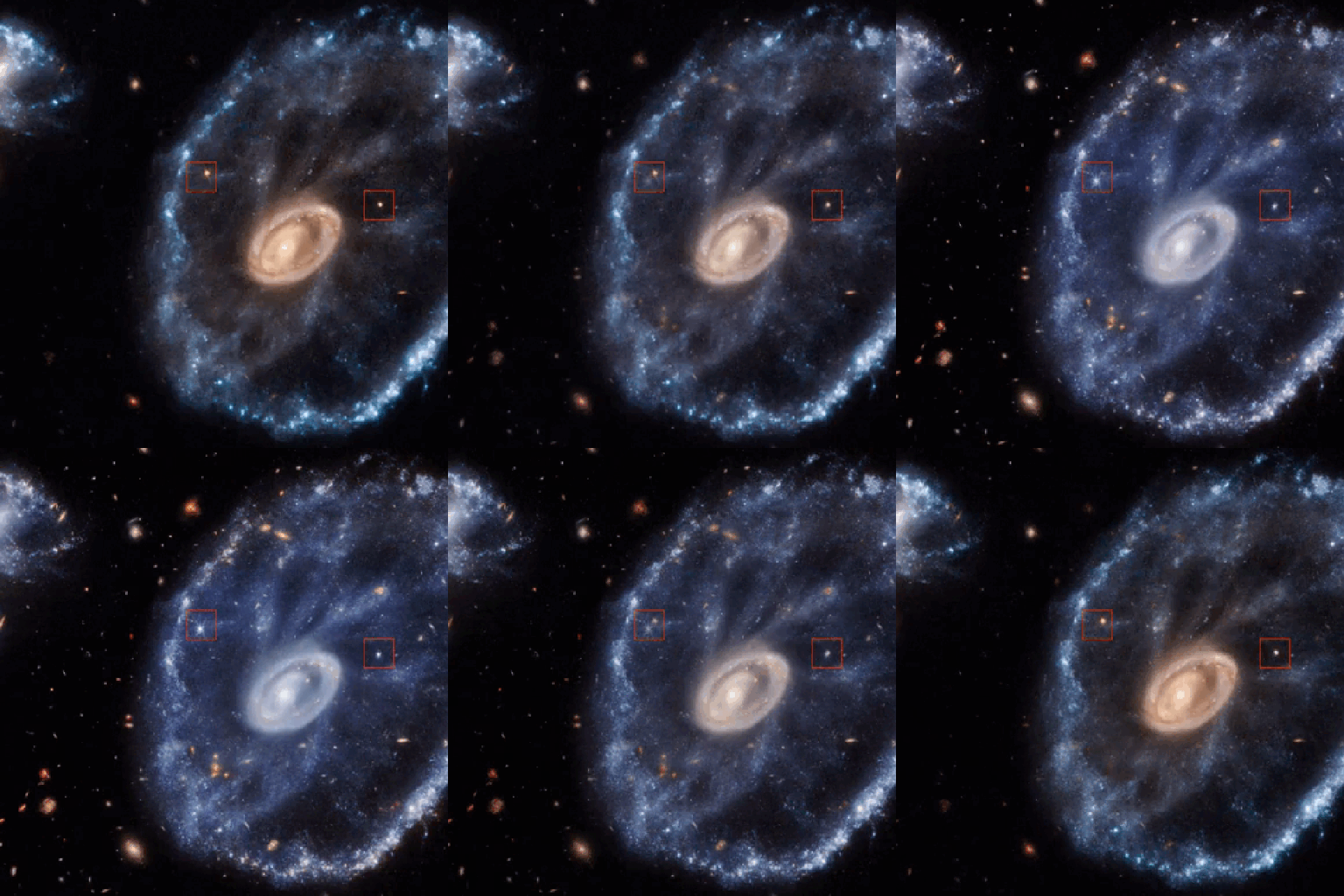
The first set of James Webb's images blew us all away. In just 2 mere months, it's seen highlights that no one could have predicted.

Einstein's relativity teaches us that time isn't absolute, but passes relatively for everyone. So how do telescopes see back through time?

No. No no no. Just... no. The JWST has truly blown our scientific minds, but it's a pure crackpot idea that the Big Bang is now disproven.

Unexpected images of galaxies from the James Webb Space Telescope do not disprove the Big Bang. There are other likelier explanations.

Hubble revolutionized astronomy more than once. Here's what we can expect from the James Webb Space Telescope.