




















Search
Space


No planet enters retrograde more frequently than Mercury, which does so 3-4 times each year. Here’s the scientific explanation for why.

Asteroid collisions aren't always bad.

Oxygen isn't strictly necessary for combustion, but it is ideal. Any advanced (alien) civilization probably uses oxygen to burn things.

In special relativity, the statement that two events happened at the same time is meaningless.

At their cores, stars can reach many millions or even billions of degrees. But even that doesn't touch the hottest of all.

There's an extra source of massive "stuff" in our Universe beyond what gravitation and normal matter can explain. Could light be the answer?

As technology advances, the use of laser weapons in space becomes more likely.


The emergence of life in the universe is as certain as the emergence of matter, gravity, and the stars. Life is the universe developing a memory, and our chemical detection system could find it.
John Templeton Foundation

"The surface is no longer a record of every impact the moon has ever had, because at some point, impacts were erasing previous impacts."

Quantum communication offers a surer path to sending an interstellar message, as well as receiving one. But can we do it?

4mins
Rituals come as much from religion as they do from the way Earth spins around the Sun.

Now that it's fully commissioned, the James Webb Space Telescope begins its exploration of the Universe. Here are its first science images!

With its very first deep-field view of the Universe now released, the James Webb Space Telescope has shown us our cosmos as never before.
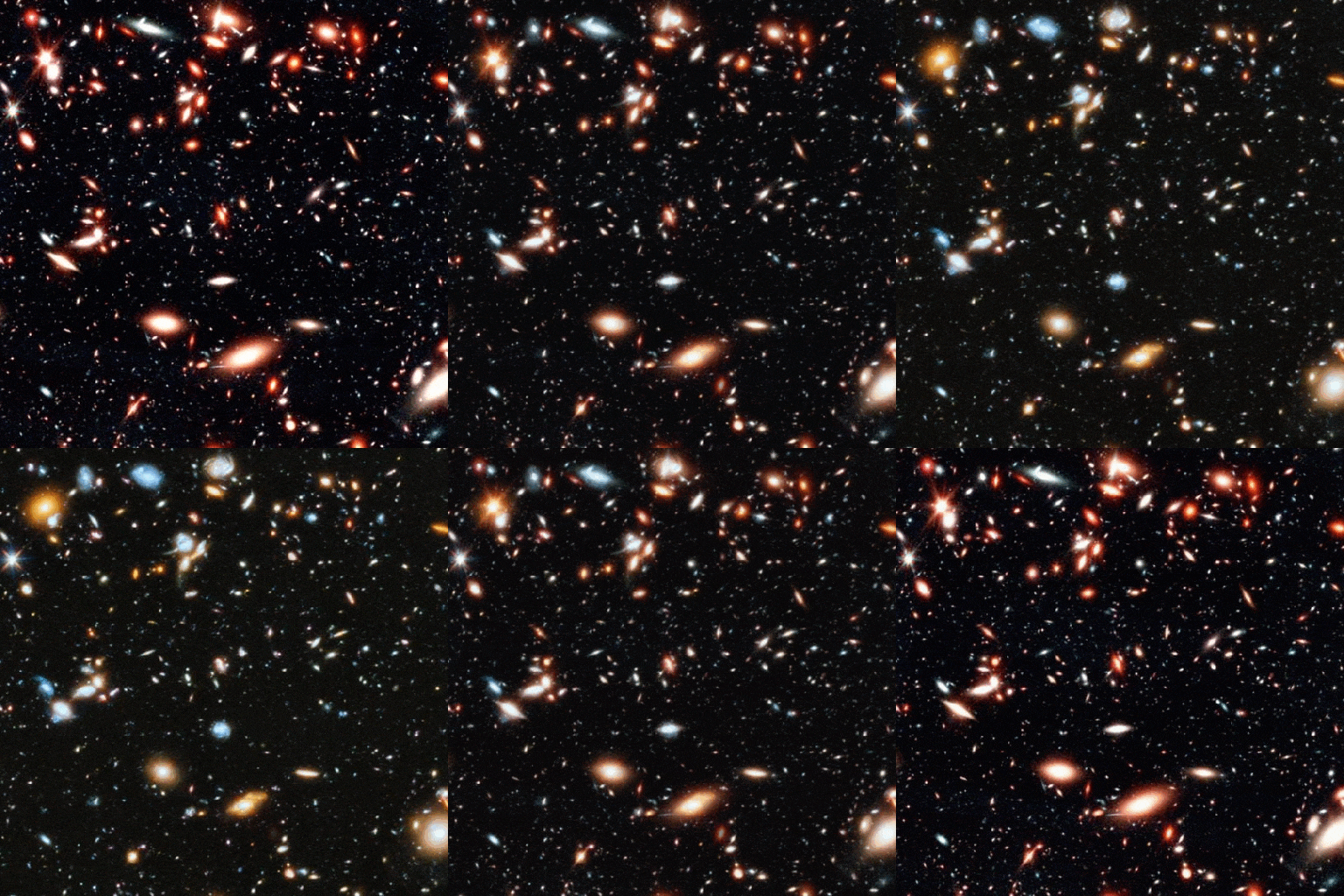
The James Webb Space Telescope has chosen 5 targets for its first science release. Here's what we know on the eve of JWST's big reveal!

LIGO can detect the inspirals and mergers of the lowest-mass black holes, but not the biggest ones. Here's how pulsars can help.

Your eyes are playing tricks on you.

The idea of gravitational redshift crossed Einstein's mind years before General Relativity was complete. Here's why it had to be there.

The Universe is expanding, and the Hubble constant tells us how fast. But how can it be a constant if the expansion is accelerating?

The discovery calls into question the few things scientists know about these powerful astronomical phenomena.
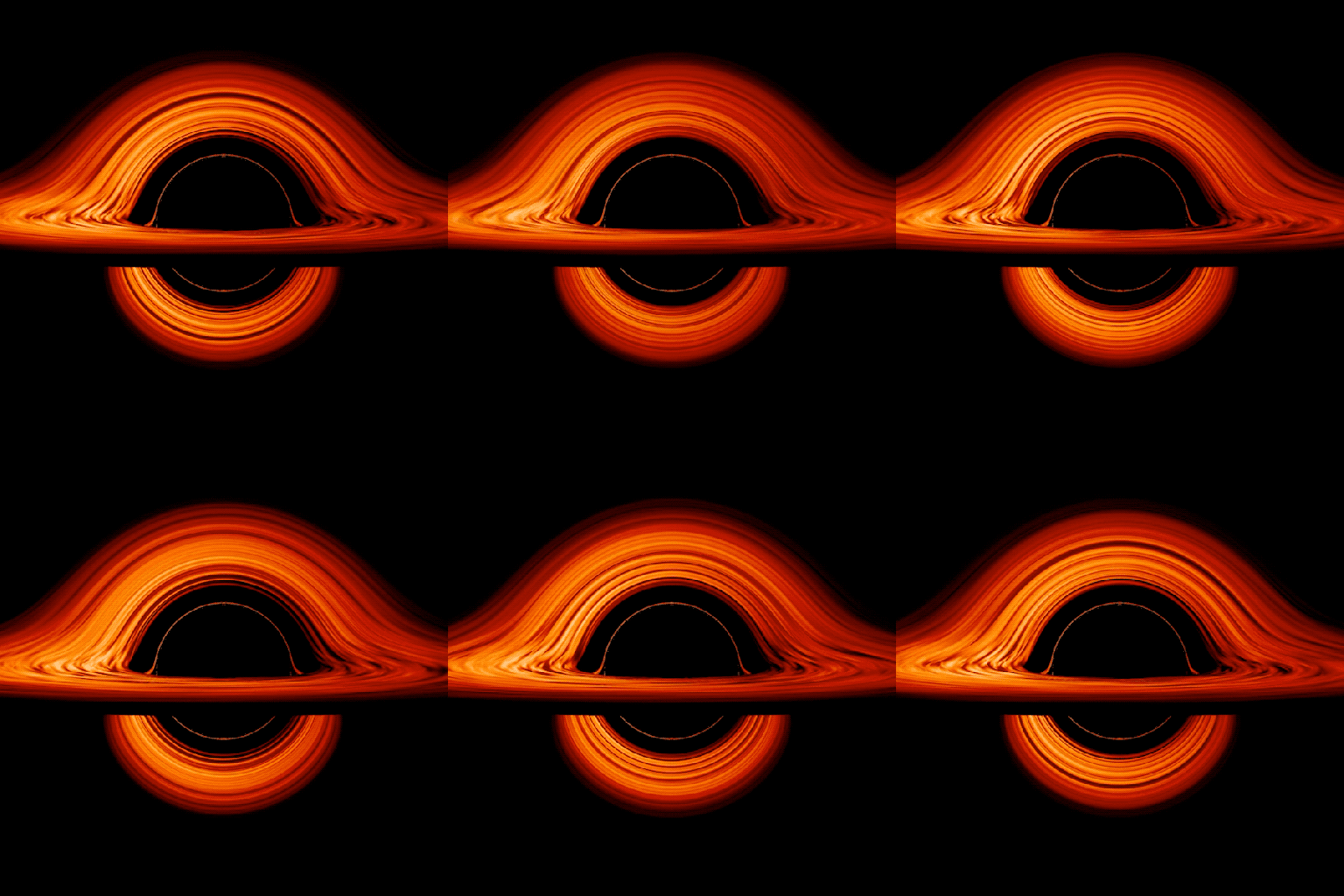
With two different black hole event horizons now directly imaged, we can see that they are, in fact, rings, not disks. But why?

When stars form, they emit energetic radiation that boils gas away. But it can't stop gravitational collapse from making even newer stars.

The James Webb Space Telescope (JWST) will study many dangerous cosmic phenomena, knowledge of which may help save humanity.

On July 12, 2022, NASA will release the first science images taken with the James Webb Space Telescope. Here's what to hope for.

The James Webb Space Telescope is about to begin science operations. Here's what astronomers are excited about.

Where did the “seed” magnetic field come from in the first place?

In all of science, no figures have changed the world more than Einstein and Newton. Will anyone ever be as revolutionary again?

"The pulsar sort of consumes the thing that recycled it, just as the spider eats its mate.”

Atomic clocks keep time accurately to within 1 second every 33 billion years. Nuclear clocks could blow them all away.