




















Search
Space

Experts say it’s likely space junk—and there’s plenty more where that came from.

The biggest, brightest galaxies are the easiest to spot, but the tiniest ones teach us about how the Milky Way assembled and grew up!

The "Ring Nebula," known for almost 250 years, is so much more than a Ring. With JWST's capabilities, we're seeing more than ever before.

Despite the vast number of planets in the Universe, Earth's specific evolutionary history guarantees that its life forms — including humans — are utterly unique.

Some constants, like the speed of light, exist with no underlying explanation. How many "fundamental constants" does our Universe require?

The Schumann resonances are the background hum of the entire planet. But they don't affect humans in any way.

The visible Universe extends 46.1 billion light-years from us, while we've probed scales down to as small as ~10^-19 meters.

From when its light was emitted, the El Gordo galaxy cluster might be the most massive object in all of existence. Here's how JWST sees it.

Nothing can escape from a black hole. So where do Hawking radiation, relativistic jets, and X-ray emissions around black holes come from?

All stars, eventually, run out of fuel and die. Given all the stars we can see and the vast distance to them, are any of them already dead?

The giant impact theory suggests our Moon was formed from proto-Earth getting a Mars-sized strike. An exoplanet system shows it's plausible.

What are supermassive black holes, how common are they, and how do they grow up throughout cosmic history? Listen and find out!

The separation of pleasure from procreation may occur throughout the cosmos, providing an explanation for the Fermi Paradox.

But it's still challenging to build a 22,000-mile elevator.

Headlines have blared that quasar ticking confirms that time passed more slowly in the early Universe. That's not how any of this works.
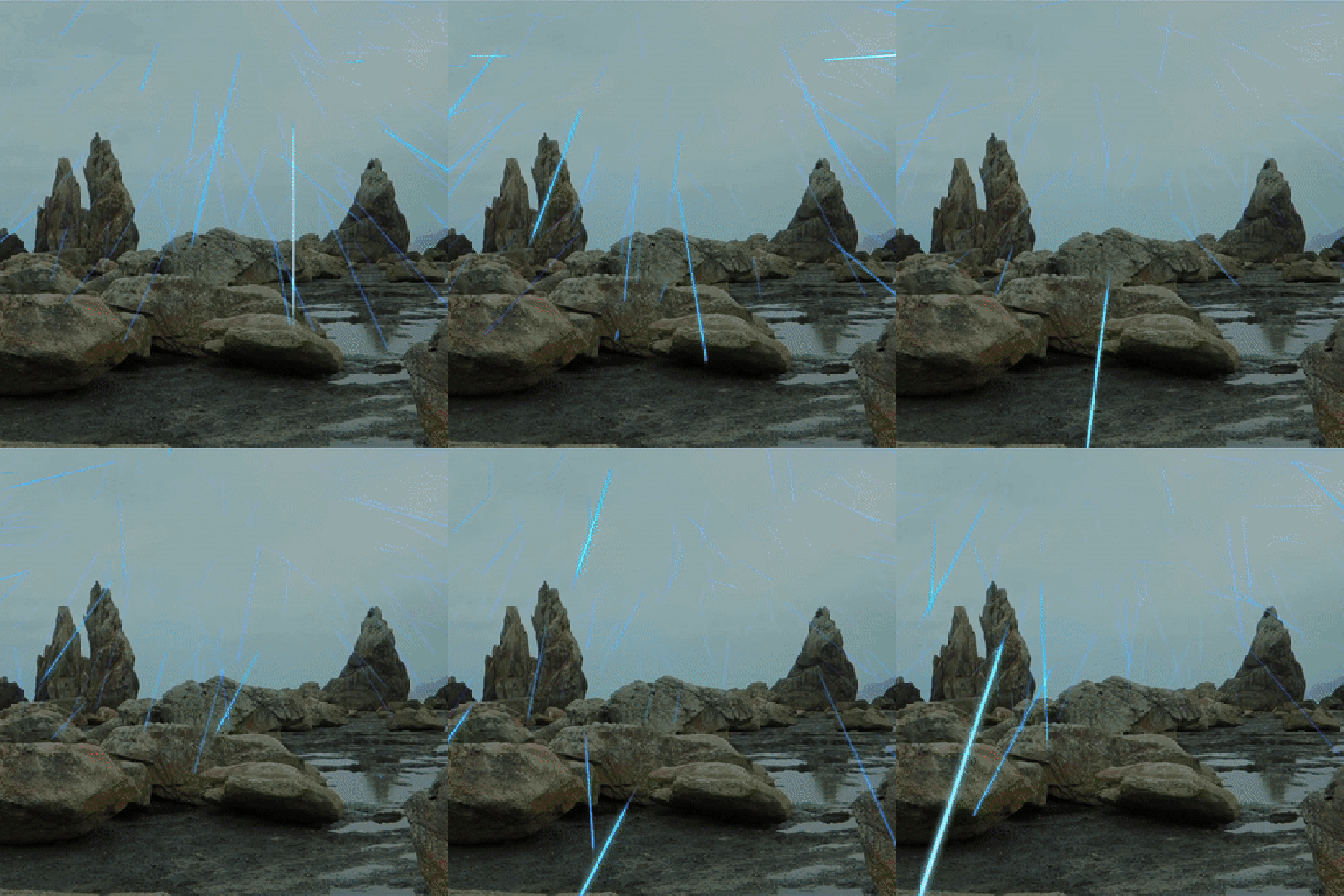
Lost in a building or underwater? A new muon-based navigation system could be your guide.

After 15 years of monitoring 68 objects known as millisecond pulsars, we've found the Universe's background gravitational wave signal!

In one experiment, the Viking landers added water to Martian soil samples. That might have been a very bad idea.

As the Earth spins and wobbles on its axis and revolves elliptically around the Sun, each day changes from the last. "24 hours" isn't right.

The truth is out there, but it's probably not in the latest whistleblower's report.

The multiverse pushes beyond the limits of the scientific method. From our vantage point in the Universe, we cannot know if it's real.

The familiar terrain of solids, liquids, and gases gives way to the exotic realms of plasmas and degenerate matter.

Despite the enormous mass of the Earth, simply depleting our groundwater is changing our axial tilt. Simple Newtonian physics explains why.

Sun-like stars live for around 10 billion years, but our Universe is only 13.8 billion years old. So what's the maximum lifetime for a star?

With hundreds of billions of stars burning bright, some galaxies are already dead. Their inhabitants might not know it, but we're certain.

There are 40 billion billion black holes in the universe. Here’s how our Solar System stacks up against ten of them.

We don't know what causes Miyake events, but these great surges of energy can help us understand the past — while posing a threat to our future.

Just by observing the tiny amount of deuterium left over from the Big Bang, we can determine that dark matter and dark energy must exist.

Dive into a realm where time, space, and even reality itself are put into question.

In 1974, Hawking showed that black holes aren't stable, but emit radiation and decay. Nearly 50 years later, it isn't just for black holes.