




















Search
Spacetime Physics

We have two descriptions of the Universe that work perfectly well: general relativity and quantum physics. Too bad they don't work together.

Binary black holes eventually inspiral and merge. That's why the OJ 287 system is destined for the most energetic event in history.

No human has ever left the Solar System, and only six already-launched spacecraft will ever exit it. Will Voyager 1 remain the most distant?

Quantum entanglement links information between particles across space and time. So what happens when one of them falls into a black hole?

Many of us look at black holes as cosmic vacuum cleaners: sucking in everything in their vicinity. But it turns out they don't suck at all.

Humans, when we consider space travel, recognize the need for gravity. Without our planet, is artificial or antigravity even possible?

Time is relative, not absolute, as gravity and motion both cause time to dilate. Your head and feet, therefore, don't age at the same rate.

The mass that gravitates and the mass that resists motion are, somehow, the same mass. But even Einstein didn't know why this is so.

Traveling back in time is a staple of science fiction movies. But according to Einstein, it's a physical possibility that's truly allowed.

The evidence that the Universe is expanding is overwhelming. But how? By stretching the existing space, or by creating new space itself?

The brilliant mind who discovered the spacetime solution for rotating black holes claims singularities don't physically exist. Is he right?

Isaac Newton and Albert Einstein are locked in an eternal battle over the nature of gravity. Whose side are you on?

Measurements of the acceleration of the universe don’t agree, stumping physicists working to understand the cosmic past and future. A new proposal seeks to better align these estimates — and is likely testable.

The first observational evidence showing the Universe is expanding is 100 years old now: in 2023. Here's the story of its 100th anniversary.

Ultracold gases in the lab could help scientists better understand the universe.
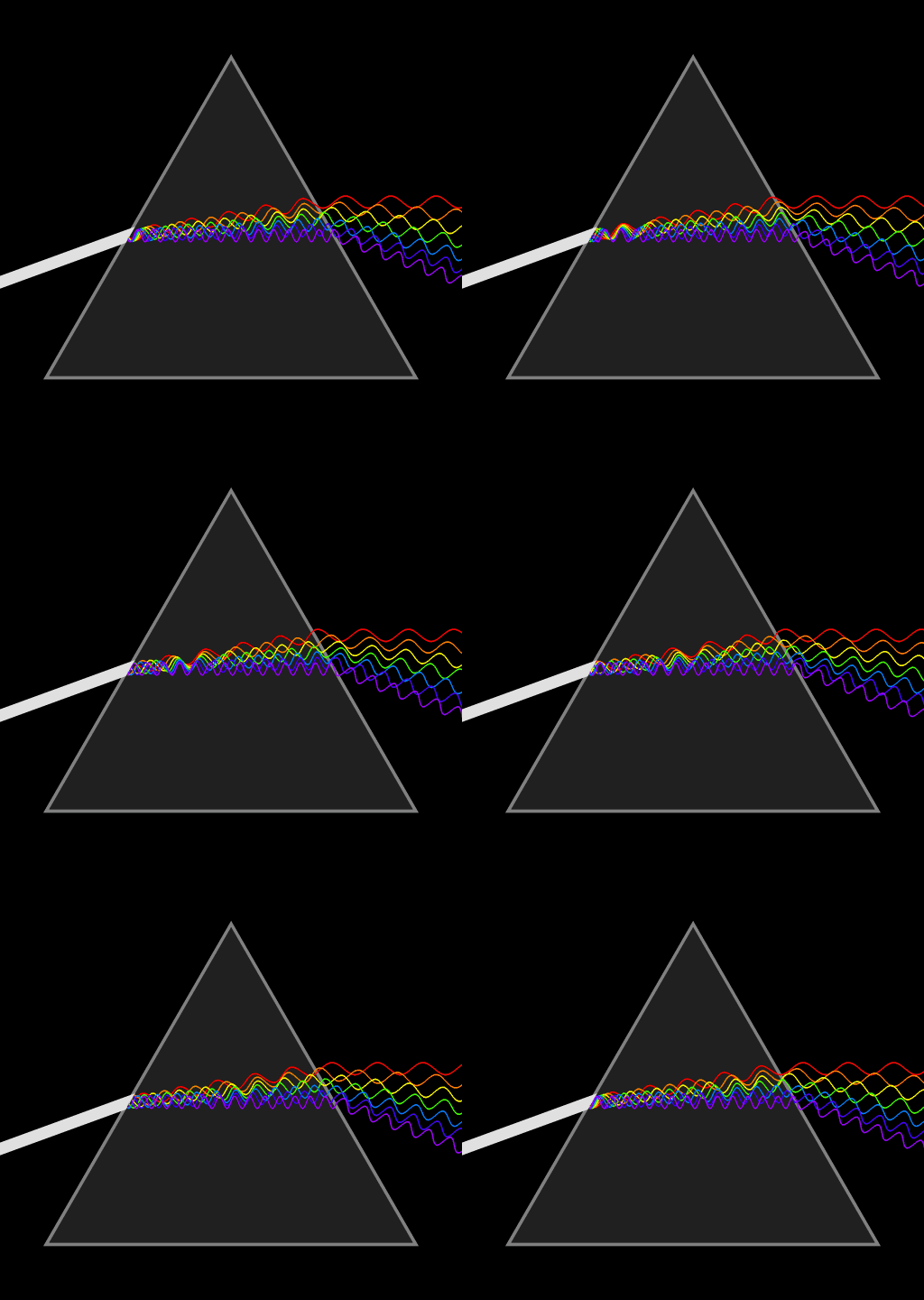
Invisible cloaks. Ghost imaging. Scientists are manipulating light in ways that were once only science fiction.

From a photon's viewpoint, the Universe is timeless and dimensionless.

There are 40 billion billion black holes in the universe. Here’s how our Solar System stacks up against ten of them.

It's been 100 years since we discovered that the Universe was expanding. But if it's expanding, then what is it expanding into?

Einstein's most famous equation is E = mc², which describes the rest mass energy inherent to particles. But motion matters for energy, too.

Einstein's relativity overthrew the notion of absolute space and time, replacing them with a spacetime fabric. But is spacetime truly real?

Time gets a little strange as you approach the speed of light.

Everything everywhere all at once.

There's the textbook answer, then there's the real answer.
We live in a four-dimensional Universe, where matter and energy curve the fabric of spacetime. But time sure is different from space!

There's a speed limit to the Universe: the speed of light in a vacuum. Want to beat the speed of light? Try going through a medium!

Extremely precise atomic clocks are not just of theoretical interest; they could help detect impending volcanic eruptions or melting glaciers.

There are a few possible solutions to the problem of interstellar travel, but they largely remain within the realm of science fiction.

The latest gravitational wave data from LIGO and Virgo finally shows us the truth: there are no "gaps" in the masses of black holes.

Or is ‘new space’ created in between the gaps of the ‘old’ space? It’s been almost 100 years since humanity first reached a revolutionary conclusion about our Universe: space itself doesn’t […]