




















Search
Stellar Evolution

It started with a bang, but won't end with one. Instead, it will "rage against the dying of the light" like nothing you've ever imagined.

Like humans, stars die. The James Webb Space Telescope's early images already give us a lot of information about how this happens.

Now that it's fully commissioned, the James Webb Space Telescope begins its exploration of the Universe. Here are its first science images!
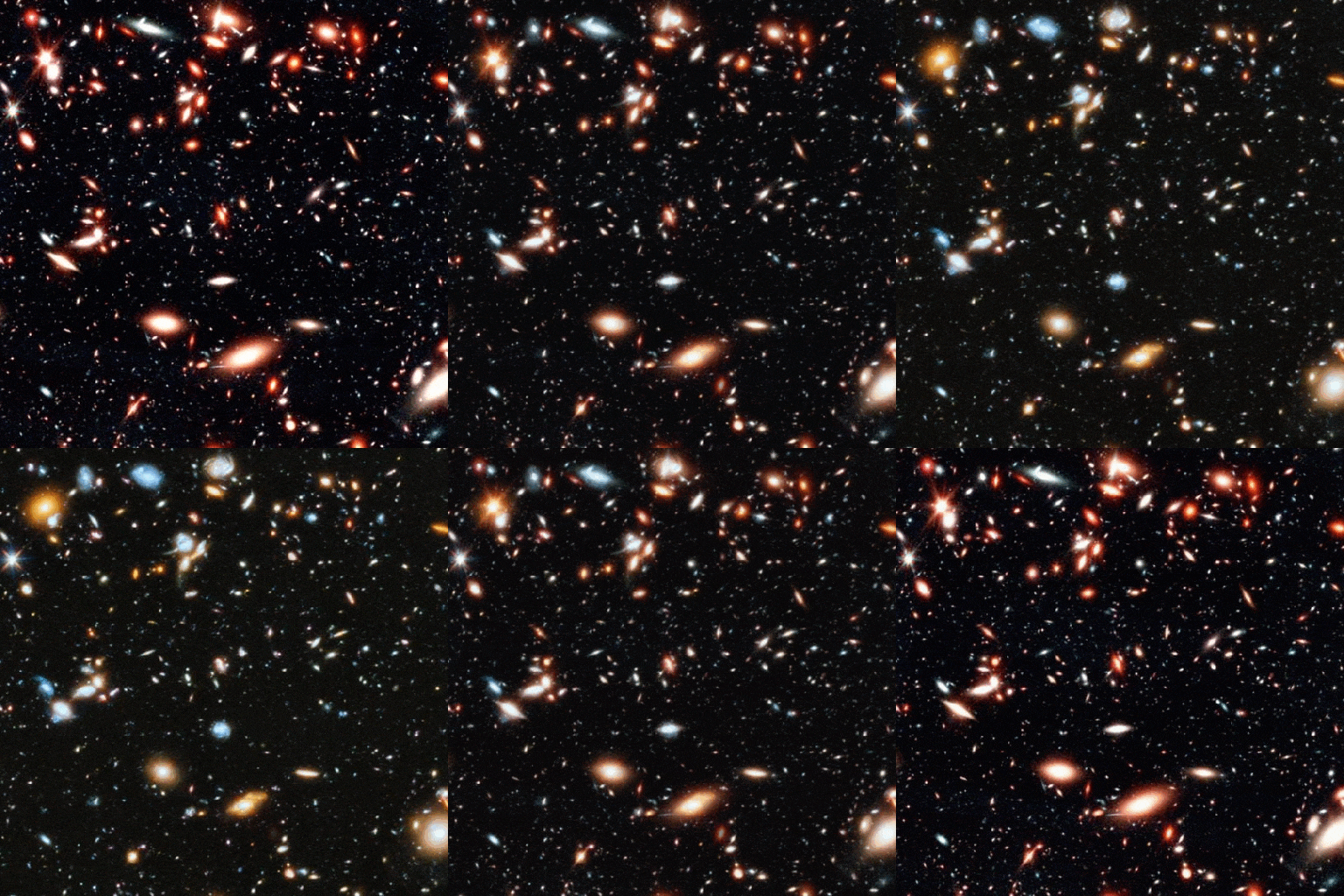
The James Webb Space Telescope has chosen 5 targets for its first science release. Here's what we know on the eve of JWST's big reveal!

The discovery calls into question the few things scientists know about these powerful astronomical phenomena.

When stars form, they emit energetic radiation that boils gas away. But it can't stop gravitational collapse from making even newer stars.

If you think you know how an astronomical nova works, buckle up. You're in for a ride like you never expected.

On July 12, 2022, NASA will release the first science images taken with the James Webb Space Telescope. Here's what to hope for.

Where did the “seed” magnetic field come from in the first place?

"The pulsar sort of consumes the thing that recycled it, just as the spider eats its mate.”

The idea of black holes has been around for over 200 years. Today, we're seeing them in previously unimaginable ways.

After years of analysis, the Event Horizon Telescope team has finally revealed what the Milky Way's central black hole looks like.

In Sun-like stars, hydrogen gets fused into helium. In the Big Bang, hydrogen fusion also makes helium. But they aren't close to the same.

The light from Earendel took 12.9 billion years to reach Hubble. The star is millions of times brighter than our Sun and 50 times as massive.

From life on Earth to the planet itself, there are four ways our planet will actually experience "the end," no matter how we define it.

From the tablets of the Babylonians to the telescopes of modern science, humans have always looked to the skies for fundamental answers.

Galactic archaeology has uncovered a spectacular find: the Milky Way already existed more than 13 billion years ago.

Even a tiny sliver of the Universe can reveal the cosmic story of what's out there and how it came to be the way it is today.

Empty, intergalactic space is just 2.725 K: not even three degrees above absolute zero. But the Boomerang Nebula is even colder.

In the night sky for March of 2022, only stars and the Moon, not planets, will greet you. The real show, however, arrives just before dawn.

Professional astronomy images are the gold standard. But this Large Magellanic Cloud composite is the amateur community's best image ever.

Once science operations begin for James Webb, we'll never look at the Universe the same way again. Here's what everyone should know.

Please stop calling our Sun an "average star." It is philosophically dubious and astronomically incorrect.

Shooting star or piece of space dust?

If you want to understand what the Universe is, how it began, evolved, and will eventually end, astrophysics is the only way to go.

The James Webb Space Telescope finally could answer the age-old question of whether we are alone in the universe.

The first supernova ever discovered through its X-rays has an enormously powerful engine at its core. It's unlike anything ever seen.

Some stars burn through their fuel as expected, and die of natural causes. But others, instead, get murdered. Here's their story.

From before the Big Bang to the present day, the Universe goes through many eras. Dark energy heralds the final one.

Known as primordial black holes, they could thoroughly change our Universe's history. But the evidence is strongly against them.