




















Search
Stellar Evolution

The photometric filters for the Vera Rubin Observatory are complete and showcase why they are indispensable for astronomy.

Previously, only the brightest and most active galaxies could pierce the obscuring wall of cosmic dust. At last, normal galaxies break through.

Although most of the Universe's mass is dark matter, which gravitates just as well as normal matter, it still can't make black holes.

The latest gravitational wave data from LIGO and Virgo finally shows us the truth: there are no "gaps" in the masses of black holes.

There are over 100 known elements in the periodic table. These 8 ways of making them account for every one.

Galaxies can have regions both hotter and colder than the background radiation of the Universe. When we talk about the depths of space, we get this picture in our heads […]

We’ve already observed three cases where it’s happened. When you look at an object in space, it’s pretty easy to tell if it’s a star or a planet. Stars are […]

The raw ingredients just weren’t there. Thankfully, their predecessors were. Here on Earth, our planet practically overflows with life. After more than 4 billion years, life has spread to practically […]

We just observed the first ‘lunar formation’ in an exoplanetary system. This one image, above, is the first to show moons actively forming around a planet. This colourful image shows […]

50% of stars are in Sun-like ‘singlet’ systems. The planetary nebulae we see just don’t line up. Around 7 billion years from now, our Sun’s life will end. As the Sun […]

The contact binary system KIC 9832227 is worth another look. Astronomers have seen some incredible occurrences across space and time. The nova of the star GK Persei, shown here in an […]

The rarest stars in the Universe are the ones we need the most to make humanity possible. Like everything in the Universe, stars are born, they live a little while, […]

An almost 40-year-old theory finally has ‘smoking gun’ evidence for it. During most of their lives, stars burn stably, changing imperceptibly. The rotten egg nebula, at lower right (and shown in […]
Despite Betelgeuse’s recent faintening and brightening, I’d bet on these stars instead. Betelgeuse, a nearby red supergiant, will someday explode. The black hole at the center of the Milky Way should […]

If you go young, blue, and massive, you top out at 50,000 K. That’s peanuts! Surprise! The biggest, most massive stars aren’t always the hottest. Although its neighbor, Messier 42, […]

How two seemingly distinct exoplanet systems turned out to be related. Practically every star in the Milky Way has a similar origin story. At some point in the past, a molecular […]

Even after our merger with Andromeda, we might retain our spiral shape for trillions of years. You probably don’t think about it very often, but the Milky Way galaxy won’t remain […]

Even addition has to play by different rules for black holes. How do you add 28 and 47 together? This simple math question helps us highlight the many different ways that […]

At just 3 solar masses, it eliminates the “mass gap.” Searching for black holes is one of the most difficult astronomical games a scientist can play. Emitting no light of their […]

Mass determines a star’s fate… except when it doesn’t. Supernova events are common, visually spectacular astronomical cataclysms. In 1987, a supernova just ~168,000 light-years away was observed in the Large Magellanic […]

Enough mass in one location will always create a black hole. But not all masses are possible. If you take enough mass and compress it into a small enough volume […]

Both views are equally spectacular, but unequally informative. Every so often, a creative amateur project highlights our professional achievements. This mosaic shows the region between the constellations of Cygnus and […]

The most massive nearby stars could be the seeds our supermassive black holes need. The problem with the Universe, as we see it today, is that we only get a snapshot […]

The Universe’s idea of a ‘typical star’ has changed dramatically over time. When you look out at the Universe today, you’re not seeing it exactly as it is at one particular […]

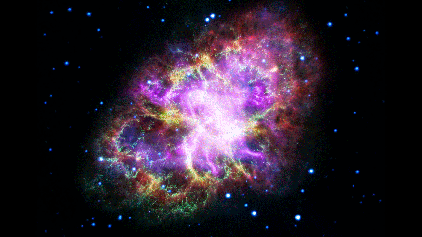
The Crab Nebula goes back to 1054, opening a window into our cosmic past. On July 4, 1054, Chinese astronomers recorded a “guest star” in the Taurus constellation. A ‘guest star’ […]

If everything eventually dies and decays, is there a way to prolong the inevitable? Our Universe, as it exists today, puts us in an incredibly privileged position. Had we come […]

NASA’s SOFIA mission is upgraded and back in action, and the Cigar Galaxy makes a perfect target. In theory, cold, neutral gas is the key to stars and galaxies. A visualization […]

Just say no to artist’s illustrations. This is what the Universe actually looks like. The Universe we observe often surpasses our greatest imaginings. This 20-year time-lapse of stars near the center […]

What we’ve seen isn’t necessarily what we get, but the most common world doesn’t look like ours. There’s a very common myth out there in astronomy: the idea that the Sun […]

If you thought it was just one rich region in space, look deeper and wider. Shining brilliantly in January’s skies is the Great Orion Nebula. By 10 PM every night in […]