




















Search
Technological Progress

Although human beings arrived on Earth just ~300,000 years ago, we've transformed the entire planet completely. Here's how we did it.

On the morning of April 20, 1961, all conditions were "go" for an attempt at free flight. A man was on standby with a fire extinguisher. Just in case.

During the industrial era the cost of artificial light fell off a cliff — and the road to illumination was paved with ingenuity and slaughter.

Lasers, mirrors, and computational advances can all work together to push ground-based astronomy past the limits of our atmosphere.

Archaeologists have identified what may be Europe’s oldest human-made megastructure.

AI is both a tool and a catalyst — and the key to successful integration is to rewrite your rule book and tinker.

Do grim sci-fi scenarios crush our hopes for real-world growth? Author Michael Harris looks elsewhere to unblock the road to a better future.

Human civilization has always survived periods of change. Will our rapidly evolving technological era be an exception to the rule?

These theoretical megastructures represent one way an advanced civilization might harvest energy from stars.

Chemists could replace bubbling flasks with tumbling ball mills.

A unique combination of DNA and silica is the strongest known material for its density (but you’ll need a lot of it before you can build a suit from it).

A true scientific view of if, where, and when extraterrestrial life exists is within our grasp thanks to biosignatures and technosignatures.

Only nine weeks later, the Wright Brothers achieved manned flight. The pathologically cynical always will find a reason to complain.

Science and technology were making early modern Europe a better place to live, but at what cost?

Wherever automation rises, religiosity falls.

Each of our three nearest stars might have an Earth-like planet in orbit around it. Here's what we'll learn when we finally observe it.

The idea that consciousness emerges naturally alongside intelligence could be an anthropocentric distortion.

Nobody actually knows what will come of AI. But we can console ourselves with the knowledge that nobody has ever really known anything about the future.

Who’s afraid of utopia? AI doubters have cold feet. History can warm them.

While many imagine terrifying futures run by AI, Rohit Krishnan is quietly identifying real problems and solutions.

Fear of technology is not new. But we misunderstand its origin. In reality, we don't fear technology but each other.

One hypothesis: "gossip traps."

Is Eliezer Yudkowsky the same false prophet that Paul Ehrlich was?

Lockheed Martin's Skunk Works engineering division has devised many jaw-dropping aircraft. Here are some of the best — and one ship.

It is easy to underestimate how much the world can change within a lifetime.
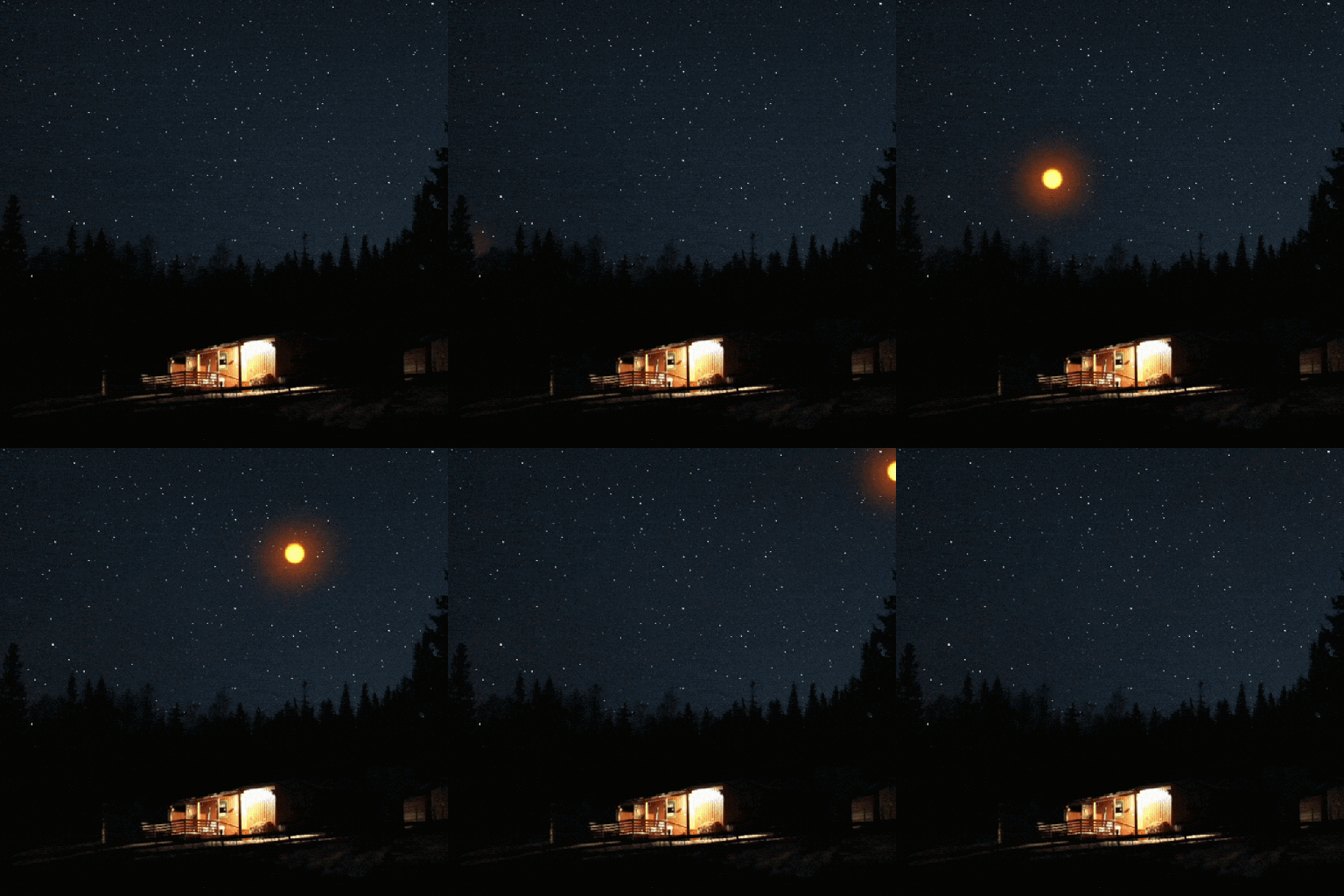
Lots of people have seen lots of bizarre events and phenomena that defy our conventional experience. But is there a scientific explanation?

Some would say AI is immortal and all-knowing — Godlike, even.

5mins
Is science close to explaining everything about our Universe? Physicist Sabine Hossenfelder reacts.

Skepticism is appropriate when gazing into the futurist's crystal ball.

NASA has finally chosen which flagship mission, like Hubble and JWST, will launch in ~2040. Detecting alien life is now a reachable goal.