




















Search
Universe Expansion

If our Milky Way were located in the Virgo cluster instead of the Local Group, chances are we'd already be a "red and dead" galaxy.

Our own galaxy, the Milky Way, is both completely normal and absolutely remarkable in a number of ways. Here's the story of our cosmic home.

Millennia ago, philosophers like Anaximander grasped that nature is the ultimate recycler.

On the largest cosmic scales, galaxies line up along filaments, with great clusters forming at their intersection. Here's how it took shape.

Want to avoid getting "spaghettified" by a black hole? Steer clear of the smaller ones.

Astronomers claim to have found structures so large, they shouldn't exist. With such biased, incomplete observations, perhaps they don't.

Here in our Solar System, we only have one star: a singlet. For many systems, including the highest-mass ones, that's anything but the norm.

Two scientists recently wagered a bottle of whiskey. The bet? Whether we'll find evidence of advanced extraterrestrial life in the next 15 years.

Today, supermassive black holes and their host galaxies tell a specific story in terms of mass. But JWST reveals a different story early on.

Observations of an enormous cosmic structure, dubbed the "Big Ring," seem to violate the Copernican principle.

For every proton, there were over a billion others that annihilated away with an antimatter counterpart. So where did all that energy go?

One newly discovered, ancient star has a composition unlike any other. Explaining its existence is already blowing astronomers' minds.

Planets can be Earth-like or Neptune-like, but only rarely are in between. This hot, Saturn-like planet hints at a solution to this puzzle.

Finding it at all was a happy accident. Examining it further may help unlock the secrets hiding within the earliest galaxies of all.

A new measurement offers insights on the density of the mysterious force driving the Universe's expansion.

Here's why the answer may forever elude scientists.
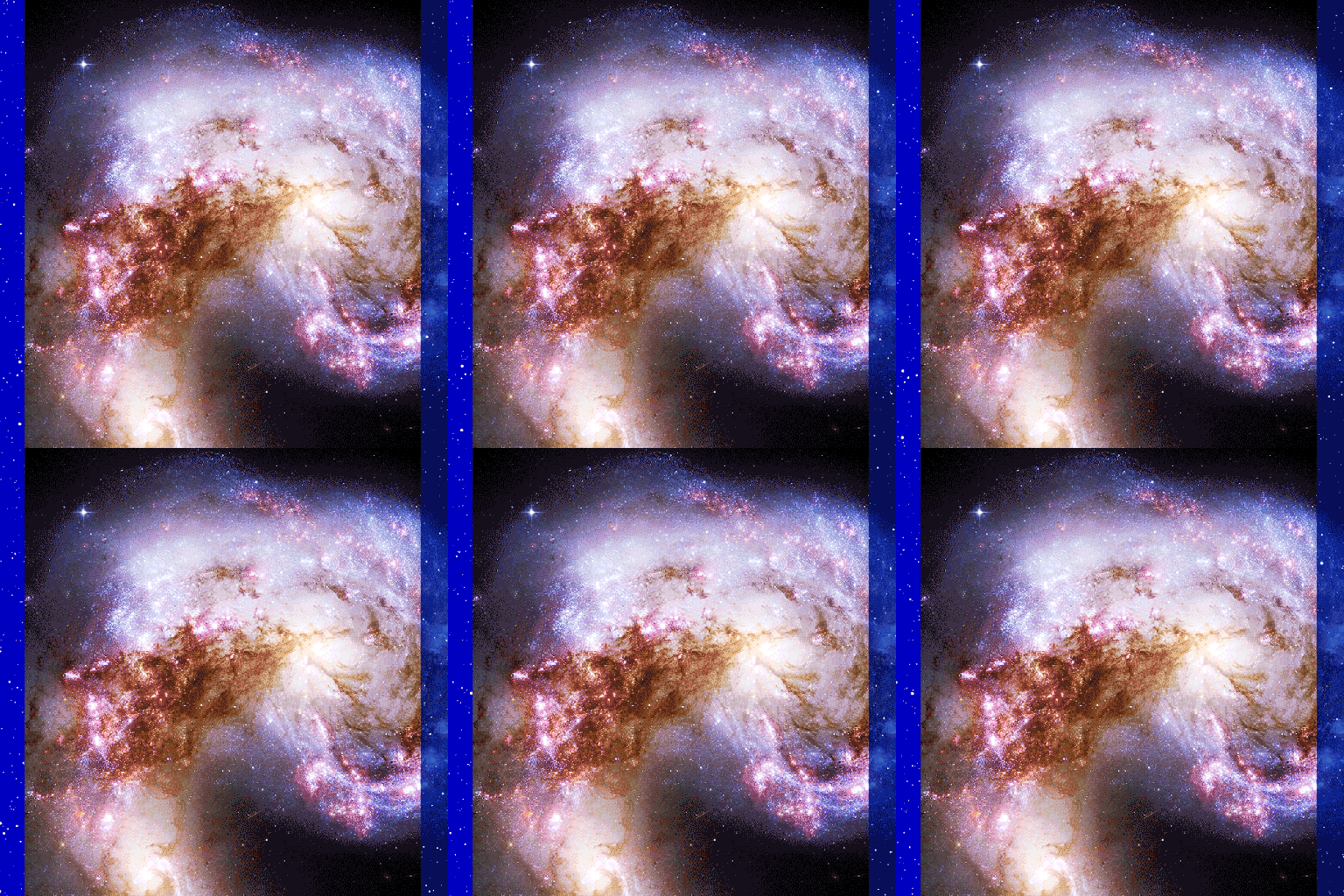
Today, the star-formation rate across the Universe is a mere trickle: just 3% of what it was at its peak. Here's what it was like back then.

Earth wasn't created until more than 9 billion years after the Big Bang. In some lucky places, life could have arisen almost right away.

As early as we've been able to identify them, the youngest galaxies seem to have large supermassive black holes. Here's how they were made.
For 550 million years, neutral atoms blocked the light made in stars from traveling freely through the Universe. Here's how it then changed.

Even after the first stars form, those overdense regions gravitationally attract matter and also merge. Here's how they grow into galaxies.
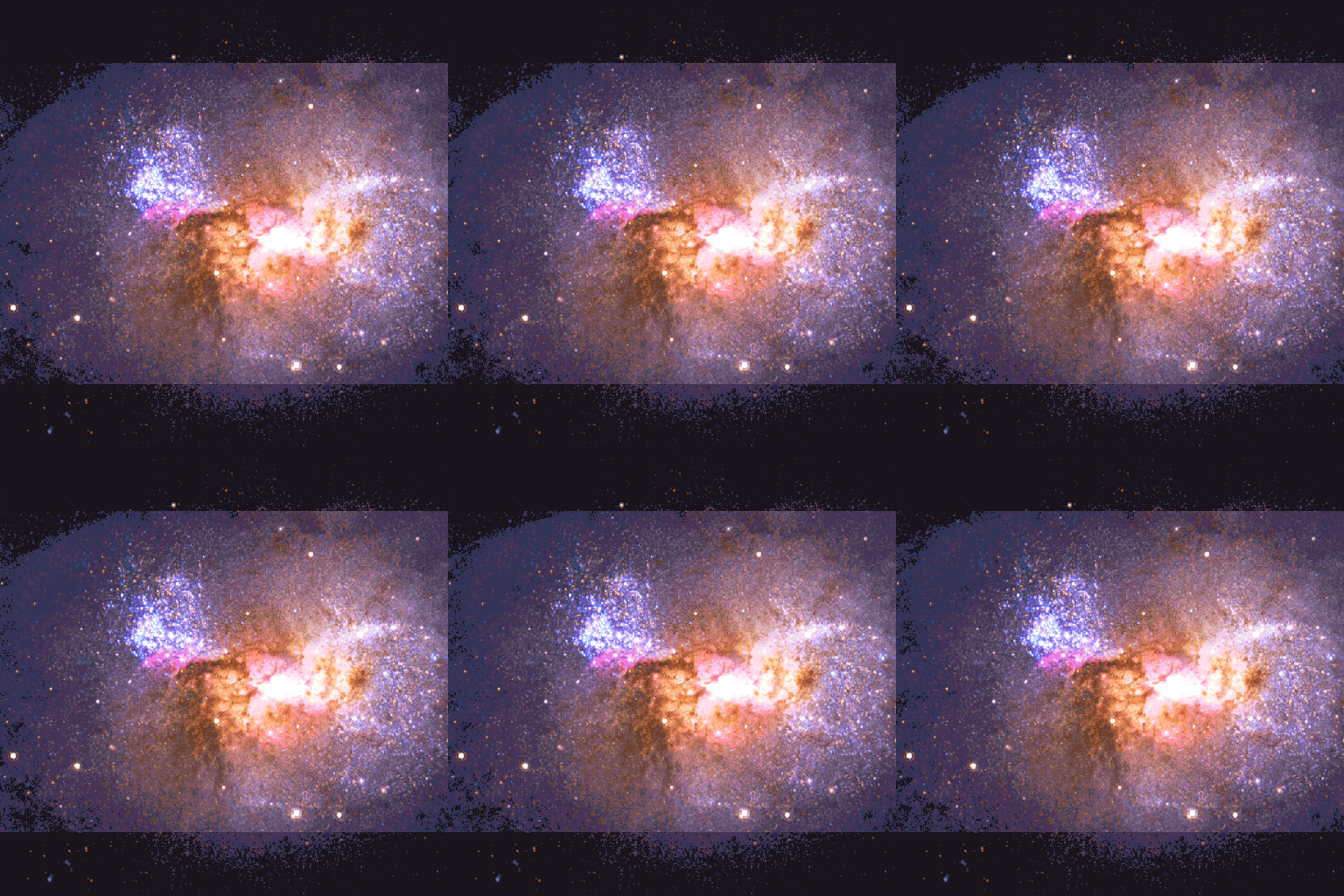
The first stars in the Universe were made of pristine material: hydrogen and helium alone. Once they die, nothing escapes their pollution.

The first stars took tens or even hundreds of millions of years to form, and then died in the cosmic blink of an eye. Here's how.

From how life emerged on Earth to why we dream, these unanswered questions continue to perplex scientists.

The Big Bang's hot glow faded away after only a few million years, leaving the Universe dark until the first stars formed. Oh, the changes!

The Universe is an amazing place. Under the incredible, infrared gaze of JWST, it's coming into focus better than ever before.

Misinformation was extremely popular in 2023, as bad science often made global headlines. Learn the truth behind these 10 dubious stories.

In our Universe, matter is made of particles, while antimatter is made of antiparticles. But sometimes, the physical lines get real blurry.

Atomic nuclei form in minutes. Atoms form in hundreds of thousands of years. But the "dark ages" rule thereafter, until stars finally form.
35mins
Kmele talked with a planetary scientist, a physicist, and a futurist, to understand how visionaries across disciplines are thinking about the future of our planet and humankind.