




















Search
Universe Expansion

After 15 years of monitoring 68 objects known as millisecond pulsars, we've found the Universe's background gravitational wave signal!

A cute mathematical trick can "rescale" the Universe so that it isn't actually expanding. But can that "trick" survive all our cosmic tests?

In a distant galaxy, a cosmic dance between two supermassive black holes emits periodic flashes of light.

As the Earth spins and wobbles on its axis and revolves elliptically around the Sun, each day changes from the last. "24 hours" isn't right.
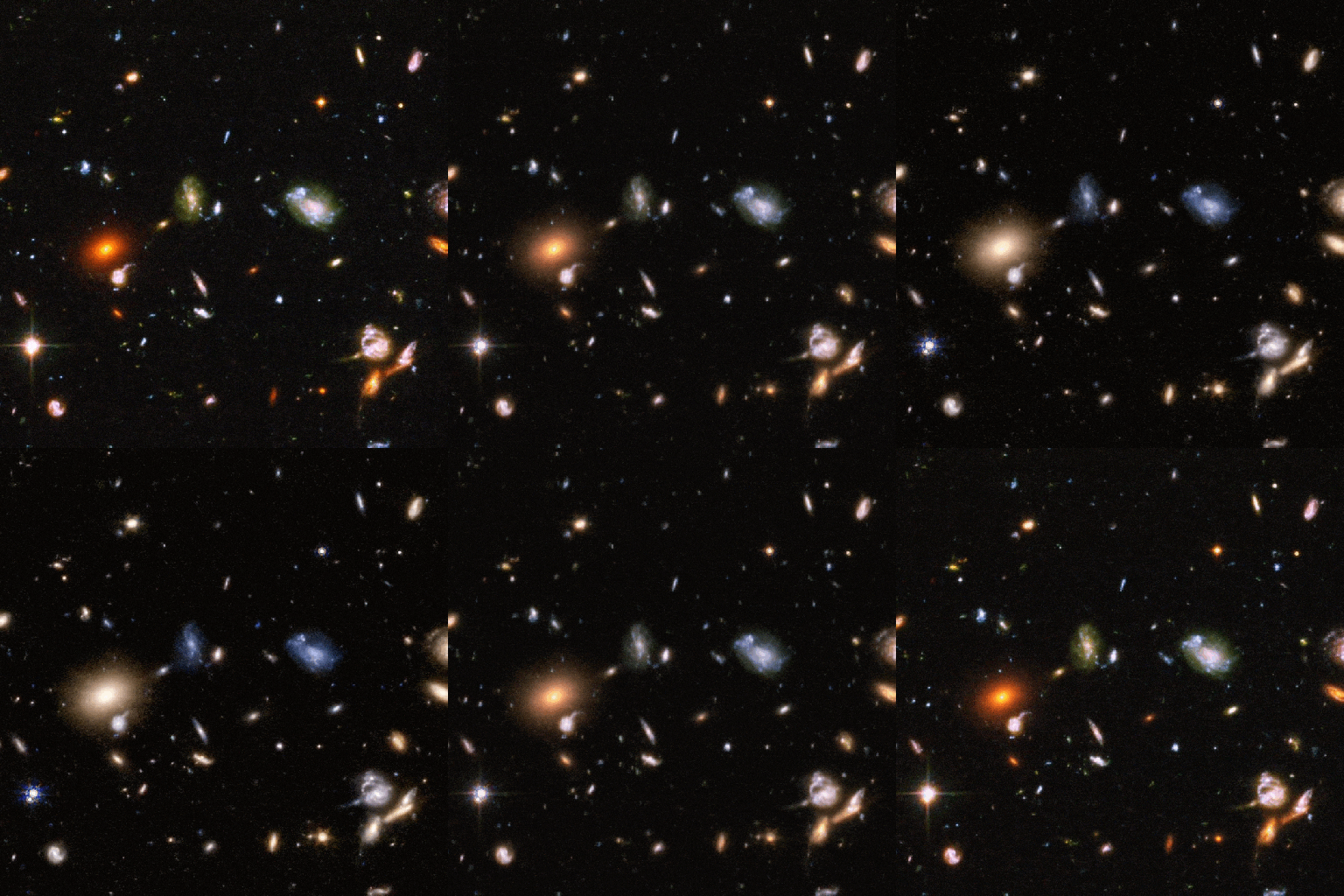
The farther away they get, the smaller distant galaxies look. But only up to a point, and beyond that, they appear larger again. Here’s how.

The multiverse pushes beyond the limits of the scientific method. From our vantage point in the Universe, we cannot know if it's real.

In many ways, we are still novices playing with toy models seeking to understand the stars.

In physics, we reduce things to their elementary, fundamental components, and build emergent things out of them. That's not the full story.

In a far-reaching discovery with astrophysicist Karolina Garcia, we discuss what's in the Universe and how it grew up.

If we waited long enough, would even protons themselves decay? The far future stability of the Universe depends on it.

What do the dark recesses of the early Universe and Zelda: Tears of the Kingdom have in common? More than you could have ever hoped for.

How are we to deal with the quantization of spacetime and gravity?

Up until 2002, we thought that the heaviest stable element was bismuth: #83 on the periodic table. That's absolutely no longer the case.

The brightest gamma-ray burst ever observed, GRB 221009A behaved in unexpected ways that might help us understand how they occur.

Sun-like stars live for around 10 billion years, but our Universe is only 13.8 billion years old. So what's the maximum lifetime for a star?

With hundreds of billions of stars burning bright, some galaxies are already dead. Their inhabitants might not know it, but we're certain.

There are 40 billion billion black holes in the universe. Here’s how our Solar System stacks up against ten of them.

Just by observing the tiny amount of deuterium left over from the Big Bang, we can determine that dark matter and dark energy must exist.

There is no such thing as a void in the Universe.

When Einstein gave General Relativity to the world, he included an extraneous cosmological constant. How did his 'biggest blunder' occur?

Gamma-ray bursts are so powerful they could vaporize the Earth from 200 light-years away. Recreating them in the lab is not easy.

Hubble showed us what our modern day Universe looks like. JWST's big goal was to teach us how the Universe grew up. Here's where we are now.

With no other galaxies in its vicinity for ~100 million light-years in all directions, it's as isolated and lonely as a galaxy can be.

There are two methods to measure the expansion rate of the Universe. The results do not agree with each other, and this is a big problem.

In 1974, Hawking showed that black holes aren't stable, but emit radiation and decay. Nearly 50 years later, it isn't just for black holes.

Particle physicists use gigantic accelerators to investigate the infinitesimal.

It's been 100 years since we discovered that the Universe was expanding. But if it's expanding, then what is it expanding into?

If our Universe were born a little differently, there wouldn't have been any planets, stars, galaxies, or chemically interesting reactions.

Perhaps the whole Universe is the result of a vacuum fluctuation, originating from what we could call quantum nothingness.

A surprising JWST discovery around Fomalhaut has a different, superior explanation: not a great dust cloud, but a mere background object.