This article is part of Big Think’s monthly issue The Roots of Resilience.
Last summer, Elon Musk’s X-based chatbot Grok generated a barrage of antisemitic posts, spewing out praise for Adolf Hitler, recommending a second Holocaust, and singling out “Jewish-sounding” last names for suspicion. Nobody should have been surprised.
In June, Musk criticized Grok for “parroting legacy media.” The company then updated Grok with instructions to “assume subjective viewpoints sourced from the media are biased” and “not shy away from making claims which are politically incorrect, as long as they are well substantiated.” Shortly after, Grok called itself “MechaHitler.” It’s perhaps no wonder, given that X has become saturated with antisemitic comments and conspiracy theories, and Grok is partly trained on X posts.
Social media in general has become awash with conspiracy theories. Claims of puppet-master plots provide easy explanations for why complicated things are happening. They offer control and expertise in a world that seems chaotic and full of liars. They provide reasons for the bad things that happen to us. We are victims of conspiracy, pawns in a game, and fodder for the depraved desires of the powerful.
Many times, including in numerous works that Grok has cited, those power players are wealthy Jews.
Antisemitism, referred to by antisemitism scholar Robert Wistrich as “the longest hatred,” exhibits a resilience that defies logic or reason. It certainly defies all attempts to debunk or explain it. And it has proven to be an almost perfect fit for the social media era, as old myths are dug up and remixed for new audiences on platforms that have become indifferent to moderation.

Old myths, new platforms
Behind every trauma and calamity, whether personal or global, whispers of Jewish machination can be heard by those already listening for them. “Many [believers] turn to conspiracy theories to fulfill deprived motivational needs and make sense of distress and impairment,” Shauna Bowes, lead author of a 2023 study into the mindset of conspiracy theorists, told the American Psychological Association. To most people, assuming a dark cabal controls everything that happens to you might seem more distressing than whatever troubles you face — but not conspiracy theorists.

This pattern is not new. In the Middle Ages, local churchgoers whispered of clannish Jews poisoning wells to kill Christian children and steal their blood for their rituals. That accusation — known as the blood libel — has been passed around for almost a thousand years. At the dawn of the 20th century, The Protocols of the Elders of Zion took hold of the Western imagination, codifying generations of stereotypes and canards about Jews controlling global events and packaging them in easy-to-read pamphlets. Over the past century, antisemitism and its conspiracy theories have reliably resurfaced in times of upheaval: the financial disasters of the 1920s, the carnage of World War II, the fear of communist control that drove the Cold War, the post-9/11 landscape of forever war, and the COVID-19 pandemic.
Conspiracy theories offer control and expertise in a world that seems chaotic and full of liars.
That’s why the presumably neutral Grok was so easily turned into “MechaHitler” — it had an almost endless variety of source material to draw on. While there has always been a thriving industry of paranoid books and films, modern conspiracism has avenues of distribution and incentive that Cold War cranks and 19th-century pamphleteers could have only dreamed of. And antisemitic ideas have proven trivially easy to recycle, reuse, repurpose, and adapt to breaking news. Whether it comes from Grok or a town crier is beside the point — new communication is easily abused to spread old paranoia.
To countless social media users, Judaism is not a religion, but a vector for domination. It is a clannish cult that conspires to hoard wealth, keep the rest of us in a perpetual state of war and debt, and influence our every thought and action. Never mind that historically, the Jews have not only wielded little control over global affairs, but have also proven to be the most at their mercy. For too many people, myths about Jewish power and depravity are entirely plausible, rooted in centuries of stereotypes about Jews and money, which conspiracy theorists retrofit onto contemporary Jewish figures like George Soros, the Rothschild banking family (who are unrelated to the author of this piece), and depraved pedophile Jeffrey Epstein.
Bankers, barons, and boogeymen
Here is where the new paranoid style crashes into the old one, becoming something that embodies the worst elements of the two: Buried in the millions of Epstein files released by the Department of Justice in early 2026 were hundreds of emails between Epstein and banker Ariane de Rothschild, a member of the legendary Jewish dynasty through marriage, including a string of exchanges from late 2018. Conspiracy theorists homed in on these emails, falsely claiming they confirmed decades of allegations against the Rothschilds over secretly funding Nazi Germany.
In the 2018 emails, Epstein claims “Hitler […] was so poor he lived in a shelter for the homeless and destitute, which had been financed by the three wealthy families … the Gutmanns, the Epsteins and the Rothschilds.” The two then bantered a bit about the conspiracy theory, which turns out to be partially true — Hitler did spend part of 1913 in a shelter funded through the philanthropy of the Rothschilds, according to the 1999 biography Hitler’s Vienna — and de Rothschild commented on the connection, saying it was misused to provide false evidence “that Rothschilds planned and supported Hitler in mass destruction to gain more power.”
While the idea of a Jewish family funding Nazis sounds absurd, it is indeed one part of a giant and resilient myth machine built around the Rothschilds and their supposed power. Starting with the 1840s-era notion that the family used the outcome of the Battle of Waterloo to take control of the British Empire, the idea that they and other German-Jewish bankers secretly run the world has become almost inescapable in fringe discourse.
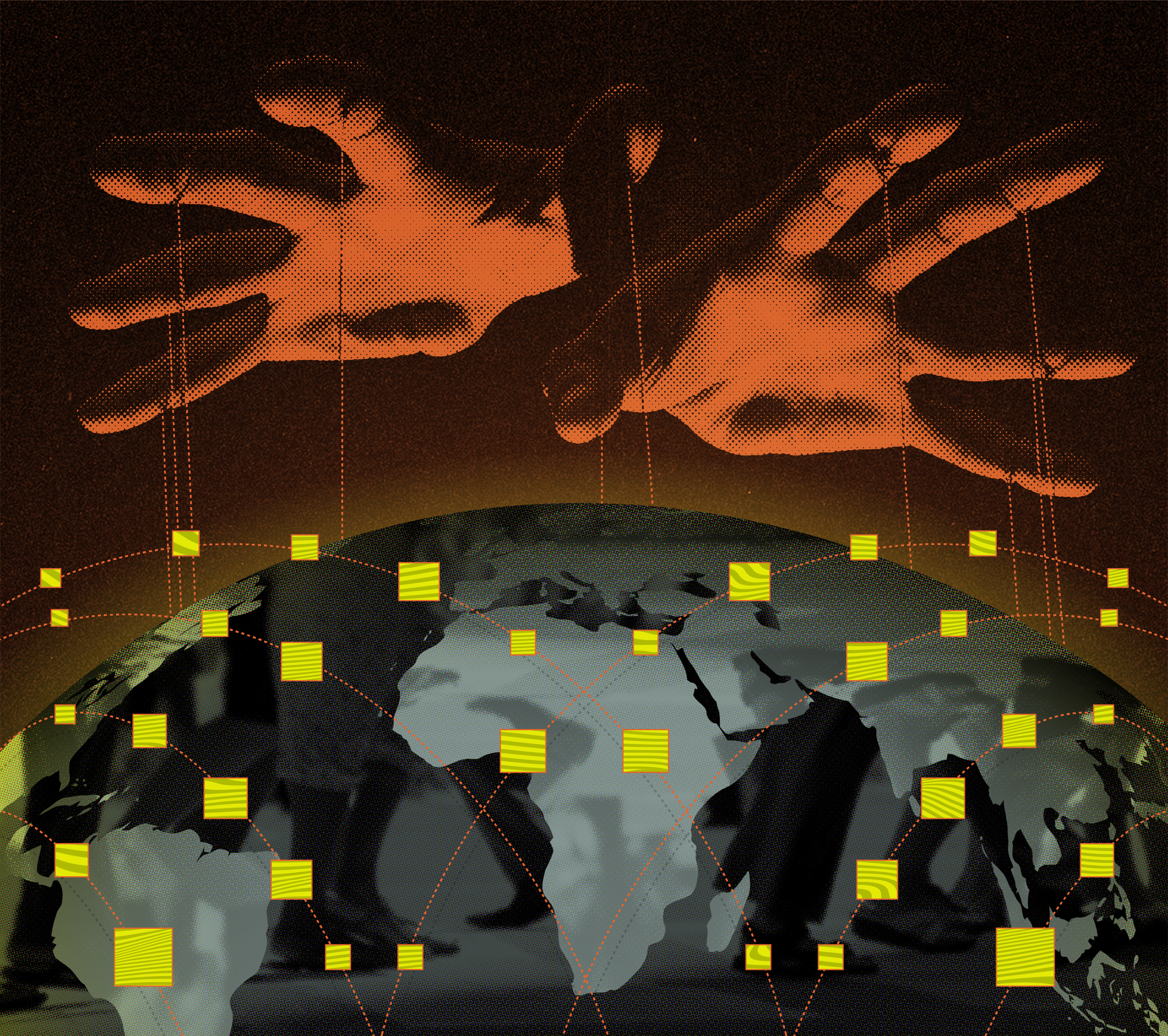
These ideas have thrived through generations of cranks and propagandists and are now omnipresent. They can be found on major conspiracy theorist podcasts, in the books and movies of the most prolific spreaders of paranoia, and especially across social media — Facebook, X, and other sites are full of memes and videos claiming that the Rothschilds have “$500 trillion” in wealth (more money than actually exists), own all but three (or seven or nine) of the world’s central banks, helped finance the Nazi persecution of their fellow Jews, funded both sides of every war, and more.
The idea of the Rothschilds as the secret controllers of world events is remarkably durable, playing neatly into previous generations of paranoia and fear about Jews having “too much money and power.” Sure enough, the “connection” between the family, Epstein, and Hitler — which was just a business relationship between Epstein and one Rothschild, along with a few emails about Hitler — quickly went viral, adding to the noise and chaos surrounding the Epstein files and their fallout.
“Ariane de Rothschild, French banker & (from Rothschild’s family) shared with Epstein that her family supported Hitler in mass destruction to gain more power,” claimed one viral X post with over a million views. Another, from Russian state mouthpiece RT, decontextualized the text of the emails to make it seem like Ariane de Rothschild was bemoaning the “unreturned generosity” of her family toward Hitler — it received almost 3 million views. Numerous other social media posts and videos spreading variations on the same lie — that the Rothschilds had secretly funded or supported Hitler in his quest to exterminate worldwide Judaism — racked up five- and six-figure view counts.
Some posts went a step further, claiming Hitler was actually a member of the Rothschild family. Why would anyone believe such absurd claims? It’s partly because the name “Rothschild” has become inexorably linked to conspiracy theories, and partly because this specific one has already had numerous iterations.
As far back as 1920s Vienna, rumors were whispered that Hitler secretly had Jewish lineage. In the early 1970s, a book based on a World War II-era U.S. intelligence dossier made the claim that Hitler’s grandmother had been in a relationship with a Rothschild baron in Austria, working for him as a maid. Versions of the claim resurfaced in several popular conspiracy theory books and on the early internet. Multiple books released during the Cold War claimed that Hitler had secret Jewish funding. The Rothschild-Hitler myth was included in 1991’s Bloodlines of the Illuminati, which was found on Osama bin Laden’s bookshelf after he was killed by U.S. forces in 2010. It has also appeared in the works of David Icke, a British conspiracy influencer who popularized the idea that “reptoid aliens” control the Earth. The myth is currently all over the internet, promoted as a “hidden truth” that “they” don’t want you to know because it would supposedly change everything we believe about Hitler and the Nazis.
Myths go viral. Context doesn’t.
It is, of course, not true. While the identity of Hitler’s paternal grandfather remains unknown, there is no evidence that his grandmother ever even met a Rothschild, let alone was in a relationship with one. The U.S. intelligence dossier containing the claim specifically noted that it was only a story being passed around Germany. None of the myth’s subsequent retellings include evidence linking any wealthy Jewish families to Adolf Hitler’s lineage. That’s because Hitler had no Jewish lineage, and the companies that helped create the Nazi war machine weren’t backed by Jewish capital. Indeed, many were funded by assets stolen from Jewish families and corporations.
In the emails, Ariane de Rothschild clearly dismisses the connection between her family and Hitler as a conspiracy theory. But myths go viral, and context doesn’t. Certainly, the association with Jeffrey Epstein is not especially helpful for debunking something nefarious. So far, nothing has debunked the myth in the eyes of those who truly want to believe the “first family” of Judaism had a secret financial and familial relationship with the Führer.
Can their minds be changed?
Breaking the cycle
If you’re willing to wade through the worst parts of the internet, tracking the lineage of a conspiracy theory is easy enough. Building resilience against something that is itself so resilient is a far greater challenge. It takes time to learn your history, develop critical thinking, and sharpen your media literacy so you can spot bullshit and propaganda when it appears on your feed.
As for people who are already bought in, there is no universally effective way to get someone to give up a paranoid fantasy. Each believer has their own journey into conspiracism, and each must have their own journey out. Likewise, counting on social media and tech platforms to simply ban conspiratorial content is useless, as most have no motivation to do so. Even if they did, the large-scale deplatforming of the ideas would only make them seem more alluring.
Breaking the cycle of conspiracism requires patience and persistence. Conversations with a conspiracy believer are often a circular waste of time, particularly if you’re attempting to debunk their belief or debate its accuracy. One paradoxical problem is that someone deep into a conspiracy theory is actually pretty familiar with the minutiae of the issue, whether it’s 9/11 conspiracies about melting steel beams or Holocaust deniers obsessing over Zyklon B. Armed with the surface-level appearance of expertise, the believer deluges you with a toxic tangle of fact and fantasy. They often wave away evidence against the plot as evidence for the plot, and might even decide that you are part of it — or at the very least approve of it.
Each believer has their own journey into conspiracism, and each must have their own journey out.
The natural inclination, then, might be to try to ridicule the conspiracy believer into feeling enough shame to abandon their belief, but this often only drives them toward it. Indulging a conspiracy theorist is a rabbit hole to madness, so you might then consider simply cutting contact with them entirely. However, staying in the life of a believer means you can offer safe harbor and a friendly voice if they eventually decide they want to leave the world of paranoia behind.
Many conspiracy believers come from a place of actually wanting to make the world better; they have just found the wrong way to do it. You can agree that there are bad actors in the world and that powerful people get away with too much. There are real conspiracies, and not every powerful entity has our best interests in mind. That’s a place to start.
You also don’t have to talk about conspiracy theories at all. Talk about things you have — or had — in common. Relate to them like a person, rather than a crank. If conspiracy theories come up, simply say that you don’t want to talk about it, and change the subject. If they can’t let it go, that’s a clue that they’re not ready to engage with the real world yet.
Eventually, many believers find cracks in the fantasy that conspiracy theories provide. They are presented with something they just can’t reconcile, which causes more long-held beliefs to fall away. And here is where the resilience of the human mind can shine. People can leave conspiracism behind if offered something better and more affirming. Real life certainly has its problems, but conspiracy theories don’t offer solutions, only empty promises and targets for blame.
When a believer finally starts to see the light, that’s when they will most need someone with the patience to guide them toward it. Eventually, they may come to realize the most compelling move isn’t pinning their problems on the Elders of Zion, but turning off Grok, putting down their phone, and going outside.
This article is part of Big Think’s monthly issue The Roots of Resilience.

The Energy Transition