AI is, I’m both intrigued and a bit terrified to say, seemingly everywhere. Including in my head, where it’s occupying prime mental real estate as I ponder how to best engage with this evolving technology. What to start doing. What to stop. How to keep pace. When to freak out.
I don’t have definitive answers — for myself or anyone else. But I’m lucky enough to work for Big Think+, a company that produces thought-provoking leadership training by interviewing subject-matter experts in a variety of fields. I’ve learned a ton just by immersing myself in their teachings. (My old boss used to describe this as pursuing a mini-MBA via osmosis.)
So here, informed by listening to these experts, are some questions I’m asking — and reasking — myself as I think about how our L&D department should partner with AI to create high-quality, trustworthy learning content.
1. Do you just want the product, or do you also want the process?
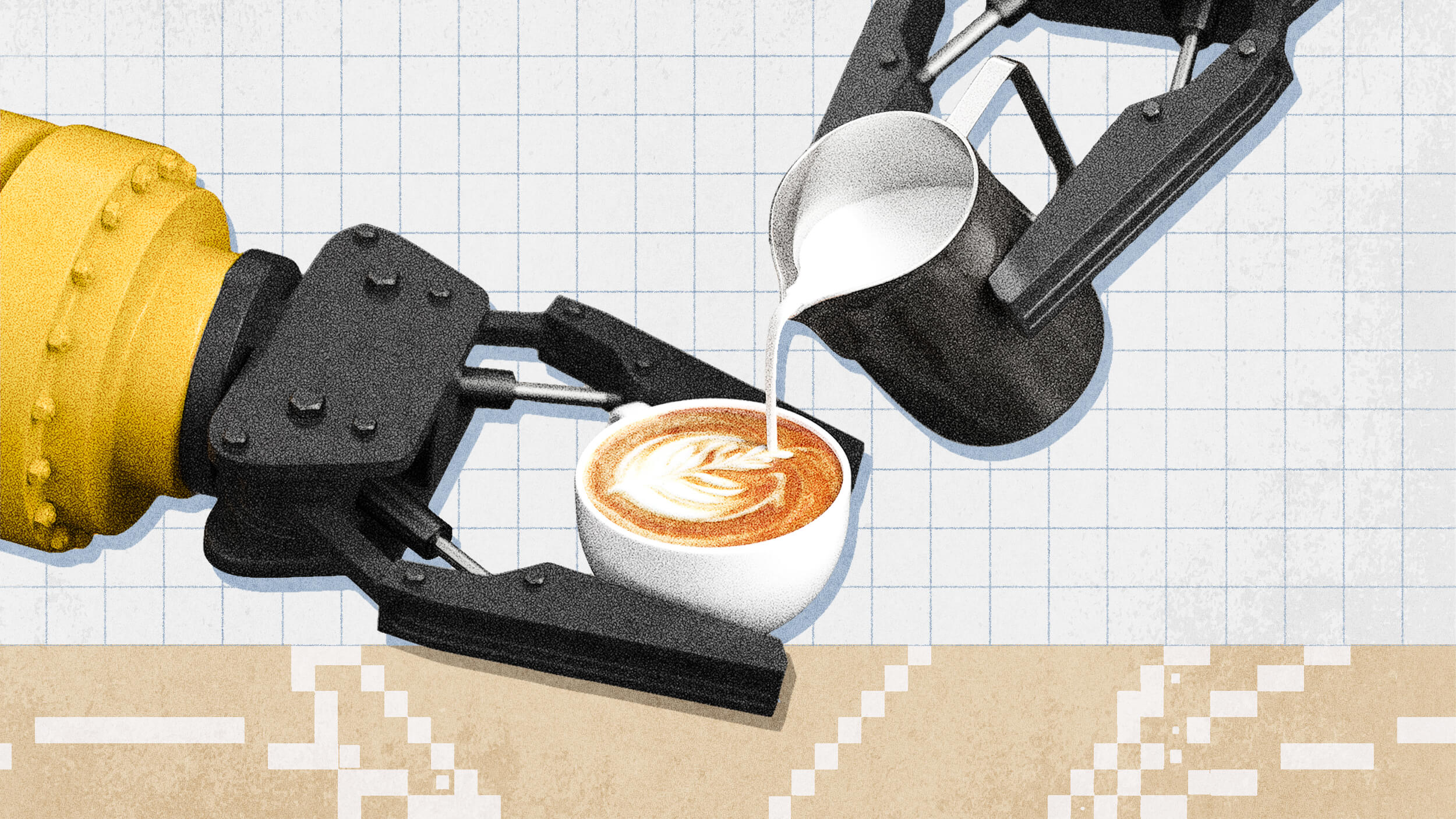
Need a memo? AI can draft it. Want a pie chart? AI can draw it. Looking for a quick prototype? As long as it’s digital, AI can probably generate it. And fast.
But should you let it?
Professor Ethan Mollick seeded this question for me when he came in to discuss his book Co-Intelligence: Living and Working with AI and said the following:
“Whenever you consult anyone about anything, you immediately go through the mental process of anchoring on that idea or concept. The same danger happens with AI. The AI does a piece of writing for you. You might say I’m going to edit it, but it’s going to be very different than if you started on your own. You’re going to have to make choices.”
So this is partly a question of ownership: How much do you want to be in the driver’s seat for this particular journey? And how much are you okay ordering up the productivity equivalent of an Uber to handle the navigation for you?
But there’s a longer-term impact to consider. As technologist Kiara Nirghin captured in an article she wrote for Freethink (Big Think’s sister brand), research suggests that repeatedly ceding a task to AI can degrade your ability to perform it. Which makes sense. We tend not to get better at jobs we outsource; we often get worse. Because the process of doing things — especially hard things — is how we learn and grow.
The takeaway for me? If a skill is ancillary to your role, by all means, see if AI can do it. But if that skill is core to your profession, you (and your team members) are probably better off holding onto at least a piece of it, even if you use AI to expedite the execution.
For instance, I consider the process of writing to be core to my ability to sequence and elucidate instructional material. So I flexed those muscles by drafting this article myself. But I used my AI buddies to critique and tighten the copy. They caught many-a-dumb typo.
2. What value are you adding?
At a recent conference, I browsed the vendor hall and talked with companies who’d built AI into their authoring tools. Need a course shell? A syllabus? A handout? Just enter a quick prompt and press the magic button.
Except … why would anyone pay for that? Why wouldn’t they just cut out the middleman, go straight to one of the large language models most of these tools are based on, and get the content they need directly from the source? ChatGPT’s customer-facing offerings can generate handouts too, and likely for a fraction of the price.
Cue Robert Kaplan, vice chairman of Goldman Sachs. He spoke to us several years ago, but his views on leadership hold up, especially regarding vision:
“Vision is ‘How do you add value to others, based on what clear, distinctive competence?’ If you want to be a leader, you need to be asking that question constantly about your business. ‘How do I add value to customers or clients? And in order to do that, based on what clear, distinctive competence? What do I need to be great at?’”
To me, this means you can absolutely use AI to help produce a marketable L&D product. But you have to apply your distinctive competence to the process (probably by applying those core professional skills you’re taking care to maintain).
At Big Think+, we consistently hear from clients that developing compelling, video-based microlearning is our distinctive competence. That starts with humans, not AI. Our pre-production team adds value by using their industry knowledge to identify and book credible experts; our video editors add value by using their cinematography training to craft compelling lessons; our instructional designers add value by using their pedagogical backgrounds to scaffold the lessons and architect supporting assets.
AI augments our workflow — by generating transcripts, captions, potential titles, etc. — and helps us iterate. But it doesn’t do all the work. As a result, the videos can’t be replicated by a single prompt, no matter how competent. They’re distinctly Big Think+.
3. How should you credit AI?
This one’s the trickiest for me. Pre-AI, if I found out someone used a ghostwriter to draft and polish their book, I generally didn’t rate it as highly as a “true” author’s original work. But I at least knew that whatever insights it contained came from a human.
Nowadays, AI can be everyone’s ghostwriter. (Or ghost instructional designer.) That doesn’t mean the resulting insights are bad. But the more new content I consume, the more I find myself wanting to know whether I’m connecting with another person or not.
When historian Yuval Noah Harari sat down with Big Think+, he framed this issue of attribution in existential terms — as a means of preserving democratic conversation:
“The same way we have a ban on fake money to protect the financial system, we need to ban bots from the conversation. We need to ban fake humans. AIs should be welcome to talk with us only if they identify as AIs.”
I agree. But when it comes to everyday output, where do we draw the line? When does AI stop being a tool and start being a co-author deserving of co-billing? (Or at least acknowledgement?)
Reasonable people can disagree here, and I’m open to suggestions. But I plan to err on the side of over-attributing. My current test is to ask myself, “If I were a learner, and I belatedly discovered that this piece of content was AI-generated, would I feel misled? Would I trust the Big Think+ brand a little less?” If the answer is yes, then I think we should disclose and describe AI’s involvement.
But to continue delivering credible, high-impact learning, we’ll keep centering human experts — including artists like “King” Willonius Hatcher, whose AI-optimism spurs me to get out of my head and turn my questions into experiments. Here’s his take:
“One of the beauties of these AI tools is you now can just be anything that you dreamt of being. You can be a DJ, you can be a chef, you can code. Are you going to be the best coder in the world? Probably not, but you can get started.”
Want to learn how? (And inform your thinking about AI and other topics?) Get a subscription for your organization to full classes from King Will, Ethan Mollick, Robert Kaplan, Yuval Noah Harari, and other experts at https://redesign.bigthink.com/plus/.
Executive Producer and Managing Director, Instructional Design | Big Think+

The Energy Transition