




















Search
Science & Tech
Explore the discoveries that reveal how the world works, alongside the technologies that extend, reshape, and sometimes challenge what’s possible.

With the right material at the right temperature and a magnetic track, physics really does allow perpetual motion without energy loss.

When the Hubble Space Telescope first launched in 1990, there was so much we didn't know. Here's how far we've come.

1hr 3mins
“The public really doesn't realize that they are much closer to CIA spies than they think they are.”

Once you cross a black hole's event horizon, there's no going back. But inside, could creating a singularity give birth to a new Universe?

Welcome to The Nightcrawler — a weekly newsletter from Eric Markowitz covering tech, innovation, and long-term thinking.

10mins
“Invention matters, but implementation matters more.”

From high school through the professional ranks, physicists still take incredible lessons away from Newton's second law.

No matter what it is that we discover about reality, the fact that reality itself can be understood remains the most amazing fact of all.

In "Dinner with King Tut," Sam Kean examines how a burgeoning field is recreating ancient tasks to uncover historical truths.
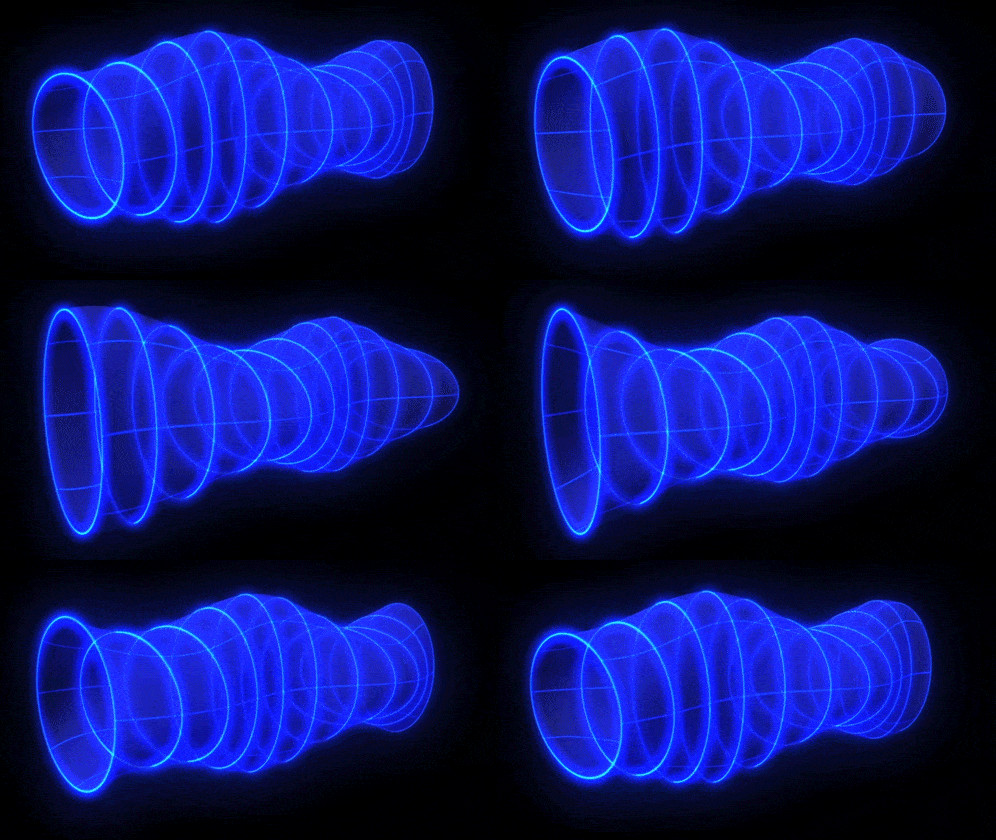
With over 300 high-significance gravitational wave detections, we now have a huge unsolved puzzle. Will we invest in finding the solution?

From Apple to Airbnb to OpenAI the generalist mindset has been an invaluable source of advantage — and we can all learn from these successes.

Will we build a successor collider to the LHC? Someday, we'll reach the true limit of what experiments can probe. But that won't be the end.

1hr 18mins
“Could black holes be the key to a quantum theory of gravity, a deeper theory of how reality, of how space and time works?”

By inviting players to tackle real scientific problems, games can offer a hand in solving medicine’s toughest challenges.

In "After the Spike," Dean Spears and Michael Geruso show why policy, rather than high population density, has the most significant impact on the environment.

Welcome to The Nightcrawler — a weekly newsletter from Eric Markowitz covering tech, innovation, and long-term thinking.

13mins
"We've sent out one or two little messages, but we certainly aren't investing billions of dollars shouting out into the cosmos saying, "Hey, we are here. Come say hi.""

65 million years ago, a massive asteroid struck Earth. Not only did Jupiter not stop it, but it most likely caused the impact itself.

Can the top quark, the shortest-lived particle of all, bind with anything else? Yes it can! New results at the LHC demonstrate toponium exists.

First 'Oumuamua, then Borisov, and now ATLAS have shown us that interstellar interlopers are real. Here's what the newest one teaches us.