This artist's illustration shows an electron orbiting an atomic nucleus, where the electron is a fundamental particle but the nucleus can be broken up into still smaller, more fundamental constituents. The simplest atom of all, hydrogen, is an electron and a proton bound together. Other atoms have more protons in their nucleus, with the number of protons defining the type of atom we're dealing with. Electrons and atomic nuclei that are bound together into neutral atoms have slightly less mass than free electrons and nuclei in unbound states.
In our physical reality, the idea of something being “fundamental” is that it’s indivisible and not made up of smaller or more elementary entities: a concept that’s thousands of years old.
We didn’t arrive at our first candidates for what “elementary” truly is until the discovery of the atom, and it was only decades later that subatomic particles were discovered as well.
Today, we know of many different species of fundamental particles, but they still don’t explain everything that must exist in the Universe. Here’s how far we’ve come, with plenty of work still ahead of us.
An astrophysics column on big questions and our universe.
In order for life to emerge within the Universe, the chemical precursor ingredients need to be delivered to an environment where life can arise, sustain itself, and thrive. This cannot happen until the elements required for life, including carbon, nitrogen, oxygen, and phosphorus, exist. None of them were created in the hot Big Bang, only later on in the interiors of their stars and through physical processes arising from their life and death cycles.
In antiquity, many opined about “the elements” in combination.
It used to be thought, more than 2500 years ago, that there were fundamental “elements” to the Universe that combined to make everything up. These elements varied from culture to culture and philosopher to philosopher, often including fire, water, ice, air, wind, acid, lightning, earth, and metal, along with several others. It was not until the development of modern chemistry in the late 1700s that we began to better understand the fundamental nature of matter.
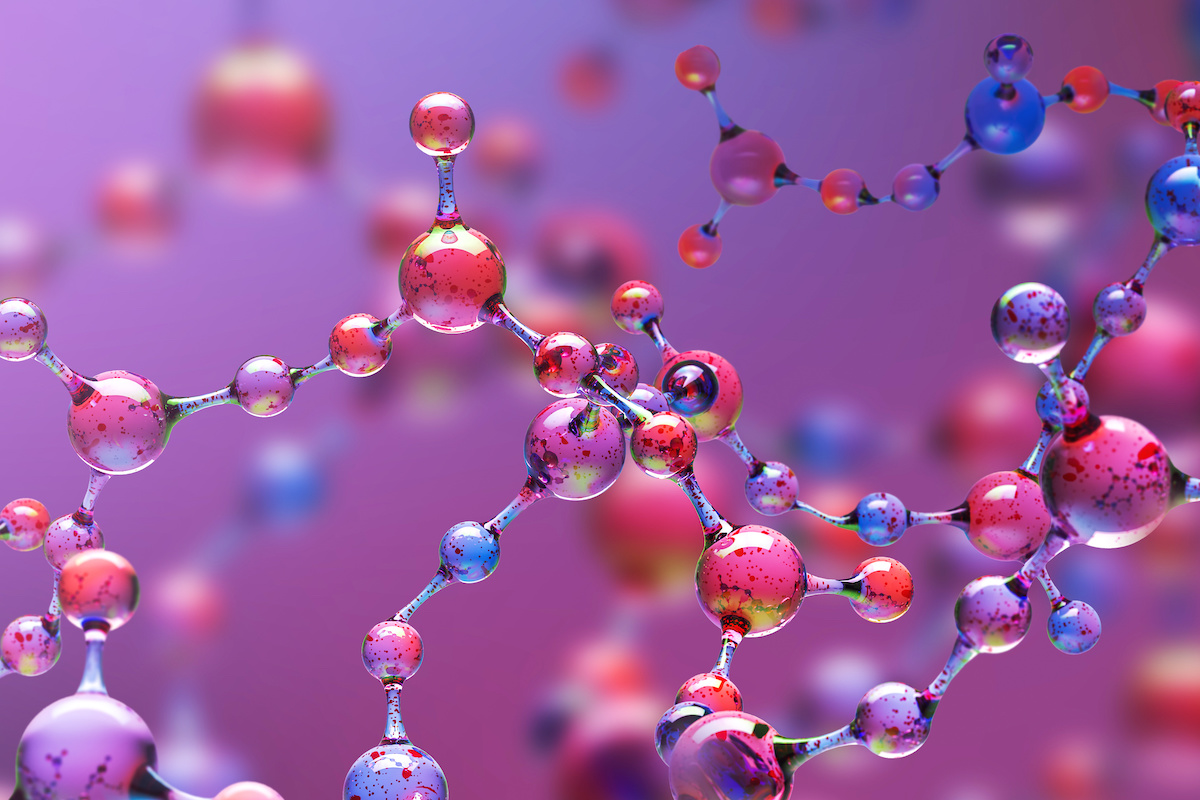
Molecules, examples of particles of matter linked up into complex configurations, attain the shapes and structures that they do owing primarily to the electromagnetic forces that exist between their constituent atoms and electrons. The variety of complex and intricate structures that can be created from only a few fundamental building blocks is almost limitless.
Although, at a fundamental level, the Universe is made up of point-like quantum particles, they assemble together to create objects of finite sizes and masses, occupying specific amounts of volume. This artist’s illustration shows several electrons orbiting an atomic nucleus, where the electron is a fundamental particle, but the nucleus can be broken up into still smaller, more fundamental constituents. Whether there are structures on scales smaller than the presently known subatomic particles remains to be discovered.
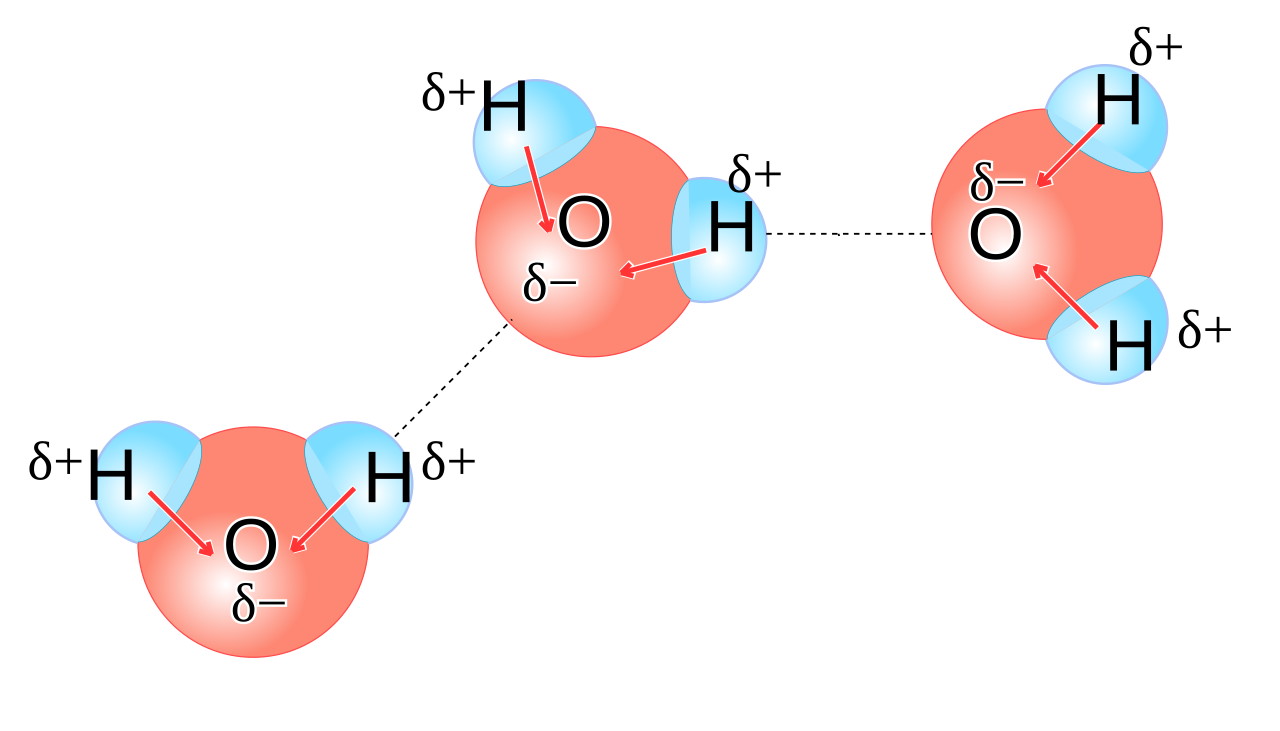
This drawing illustrates the interactions of water molecules with one another. Water is a V-shaped, highly polar molecule, possessing a negatively charged side (where the oxygen atom is) and positively charged ends where the hydrogens are. Neighboring water molecules interact with one another by way of hydrogen bonds, depicted with dotted lines in this drawing. Hydrogen was discovered in 1766 by Henry Cavendish, while oxygen was discovered in 1774 by Joseph Priestly.
Credit: すじにくシチュー/Wikimedia Commons, modified by E. Siegel
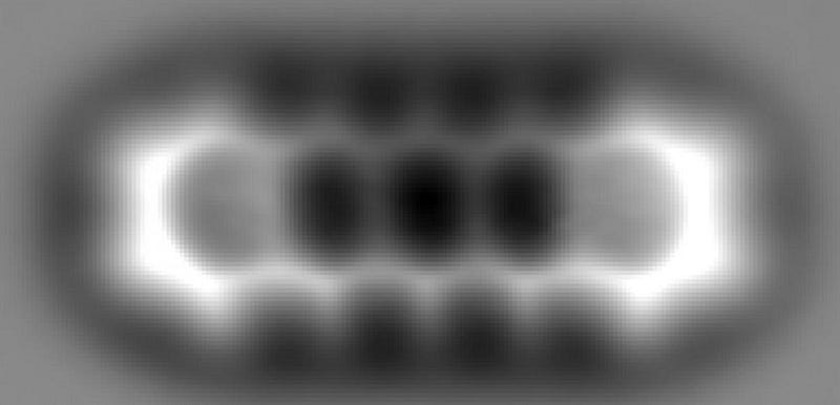
A pentacene molecule, as imaged by IBM with atomic force microscopy and single-atom resolution. This was the first single-atom image ever taken, which took advantage of a new technique called in situ functionalization of the tip of the force probe. Although atoms had been theorized for thousands of years, they were not directly observed, individually, until 2009.
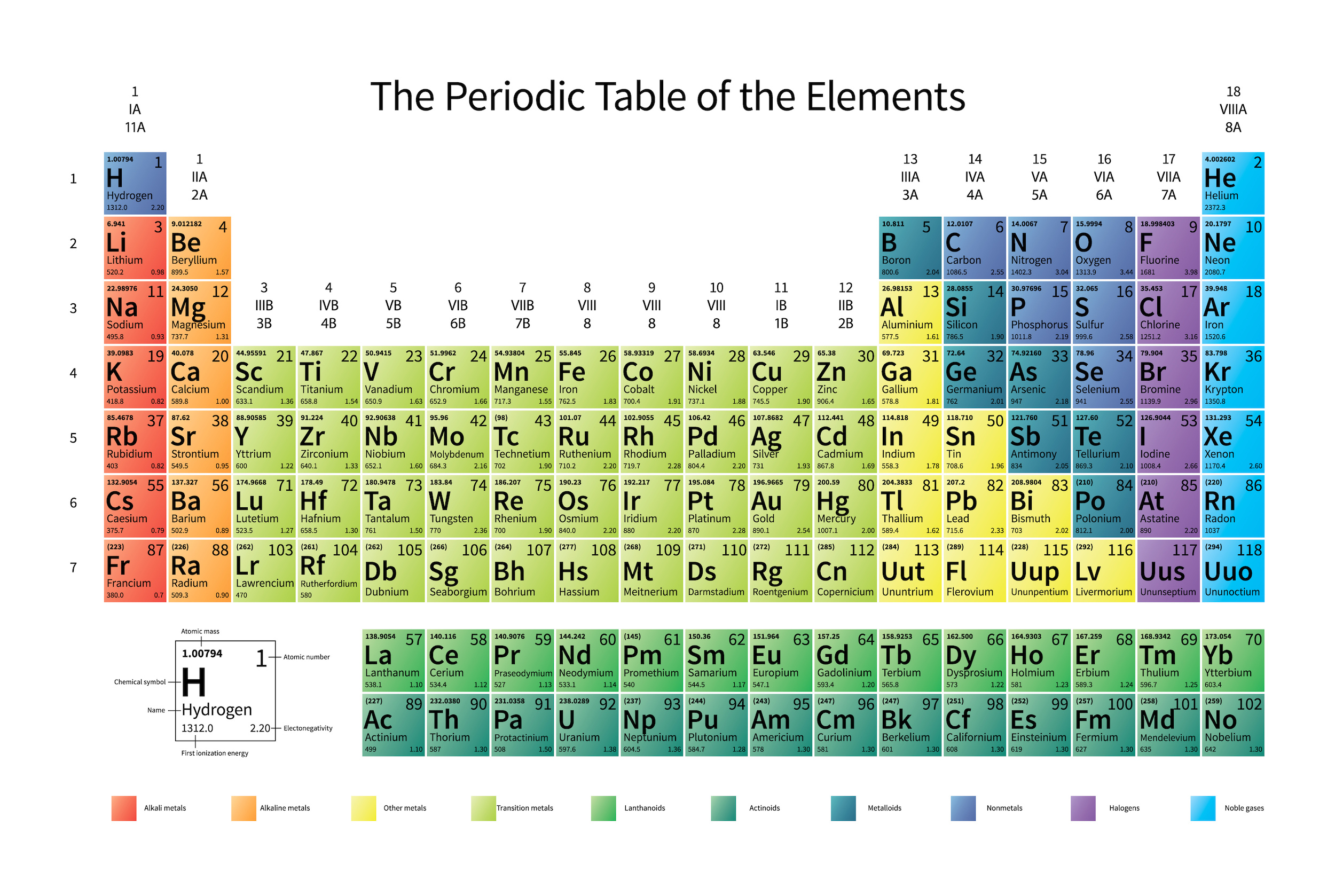
The periodic table of the elements is sorted as it is (in row-like periods and column-like groups) because of the number of free/occupied valence electrons, which is the number one factor in determining each atom’s chemical properties. Atoms can link up to form molecules in tremendous varieties, but it’s the electron structure of each one that primarily determines what configurations are possible, likely, and energetically favorable.
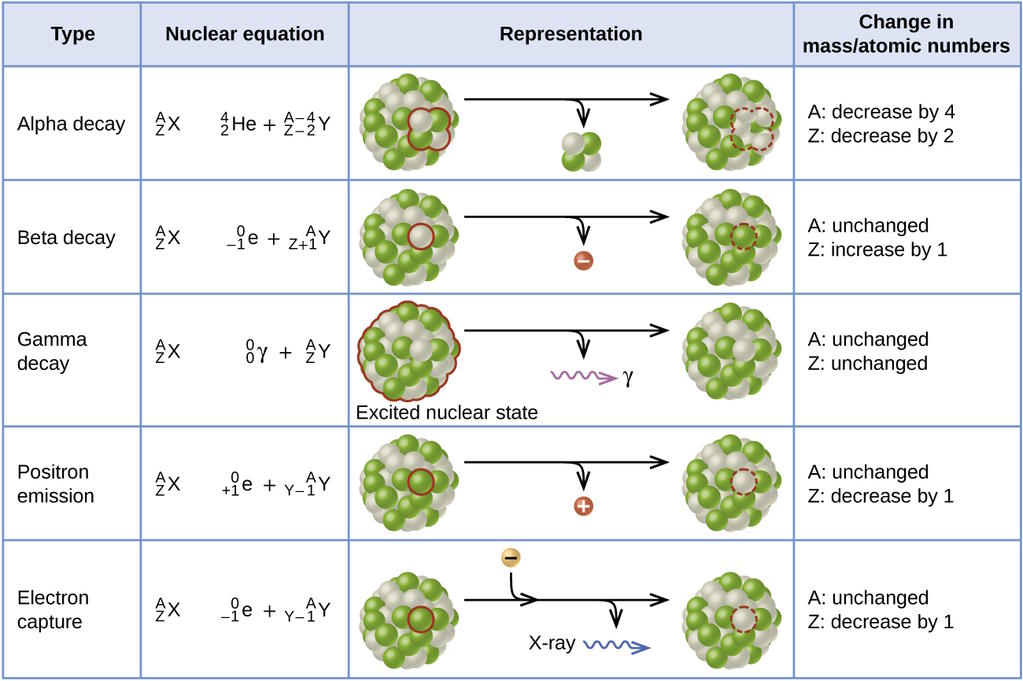
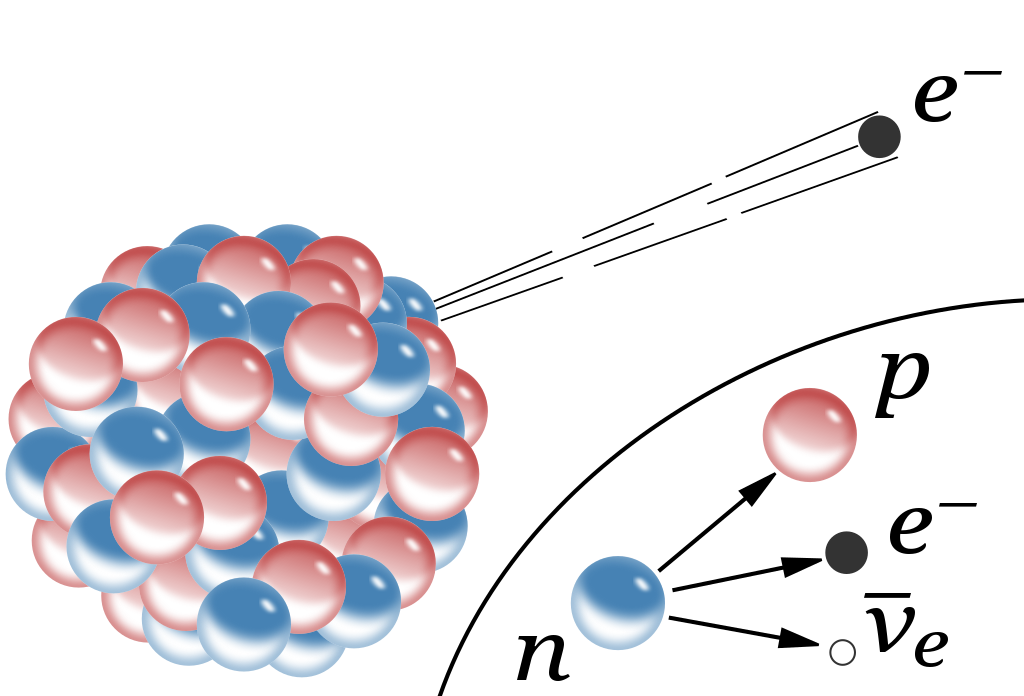
This illustration shows 5 of the main types of radioactive decays: alpha decay, where a nucleus emits an alpha particle (2 protons and 2 neutrons), beta decay, where a nucleus emits an electron, gamma decay, where a nucleus emits a photon, positron emission (also known as beta-plus decay), where a nucleus emits a positron, and electron capture (also known as inverse beta decay), where a nucleus absorbs an electron. These decays can change the atomic and/or mass number of the nucleus, but certain overall conservation laws, like energy, momentum, and charge conservation, must still be obeyed. Beta decay always involves a neutron, whether free or within a nucleus, decaying into a proton, electron, and electron antineutrino.
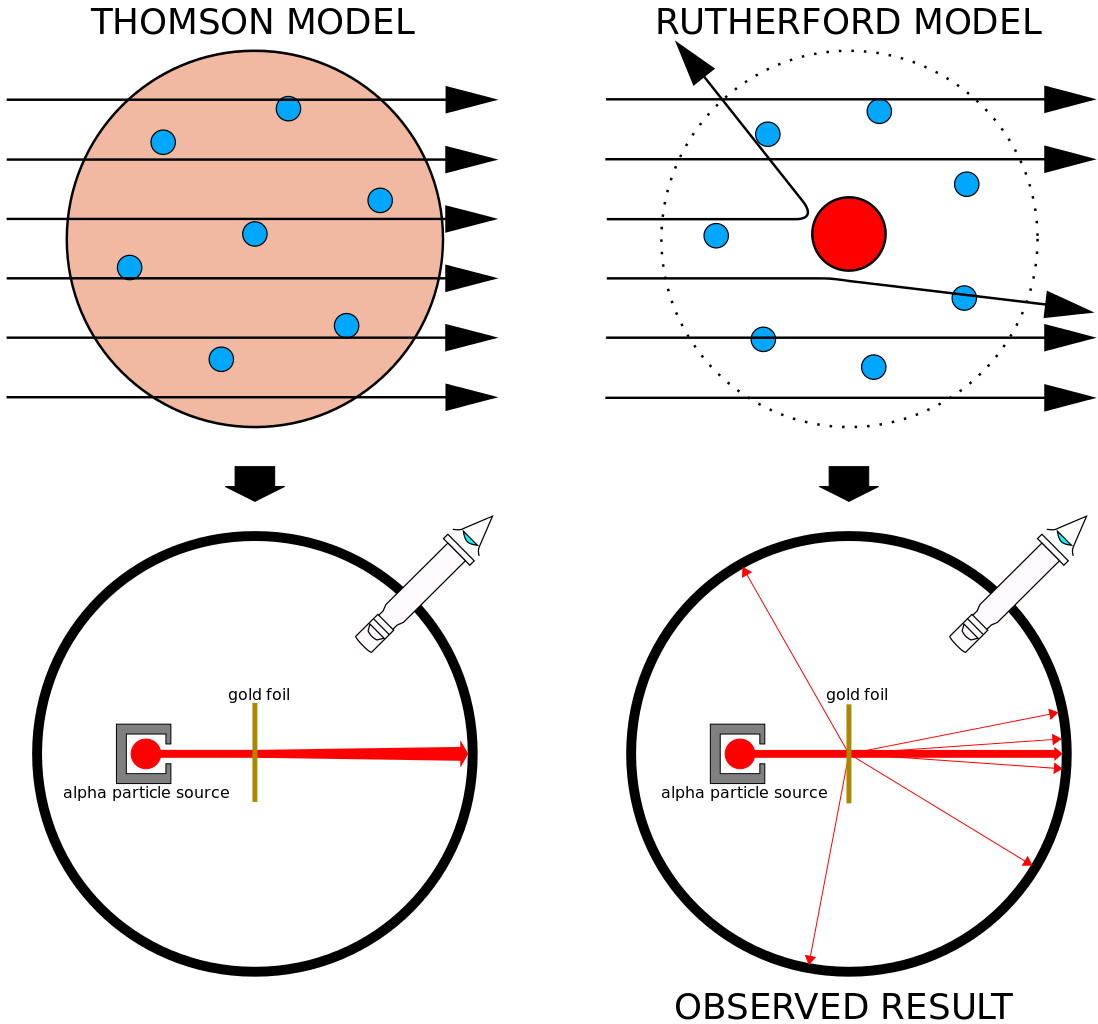
If atoms had been made of continuous structures, then all the particles fired at a thin sheet of gold would be expected to pass right through it. The fact that hard recoils were seen quite frequently, even causing some particles to bounce back from their original direction, helped illustrate that there was a hard, dense nucleus inherent to each atom.
In theory, any type of baryon, or entity made of three quarks, can bind together to any other type of baryon. However, while protons-and-neutrons can bind together to form stable bound states (like atomic nuclei), neutrons-and-neutrons and protons-and-protons do not.
With “fundamental” protons, neutrons, and electrons, normal atom-based matter made sense.
Traditionally, atoms are viewed as dense nuclei, a mix of protons and neutrons, surrounded by electrons that move in specific orbital paths. This picture is useful in some circumstances, but simpler than the full quantum reality, which includes subatomic particles inside of protons and neutrons, and a view of the electron as a cloud rather than a concrete particle that moves in an orbit. Inside of every atom, an entire Universe of complexity can be found.
Credit: Annelisa Leinbach, Thomas Wright
But other particles soon emerged, whether wanted or desired.
Schematic illustration of nuclear beta decay in a massive atomic nucleus. Only if the (missing) neutrino energy and momentum is included can these quantities be conserved. The transition from a neutron to a proton (and an electron and an antielectron neutrino) is energetically favorable, with the additional mass getting converted into the kinetic energy of the decay products. The inverse reaction, of a proton, electron, and an antineutrino all combining to create a neutron, never occurs in nature.
Pauli’s neutrino, proposed in 1930, was detected in 1956.
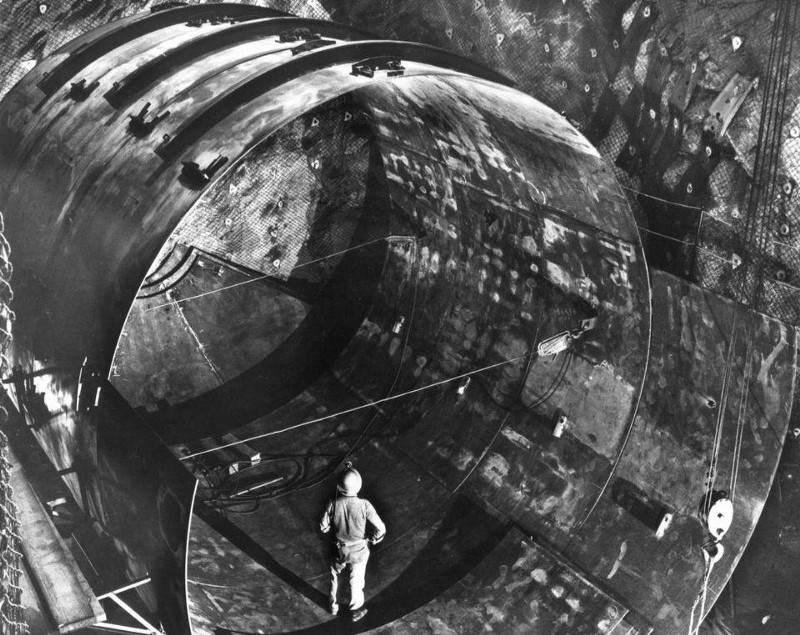
The neutrino was first proposed in 1930, but was not detected until 1956, from nuclear reactors. In the years and decades since, we’ve detected neutrinos from the Sun, from cosmic rays, and even from supernovae. Here, we see the construction of the tank used in the solar neutrino experiment in the Homestake gold mine from the 1960s. This technique, of building neutrino observatories deep underground, has been a hallmark of particle physics experiments for over 60 years.
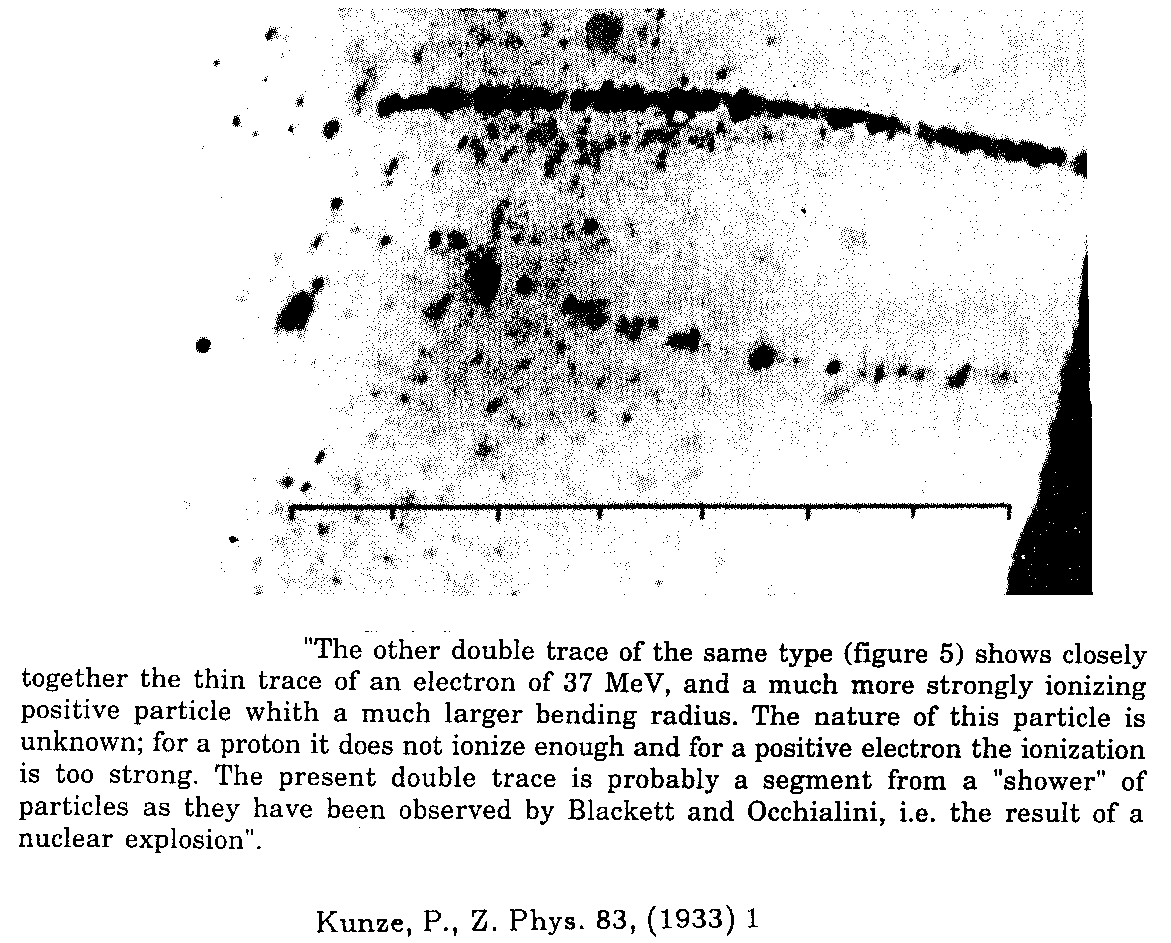
Just as an atom is a positively charged, massive nucleus orbited by one or more electrons, antiatoms simply flip all of the constituent matter particles for their antimatter counterparts, with positron(s) orbiting the negatively-charged antimatter nucleus. The same energetic possibilities exist for antimatter as matter. First hypothesized in 1928/9 by Dirac, antimatter (in the form of positrons) was first detected in the lab only a few years later: in 1932.
The first muon ever detected, along with other cosmic ray particles, was determined to be the same charge as the electron, but hundreds of times heavier, due to its speed and radius of curvature. The muon was the first of the heavier generations of particles to be discovered, dating all the way back to the 1930s.
Later particle physics experiments produced mesons, baryons, and antibaryons: composite particles.
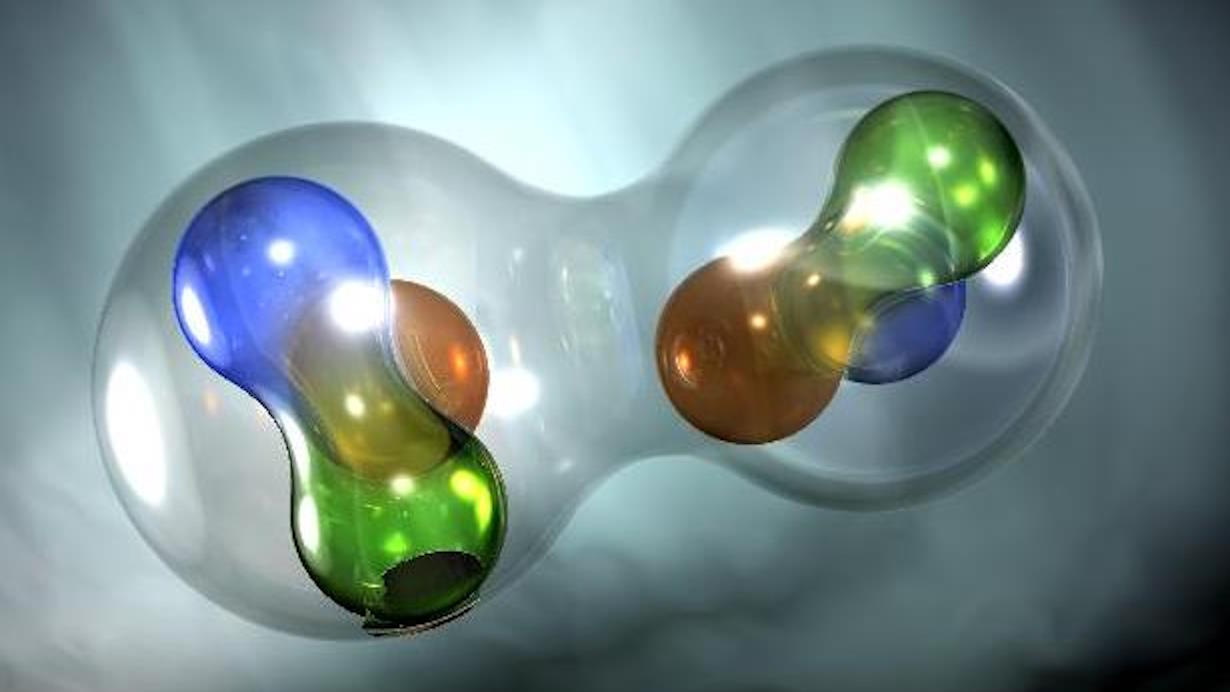
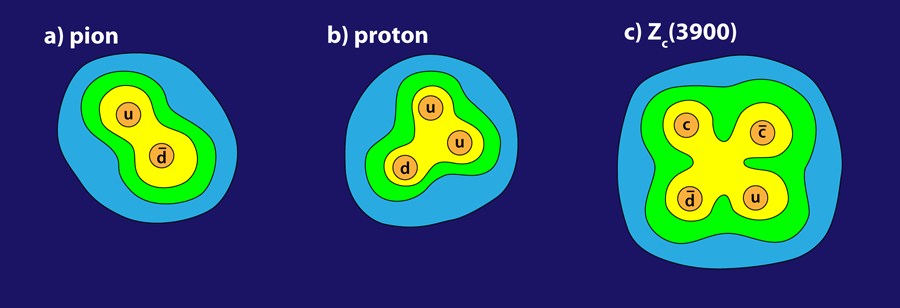
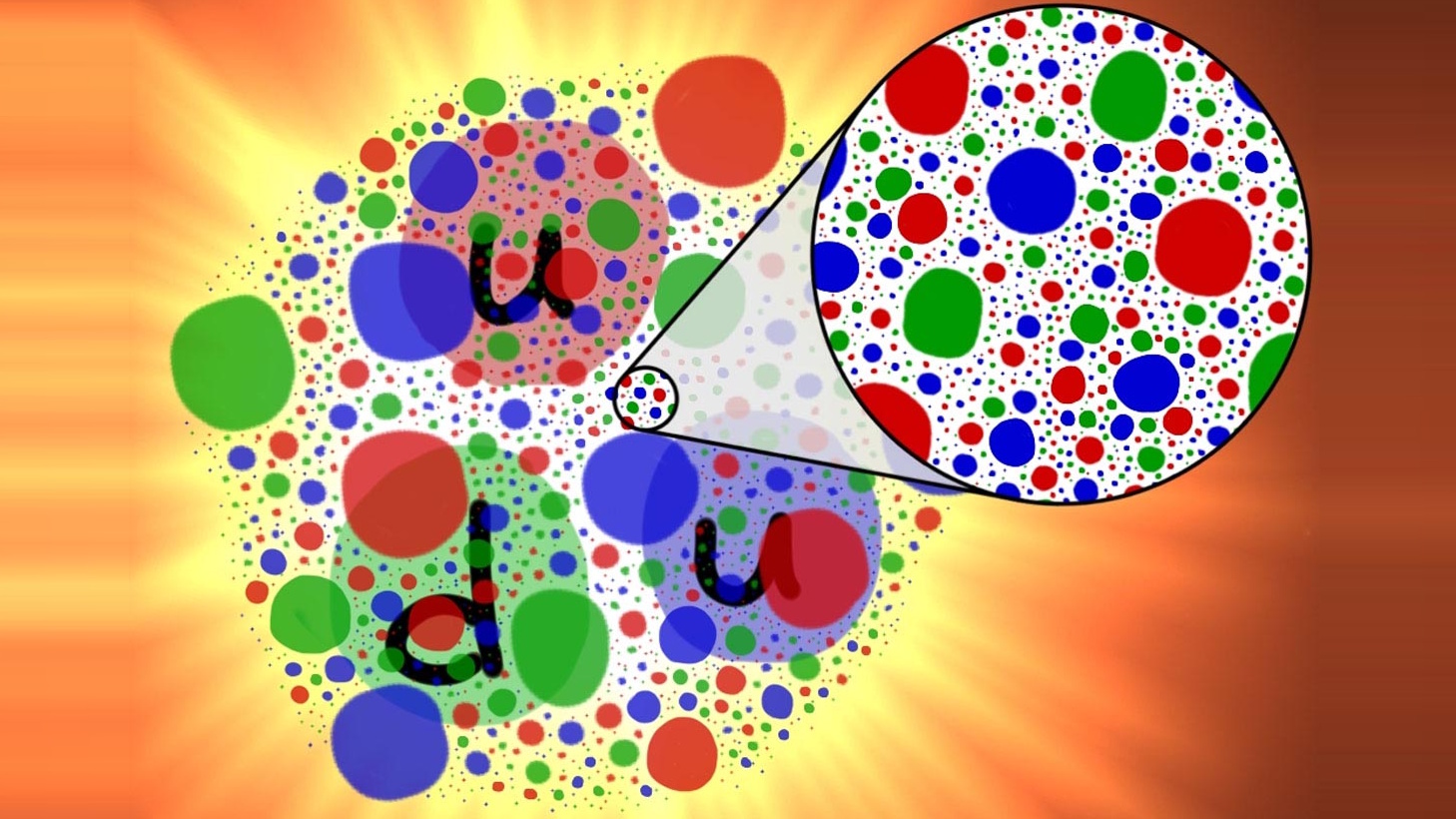
Originally, the only hadrons known to exist were either combinations of three quarks (baryons), three antiquarks (antibaryons), and quark-antiquark pairs (mesons). Now, more exotic states such as tetraquarks, including the Z_c(3900) shown here, are known to exist as well. Glueballs, pentaquarks, and other exotics remain tantalizing and expected possibilities as well.
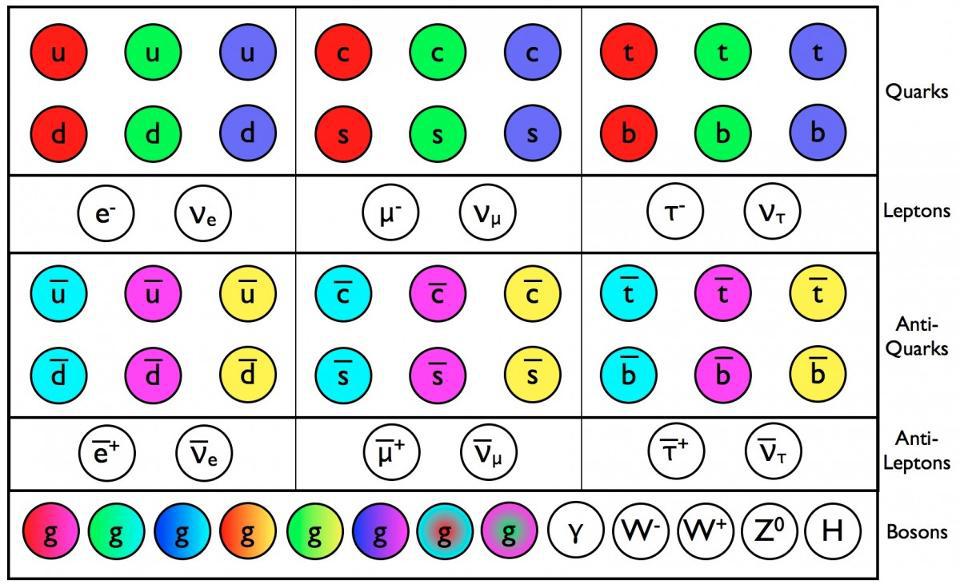
The quarks, antiquarks, and gluons of the Standard Model have a color charge, in addition to all the other properties like mass and electric charge. All of these particles, except gluons and photons, experience the weak interaction. Only the gluons and photons are massless; everyone else, even the neutrinos, has a non-zero rest mass. The Higgs boson, discovered in 2011/2012, was the last Standard Model particle to be directly detected.
Dark matter’s, dark energy’s, and gravitation’s underlying elementary structure remains unknown.
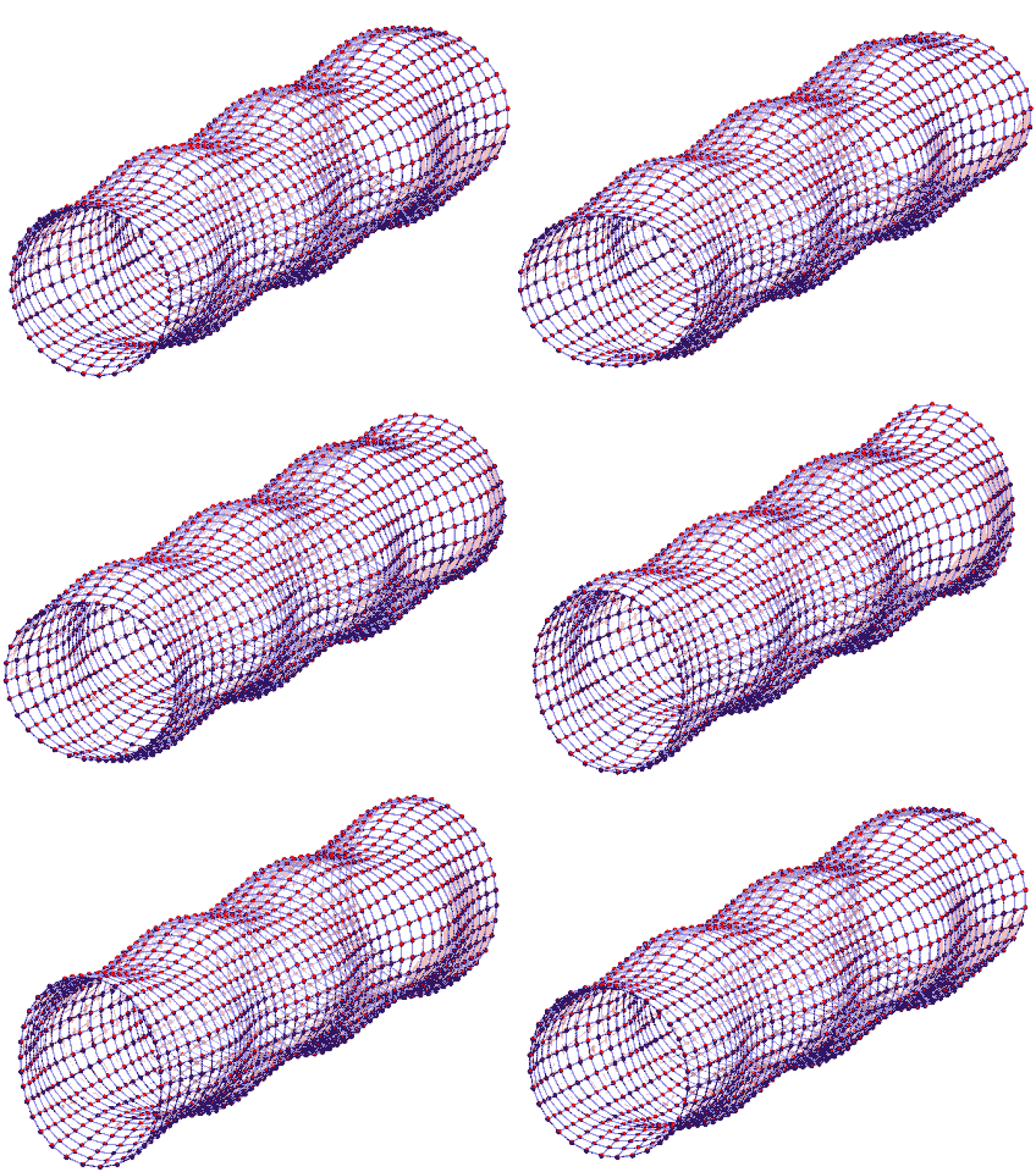
Gravitational waves propagate in one direction, alternately expanding and compressing space in mutually perpendicular directions, defined by the gravitational wave’s polarization. Gravitational waves themselves, in a quantum theory of gravity, should be made of individual quanta of the gravitational field: gravitons, a theoretical spin-2 boson that mediates the gravitational force. We do not know whether gravitons are real or whether there is a fundamental quantum theory of gravity, nor do we know what’s behind dark matter and/or dark energy.
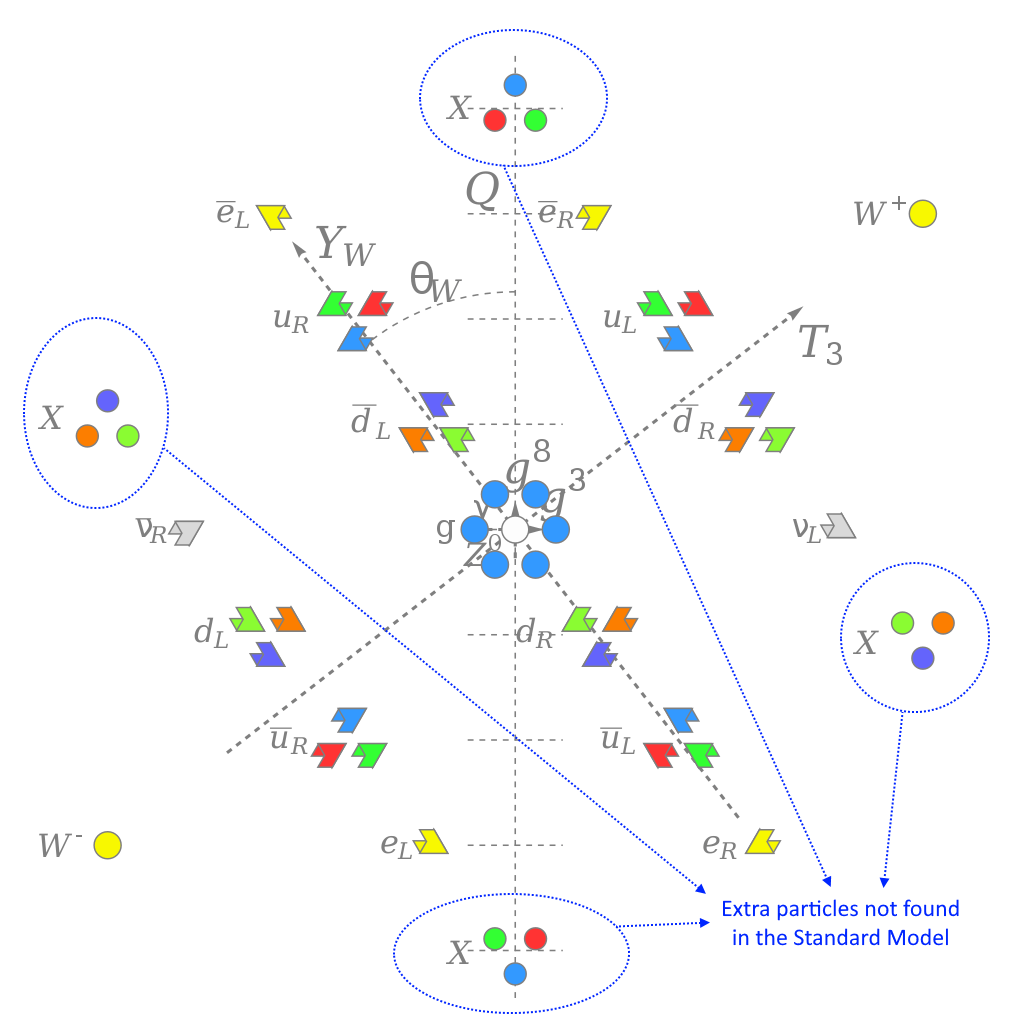
The particle content of the hypothetical grand unified group SU(5), which contains the entirety of the Standard Model plus additional particles. In particular, there are a series of (necessarily superheavy) bosons, labeled “X” in this diagram, that contain both properties of quarks and leptons, together, and would cause the proton to be fundamentally unstable. Their absence, and the proton’s observed stability, provide strong evidence against the validity of this theory in a scientific sense. Despite all we’ve learned, there are no beyond-the-Standard-Model particles that we’ve ever discovered.