




















Search
Biodiversity

Once land plants, seagrasses staged one of evolution’s boldest reversals — returning to the ocean and reinventing their biology to thrive beneath the waves.
10mins
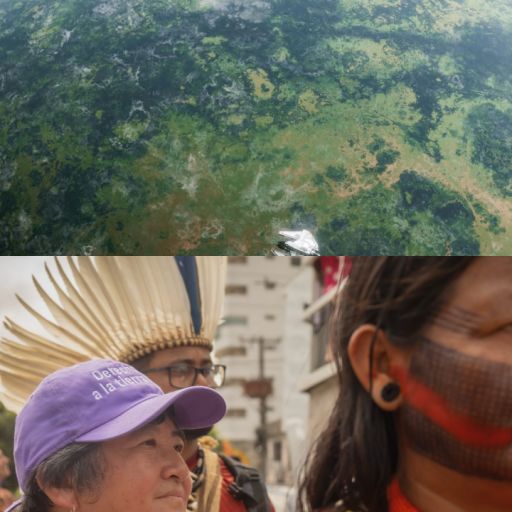
At COP30, Indigenous leaders came with a message the world can’t ignore: 5% of the global population is safeguarding 80% of Earth’s biodiversity. A $1.8B pledge was made to support their land rights — but will the money follow their lead?
Skoll Foundation

54mins
“How can all the diversity and, sort of, seeming order that's out there in the world emerge from a process dependent upon chance?”

Well before plants and animals, there were fungi.

Maybe — just don't expect a carbon copy.

7mins
“The idea of evolution by natural selection is, for me, probably the most beautiful idea in biology.”

In "After the Spike," Dean Spears and Michael Geruso show why policy, rather than high population density, has the most significant impact on the environment.
2mins
The ocean is evolving, and it’s not based on the ‘survival of the fittest.’ Astrobiologist Betül Kaçar explains how it’s not competition that has kept the ocean alive, but collaboration.

1hr 11mins
“It's a remarkable series of events that were required for us to be here, and that so many things could have happened in a different way that we wouldn't be here at all, both individually, and as a species.”

1hr 17mins
"It's not that I don't think these problems are big or that they're urgent, but I can start to see that these problems are solvable."

5mins
“While society's been humming along and enjoying all these advances in agriculture and medicine, in the last 50 or 60 years, ecologists have learned a lot about how nature works. I've codified these into a set of rules called the 'Serengeti Rules.'”

Around the world, biofuels, so-called green energy sources, are waving major red flags.

Off-the-shelf consumer technology is helping people pursue their interests — and advancing science at the same time.

A member of a species that kills trees, this mushroom is not the first to be called the Humongous Fungus — and perhaps not the last.

Early modern humans interbred with Neanderthals — and scientists recently pinpointed a key site of contact.

Think twice before stepping on that crunchy top layer of soil.

Slowing growth and limiting development isn’t living in harmony with nature—it is surrendering in a battle.

Researchers are working nest by nest to limit the threat while developing better eradication methods.

2mins
“We wouldn’t be able to talk about minerals if it weren’t for the minerals themselves.” Mineralogist Bob Hazen explains how Earth’s rocks can teach us about our planet’s technicolor history.

3mins
The mind-blowing theory that everything is evolving—from minerals to music—explained in 3 minutes by a Carnegie scientist.

New tests to detect species being traded, as well as population studies, aim to help save them.

7mins
“If given a chance, nature can rebound, and nature can rebound dramatically.” Biologist Sean B. Carroll discusses the resilience of nature and how humans can help it thrive. Humans litter, […]

Although mammals may be the dominant form of life today, we're relative newcomers on planet Earth. Here's our place in natural history.

As the world warms, trees in forests such as those in Minnesota will no longer be adapted to their local climates. That’s where assisted migration comes in.

13.8 columnist Marcelo Gleiser reflects on his recent voyage to Earth's last wild continent.

As wind power grows around the world, so does the threat the turbines pose to wildlife. From simple fixes to high-tech solutions, new approaches can help.

Without even realizing it, we’ve actually become pretty god-like in our powers.

These nematodes complicate how we understand evolutionary lineages.

Hundreds of millions of animals get killed for meat every day.

The problem with carnivores turned omnivores.