




















Search
Galaxy Formation
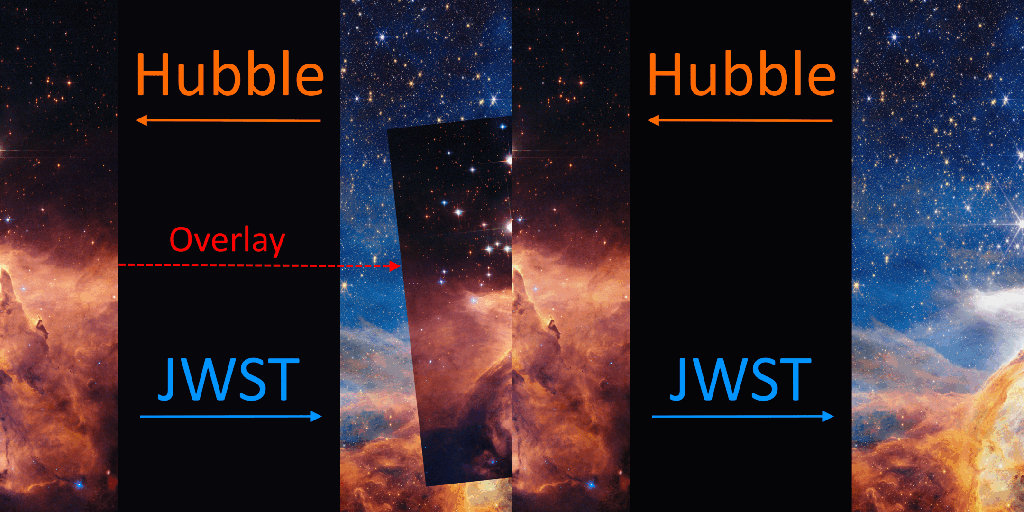
JWST isn't the first telescope to peer into this factory of star-birth some 5500 light-years away, but its views are the most educational.

With several seemingly incompatible observations, cosmology faces many puzzles. Could early, supermassive stars be the unified solution?

As we look to larger cosmic scales, we get a broader view of the expansive cosmic forest, eventually revealing the grandest views of all.
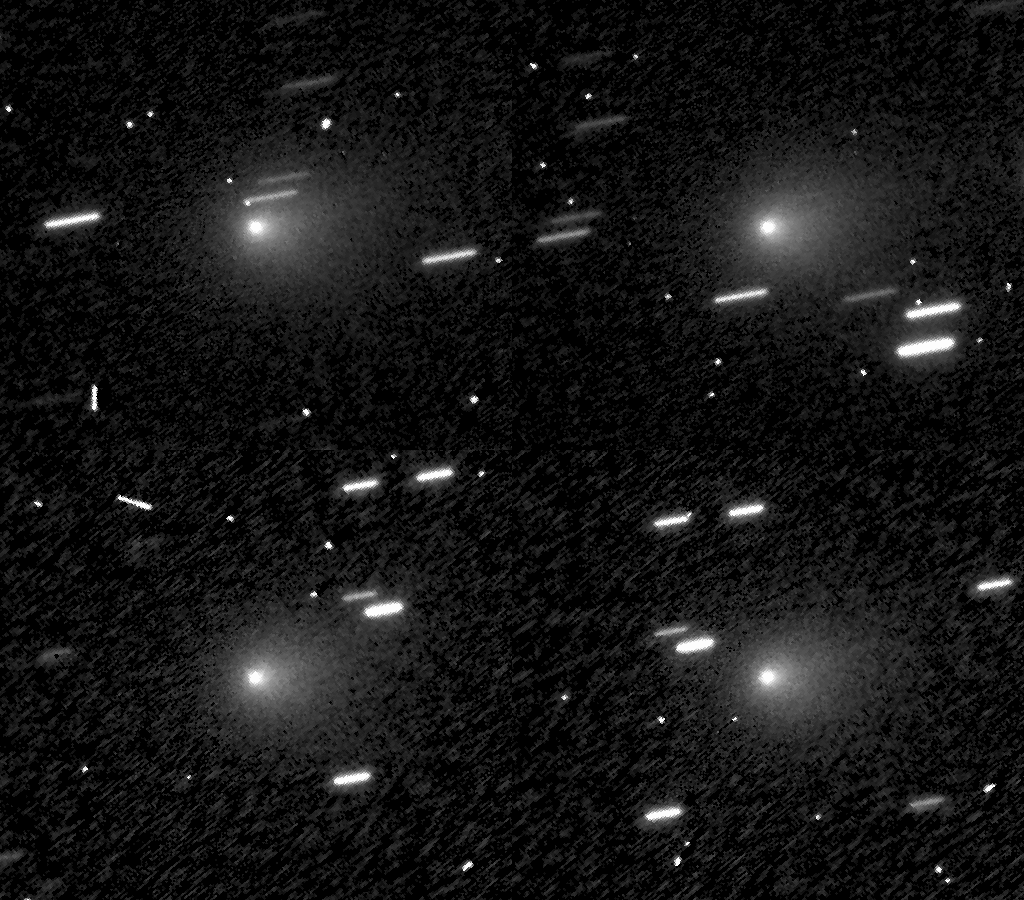
Designed to map galaxies, the SPHEREx mission's first science result is instead about interstellar interloper 3I/ATLAS. No, it's not aliens.

At the center of Hubble's famous "cosmic horseshoe," a very heavy supermassive black hole has been robustly measured. How is it possible?

On the largest scales, galaxies don't simply clump together, but form superclusters. Too bad they don't remain bound together.

Originally, the abundance of bright, early galaxies shocked astronomers. After 3 years of JWST, we now know what's really going on.

For hundreds of millions of years, a cosmic fog blocked all signs of starlight. At last, JWST found the galaxies that cleared that fog away.

The tiniest galaxies of all are the most severely dominated by dark matter. Could black holes be the cause of the extra gravity instead?

The first galaxies were irregular blobs of gas and stars. But modern features, like spiral arms and bars, appeared earlier than expected.

If the Universe is 13.8 billion years old today, but different ages the farther we look back, what does it mean for a star to be the first?

The COSMOS-Web has just finalized their release of their full field: larger and deeper than any other JWST program. Here's what's inside.

For decades, astronomers have claimed the Milky Way will merge with Andromeda in ~4 billion years. Here's why, in 2025, that seems unlikely.

In our Universe, dark matter outmasses normal matter by a 5-to-1 ratio, shaping the Universe as we know it. What if it simply weren't there?
Many were hoping that JWST would find the first stars of all. Despite many hopeful claims, it hasn't, and probably can't. Here's how we can.

Coming from just 280 million years after the Big Bang, or 98% of cosmic history ago, this new, massive galaxy is a puzzle, but not a mirage.

There's an old saying that "what you see is what you get." When it comes to the Universe, however, there's often more to the full story.

With stars, gas, and dark matter, galaxies come in a great array of sizes. This new one, Ursa Major III/UNIONS 1, is the smallest by far.

The COSMOS-Web survey is now complete, combining JWST and Hubble infrared data. Its spectacular views show us the Universe as never before.

The Hubble Space Telescope, launched in 1990, was originally seen as a colossal mistake. This one image, taken in 1995, changed everything.

The most famous Hubble images show glittering stars and galaxies amidst the black backdrop of space. But more was captured than we realized.

Large, massive, rotating galaxies like the Milky Way are common today. So how could one form a mere ~2 billion years after the Big Bang?

Someday, we'll look back and see a young galaxy forming stars for the first time. JADES-GS-z14-0, the farthest ever, isn't early enough.

Our scientific instruments are constantly improving, revealing nature's workings as never before. Without them, we'll remain in the dark.

Some nebulae emit their own light, some reflect the light from stars around them, and some only absorb light. But that's just the beginning.

When we see spiral galaxies, some are face-on, others are edge-on, but most are tipped at an angle. But which side is closest to us?

The tiniest galaxies of all are the most susceptible to violence by their larger, bullying siblings. That's why we need them in isolation.

The Universe is expanding, and individual, bound structures are all receding away from one another. How, then, are galaxies still colliding?

Just 165,000 light-years away, the Large Magellanic Cloud is suspected to house a supermassive black hole. At last, evidence has arrived.

Astronomers see spiral and elliptical nebulae nearly everywhere, except by the Milky Way's plane. We didn't know why until the 20th century.