




















Search
Galaxy Formation
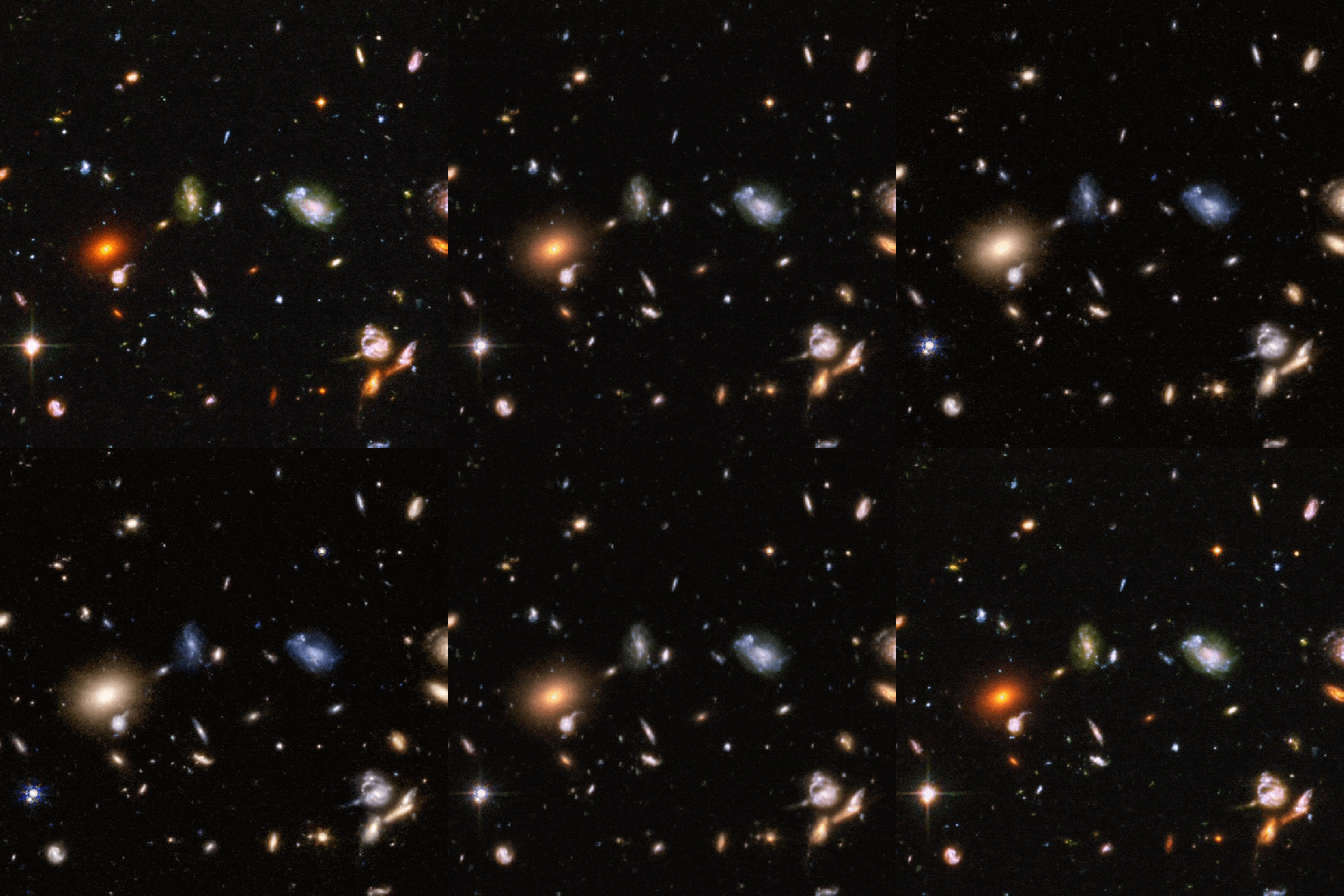
The "little red dots" were touted as being too massive, too early, for cosmology to explain. With new knowledge, everything adds up.

Most stars in the Universe are located in big, massive, Milky Way-like galaxies. But most galaxies aren't like ours at all.
In July of 2022, the first science images from JWST were unveiled. Two years later, it's changed our view of the Universe.

For its 2-year science anniversary, JWST has revealed unprecedented details in "the Penguin and the Egg." Here are the surprises inside.

The Bullet Cluster has, for nearly 20 years, been hailed as an empirical "proof" of dark matter. Can their detractors explain it away?

The standard picture of our Universe is that it's dominated by dark matter and dark energy. But this alternative is also worth considering.

The last infant stars are finishing their formation inside these pillars of gas. The evaporation of those columns is almost complete.

There was a time where no starlight was visible throughout the entire cosmos. That time was short-lived: shorter than astronomers imagined.

Known as hypervelocity stars, we originally thought just one would be ejected every 100,000 years. The real number is much greater.

Is gravity weaker over distances of billions of light-years?

A new all-time record! JWST's discovery of JADES-GS-z14-0 pushes the earliest galaxy ever seen to just 290 million years after the Big Bang.

We normally think of dark matter as the "glue" that holds galaxies and larger structures together. But it's so much more than that.

This first-of-its-kind image offers a detailed look at the magnetic fields within the Central Molecular Zone.

The JWST's observations of well-developed galaxies early in universal history may coincide with accepted astronomical theory after all.

The center of the galaxy doesn't just host stars and a black hole, but an enormous set of rich gassy and dusty features. Find out more!

Because of dark energy, distant objects speed away from us faster and faster as time goes on. How long before every galaxy is out of reach?

Given enough time, all galaxies will expel their star-forming material and wind up dead. Is this the earliest one, or is it just asleep?

Galaxies don't simply feed their central supermassive black holes, but the activity generated inside affects the entire galaxy and more.

Almost every large structure in the Universe displays a 5:1 dark matter-to-normal matter ratio. Here's how some galaxies defy that rule.

Beyond the planets, stars, and Milky Way lie ultra-distant objects: galaxies and quasars. Here's how far back we've seen throughout history.

It took 9.2 billion years of cosmic evolution before our Sun and Solar System even began to form. Such a small event has led to so much.

Early on, only matter and radiation were important for the expanding Universe. After a few billion years, dark energy changed everything.

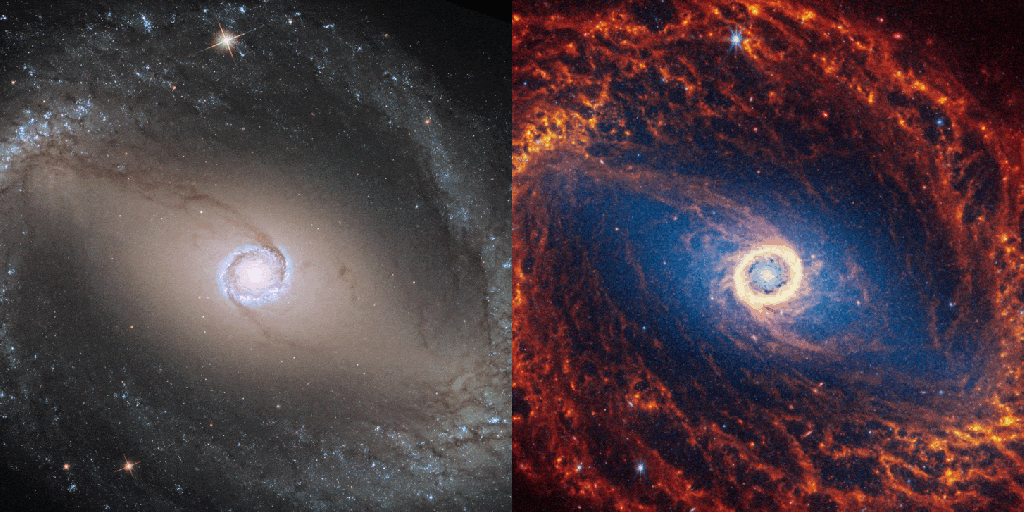
Stars are born, live, and die within the spiral arms of galaxies like the Milky Way. These 19 JWST spirals deliver unprecedented riches.

If our Milky Way were located in the Virgo cluster instead of the Local Group, chances are we'd already be a "red and dead" galaxy.

Our own galaxy, the Milky Way, is both completely normal and absolutely remarkable in a number of ways. Here's the story of our cosmic home.

On the largest cosmic scales, galaxies line up along filaments, with great clusters forming at their intersection. Here's how it took shape.

Astronomers claim to have found structures so large, they shouldn't exist. With such biased, incomplete observations, perhaps they don't.

Life became a possibility in the Universe as soon as the raw ingredients were present. But living, inhabited worlds required a bit more.

Today, supermassive black holes and their host galaxies tell a specific story in terms of mass. But JWST reveals a different story early on.

One newly discovered, ancient star has a composition unlike any other. Explaining its existence is already blowing astronomers' minds.