




















Search
Galaxy Formation

Finding it at all was a happy accident. Examining it further may help unlock the secrets hiding within the earliest galaxies of all.
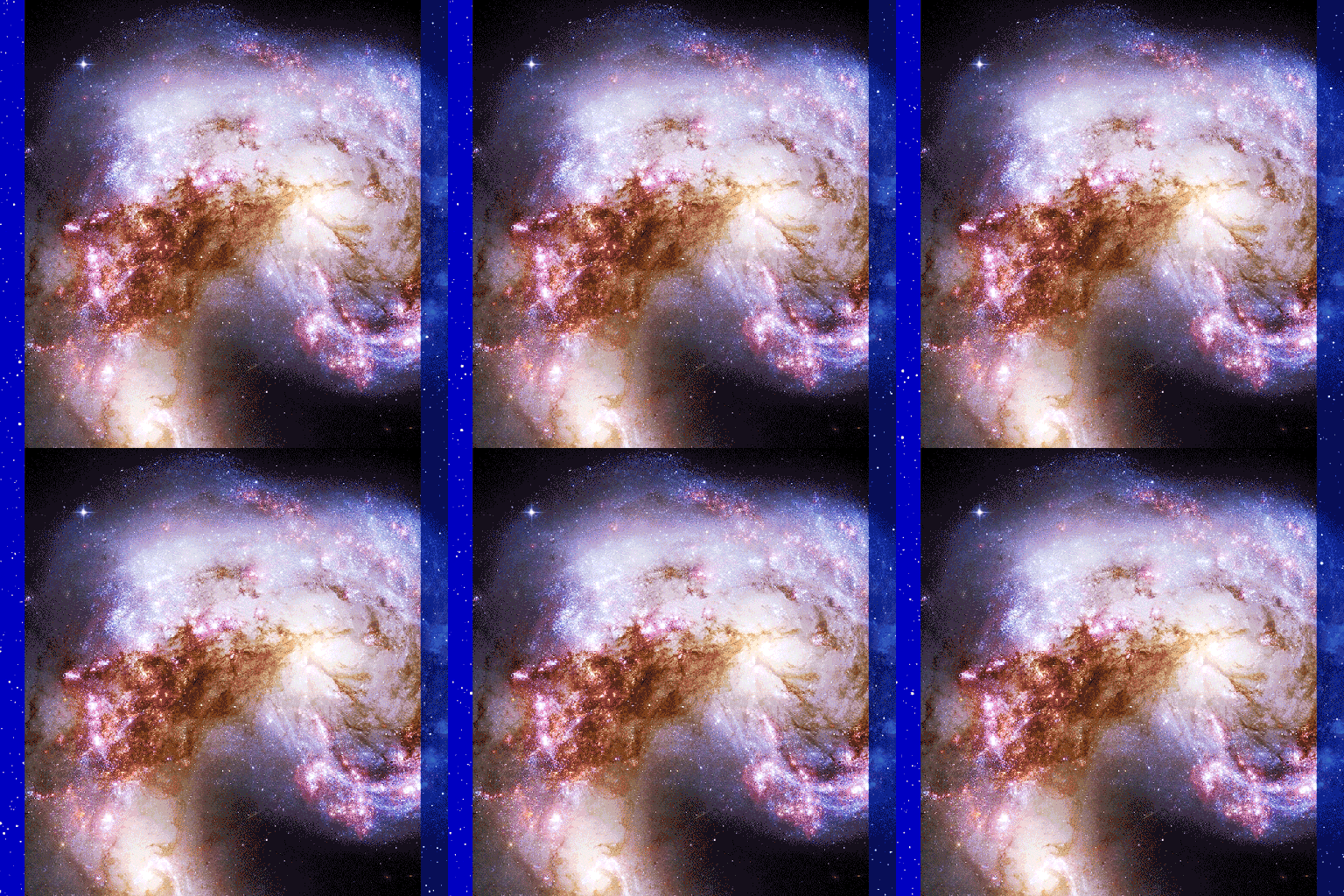
Today, the star-formation rate across the Universe is a mere trickle: just 3% of what it was at its peak. Here's what it was like back then.

As early as we've been able to identify them, the youngest galaxies seem to have large supermassive black holes. Here's how they were made.
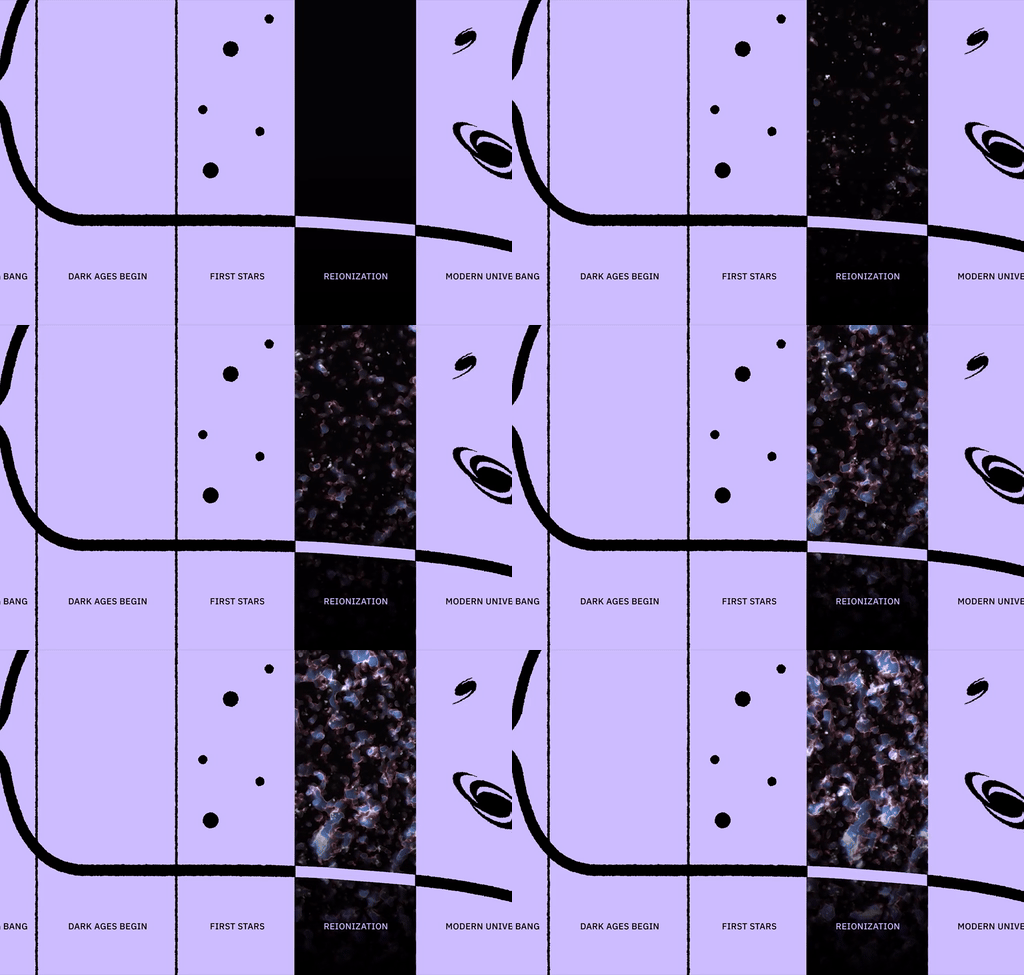
For 550 million years, neutral atoms blocked the light made in stars from traveling freely through the Universe. Here's how it then changed.

Even after the first stars form, those overdense regions gravitationally attract matter and also merge. Here's how they grow into galaxies.

Since JWST first glimpsed the Universe, we've entered a new era in understanding the earliest objects in the Universe. What have we learned?

The first elements in the Universe formed just minutes after the Big Bang, but it took hundreds of thousands of years before atoms formed.

The Big Bang theory is not threatened, but astrophysicists have some explaining to do.

The paper does not prove the existence of dark matter, but it mostly eliminates a rival theory called Modified Newtonian Dynamics.

In 2022, Hubble owned the record for most distant galaxy. Today, that galaxy is down to the 9th most distant object. Thanks, JWST.

JWST has already broken many of Hubble's cosmic records. Perhaps additional record-breakers already exist within this data-rich image?

With so many early galaxies of unexpectedly large brightnesses, JWST surprised us all. Here's how scientists made sense of what we see.

A more distant galaxy liked the lens so much that it went and put a ring on it. Here's the science behind this remarkable cosmic object.

The hot Big Bang was an energetic, brilliantly luminous event. Today's Universe is alight with stars. But in between, the dark ages ruled.

How does star-formation, occurring in small regions within galaxies, affect the entire host galaxy that contains it? JWST holds the answers.

A spherical structure nearly one billion light-years wide has been spotted in the nearby Universe, dating all the way back to the Big Bang.

With ~400 billion stars in the Milky Way and 6-20 trillion galaxies overall, that makes for a lot of stars. But not as many as you'd think.

The biggest, brightest galaxies are the easiest to spot, but the tiniest ones teach us about how the Milky Way assembled and grew up!

The Universe isn't just expanding, the expansion is also accelerating. If that's true, how will the Milky Way and Andromeda eventually merge?

As Marcel Proust said, “The real voyage of discovery... consists not in seeking new landscapes, but in having new eyes.”

From when its light was emitted, the El Gordo galaxy cluster might be the most massive object in all of existence. Here's how JWST sees it.

There are two types of missing, or "dark" matter: baryonic (made of normal matter) and non-baryonic. Have we finally found the normal stuff?

What are supermassive black holes, how common are they, and how do they grow up throughout cosmic history? Listen and find out!

From the present day all the way to less than 400 million years after the Big Bang, we're seeing how the Universe grew up like never before.

Some 55 million light-years away lies the giant galaxy Messier 87. Its supermassive black hole, inside and out, looks better than ever.

In physics, we reduce things to their elementary, fundamental components, and build emergent things out of them. That's not the full story.

In a far-reaching discovery with astrophysicist Karolina Garcia, we discuss what's in the Universe and how it grew up.

What do the dark recesses of the early Universe and Zelda: Tears of the Kingdom have in common? More than you could have ever hoped for.

With hundreds of billions of stars burning bright, some galaxies are already dead. Their inhabitants might not know it, but we're certain.

Hubble showed us what our modern day Universe looks like. JWST's big goal was to teach us how the Universe grew up. Here's where we are now.