




















Search
Gravitational Waves
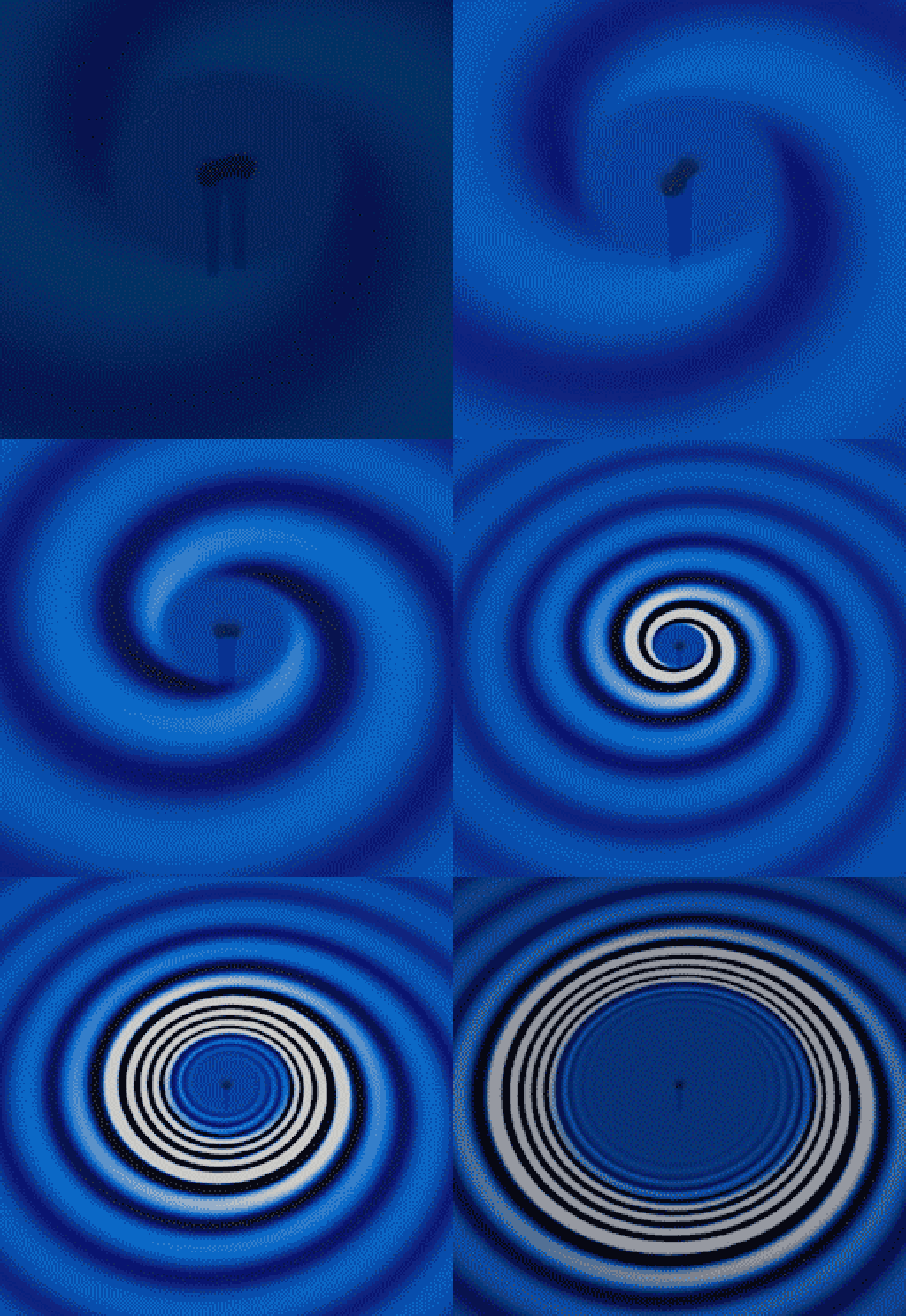
As light travels across the Universe, it's subject to cosmic expansion, changing fields, and relative motion. How about gravitational waves?

Binary black holes eventually inspiral and merge. That's why the OJ 287 system is destined for the most energetic event in history.

In traveling through the expanding Universe, particles slow down while light and gravitational waves redshift. What degrades and what won't?

No human has ever left the Solar System, and only six already-launched spacecraft will ever exit it. Will Voyager 1 remain the most distant?

When objects are gravitationally bound, they cannot escape from one another's influence. How does that work within the expanding Universe?

We first measured G, the gravitational constant, back in the 18th century. As the least well-known fundamental constant, can it be improved?

In 2017, a kilonova sent light and gravitational waves across the Universe. Here on Earth, there was a 1.7 second signal arrival delay. Why?
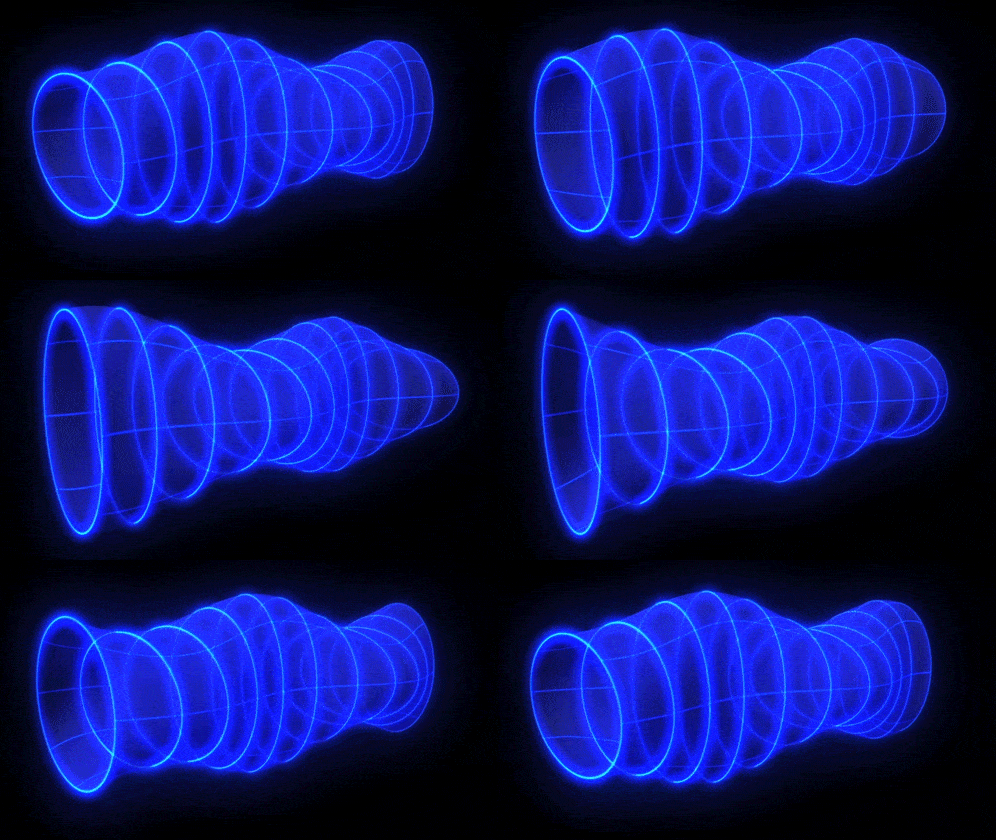
We've now detected hundreds of gravitational waves with LIGO, Virgo, and KAGRA. What if we tried Weber's original method in the modern day?

We've long known we can't go back to infinite temperatures and densities. But the hottest part of the hot Big Bang remains a cosmic mystery.

The universe is filled with unlikely events, but it is also full of ways to fool ourselves.

10 years ago, LIGO first began directly detecting gravitational waves. Now better than ever, it's revealing previously unreachable features.
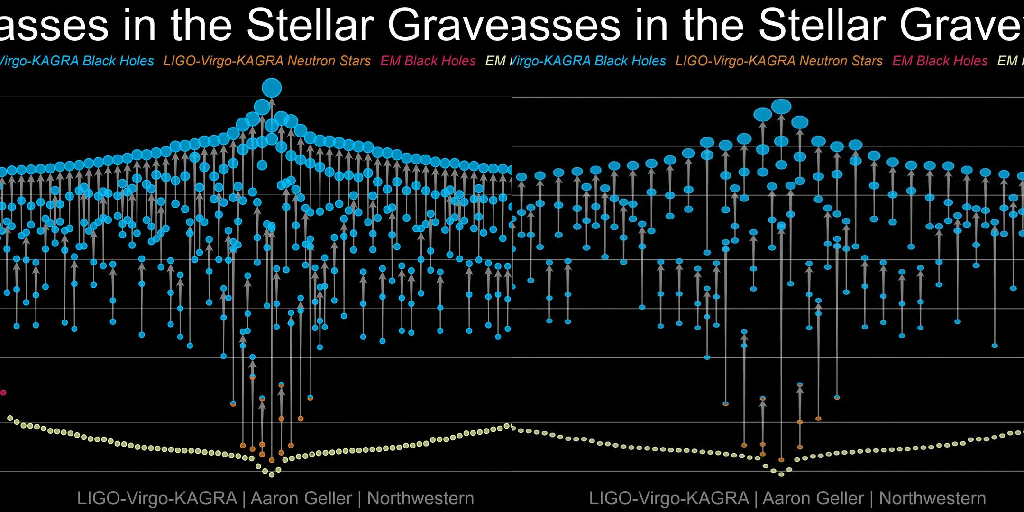
10 years ago, LIGO saw its first gravitational wave. After 218 detections, our view of black holes has changed forever. Can this era endure?

Two supermassive black holes on an inevitable death spiral push the limits of Einstein's relativity. New observations reveal even more.
With over 300 high-significance gravitational wave detections, we now have a huge unsolved puzzle. Will we invest in finding the solution?

NASA astrophysics, which gave us Hubble, JWST, and so much more, faces its greatest budget cut in history. All future missions are at risk.

Just 10 years ago, humanity had never directly detected a single gravitational wave. We're closing in on 300 now, with so much more to come!

Einstein's general relativity has reigned supreme as our theory of gravity for over a century. Could we reduce it back down to Newton's law?
The ultimate multi-messenger astronomy event would have gravitational waves, particles, and light arriving all at once. Did that just occur?

From LIGO, there weren't enough neutron star-neutron star mergers to account for our heavy elements. With a JWST surprise, maybe they can.

Cosmic inflation, proposed back in 1980, is a theory that precedes and sets up the hot Big Bang. After thorough testing, is it still valid?

New telescopes, radio dishes, and gravitational wave detectors are needed for next-generation science. Will the USA lead the way?

Earth is actively broadcasting and actively searching for intelligent civilizations. But could our technology even detect ourselves?

Most waves need a medium to travel through. But the way that light and gravitational waves travel shows that space can't be a medium at all.
Gravitational waves are the last signatures that are emitted by merging black holes. What happens when these two phenomena meet in space?

Two parts of our Universe that seem to be unavoidable are dark matter and dark energy. Could they really be two aspects of the same thing?

We know of stellar mass and supermassive black holes, but intermediate mass ones have long proved elusive. Until now.

Gravitational waves carry enormous amounts of energy, but spread out quickly once they leave the source. Could they ever create black holes?

Is gravity weaker over distances of billions of light-years?
In 2017, we detected gold being forged in a neutron star-neutron star merger. Now, in 2024, the amounts created simply don't add up.

A great many cosmic puzzles still remain unsolved. By embracing a broad and varied approach, particle physics heads toward a bright future.