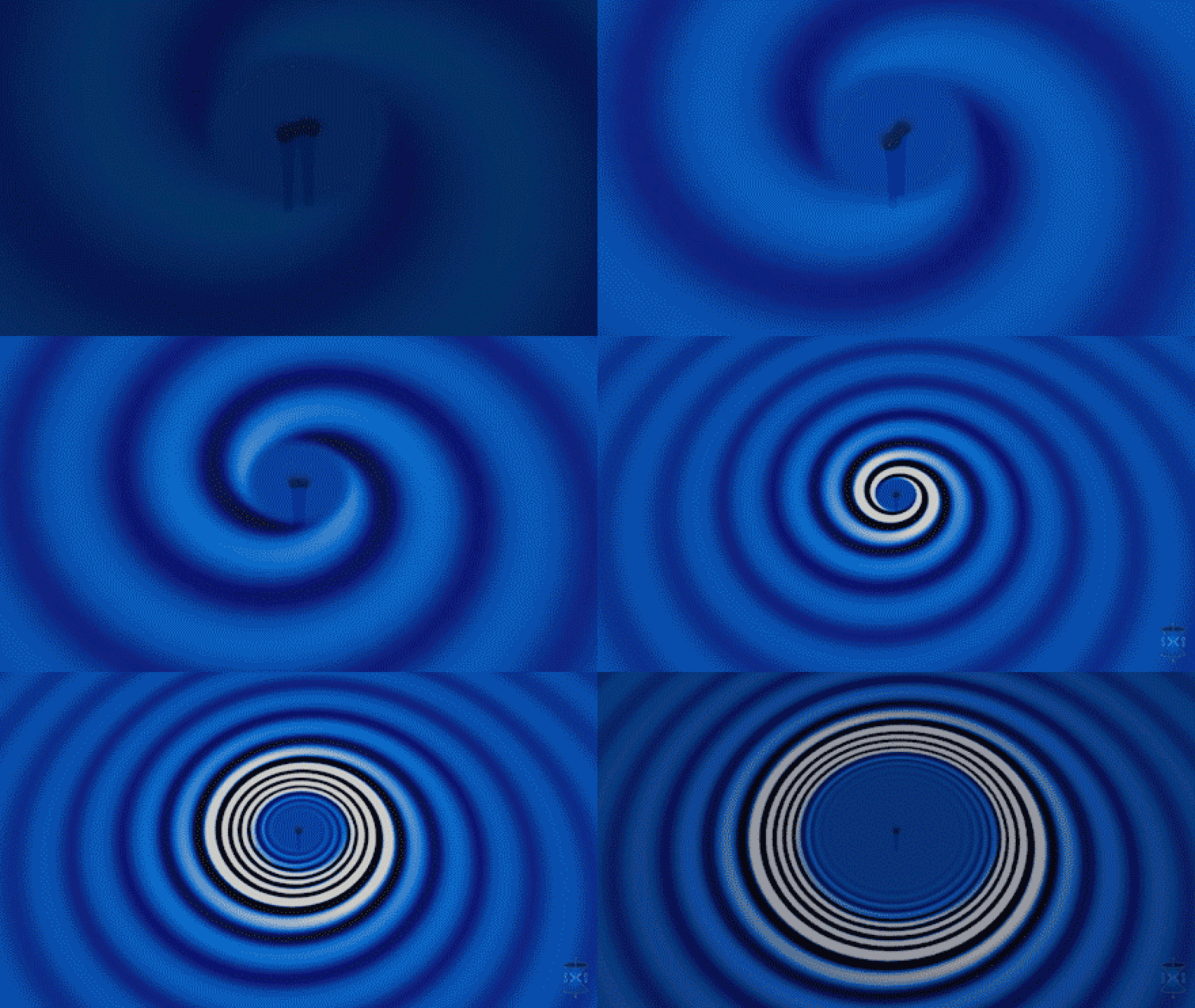

Here in our Universe, the light that gets emitted from objects isn’t necessarily the same as the light that arrives in either our eyes or our instruments. Not only are there many intervening effects that can alter a signal on the way — by interacting with fields, by passing through neutral and ionized matter, and by having to compete with sources of noise — but there are kinetic (motion-based) and gravitational (spacetime-based) effects that alter those signals while in transit as well. In particular, three main effects all can systematically shift light of any wavelength toward either redder or bluer wavelengths:
- the relative motion of the emitting source and the receiving observer,
- the changes in the gravitational field that the traveling signal experiences during its journey,
- and the effects of either expansion or contraction of the spacetime through which the signal travels.
These three effects can lead to redshifts or blueshifts, depending on which direction they occur in, and it was long expected that they’d affect all waves, not just light waves, in a similar fashion. Now that we’re in the era of gravitational wave direct detection, is that true? That’s what Bill Stutters wants to know, asking simply:
“Do gravity waves get redshifted the same as radiation, such as light, does?”
Gravitational waves are a form of radiation, and while they have many similarities to light waves, there are some fundamental differences. Here’s what does, and doesn’t, apply to gravitational waves as far as redshifts go.
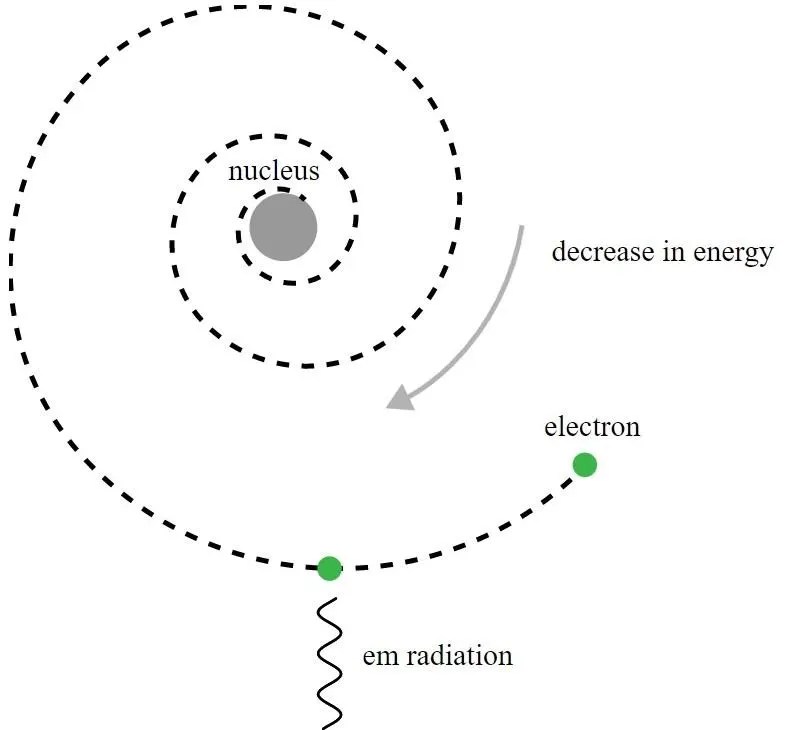
The first thing you have to understand about gravitational waves is that they are, in fact, a form of radiation. It was recognizing the parallels between:
- how an electron, which accelerates through an electric (or magnetic) field, must emit radiation to conserve energy and momentum,
- and how a mass, which accelerates through a gravitational field, must emit some type of radiation in order to also conserve both energy and momentum,
that led to the derivation of the necessary existence of gravitational radiation. As you can see, above, this was a huge problem for atoms, as first identified by Rutherford: the discoverer of the atomic nucleus. Rutherford couldn’t explain why electrons didn’t spiral into the atomic nucleus inside of atoms, and it’s hard to fault him: it would take a whole new set of physics (quantum physics) to explain why atoms don’t exhibit such a pathology.

For gravity, however, if you have a mass moving through the gravitational field generated by another mass — i.e., moving through curved spacetime — that mass is going to accelerate. That acceleration, which for one mass orbiting another (like a planet orbiting a star) is both non-spherical and asymmetrical, necessitates the emission of gravitational radiation in order to conserve both energy and momentum. That gravitational radiation is similar to conventional, electromagnetic radiation in many ways, but different in a few profound ones.
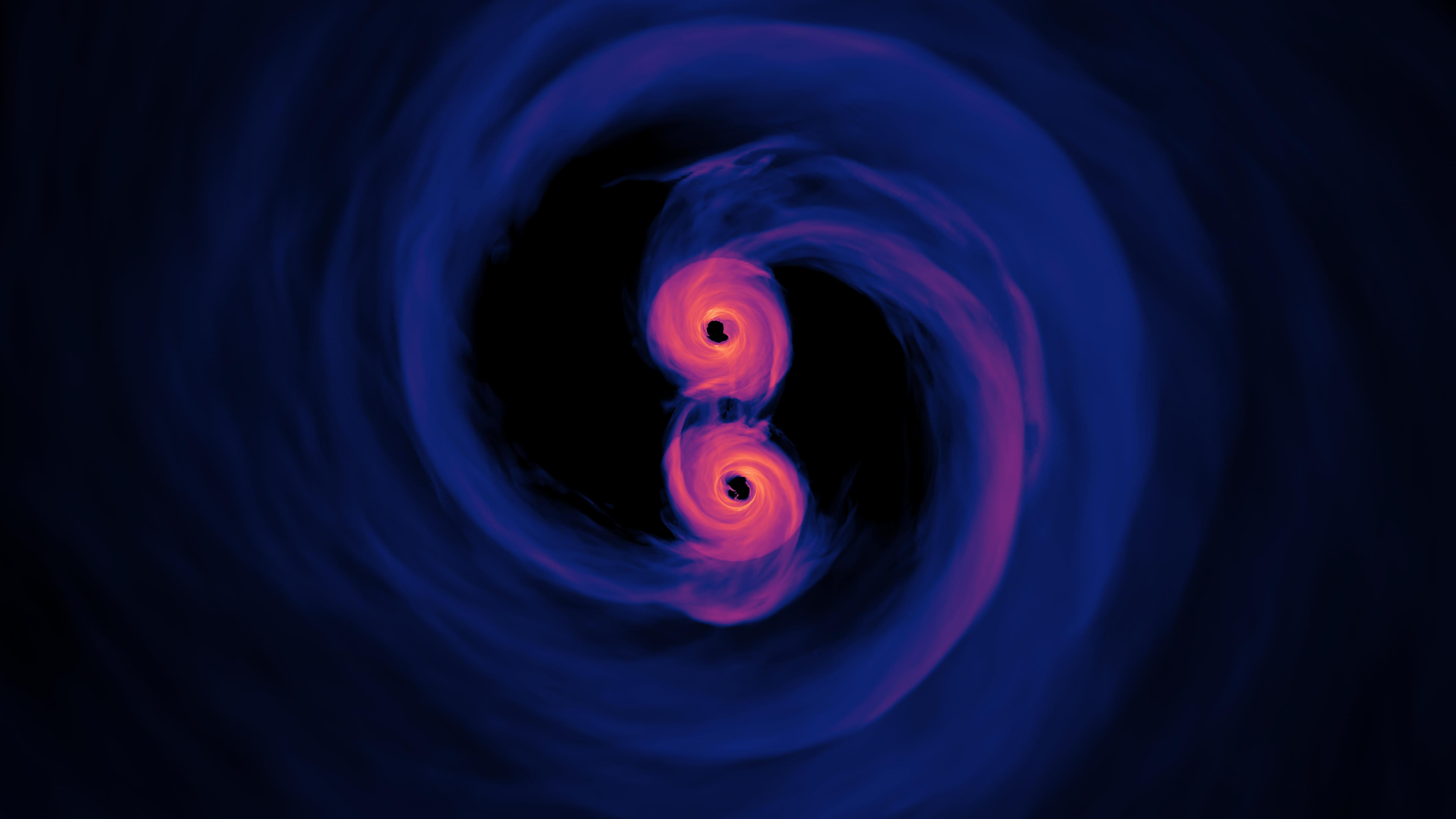
The similarities are that:
- This radiation carries energy, but has no inherent mass.
- Gravitational radiation travels at the speed of light through a vacuum: the same speed as electromagnetic radiation.
- Gravitational radiation propagates outward away from the source that generates it, and propagates through spacetime.
However, there are profound differences, too.
Electromagnetic radiation is strong, as the electromagnetic force between two protons is more than 30 orders of magnitude stronger than the gravitational force between those same two protons. As a result, gravitational radiation is much weaker in magnitude compared to electromagnetic radiation, and much harder to detect. Electromagnetic radiation is, by its nature, dipole radiation: you can generate it simply by shaking a charge back-and-forth. Gravitational radiation is quadrupolar in nature: you need some sort of “shape change” to your gravitational system in multiple dimensions; simply moving a mass back-and-forth won’t create it. And whereas electromagnetic radiation can interact very easily with the normal matter that we’re familiar with (because the particles making us up are electrically charged), gravitational radiation barely interacts with matter at all, largely passing through it, unaffected.
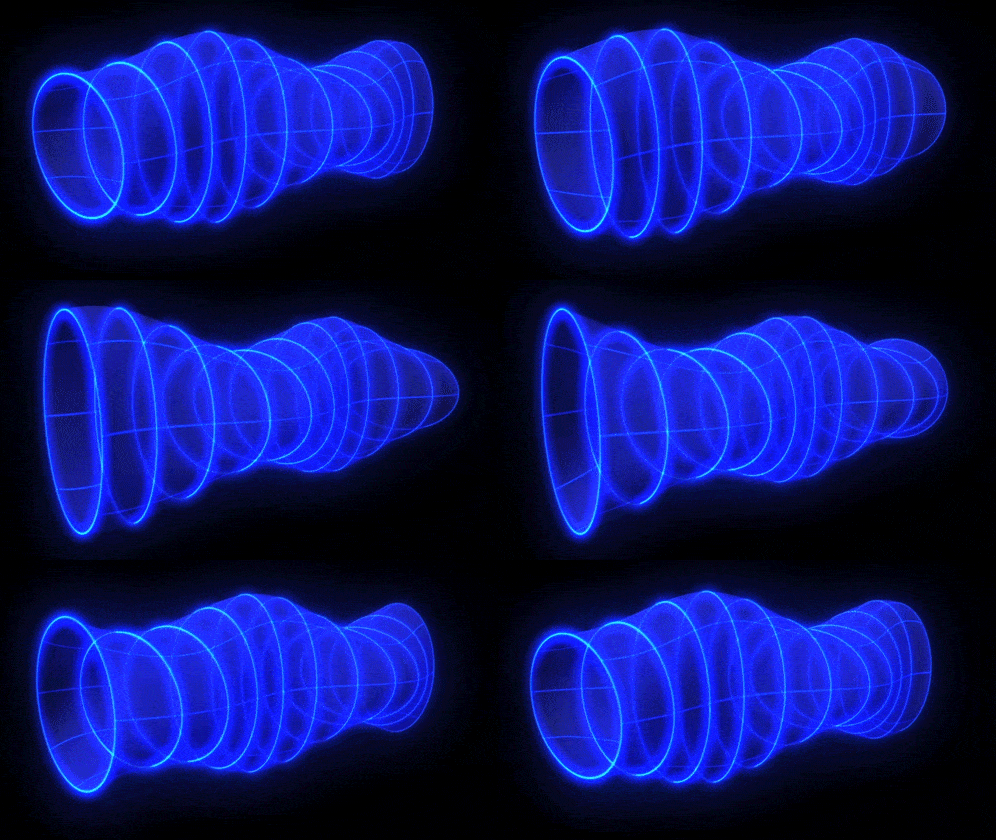
This means that any effect that causes a shift in the frequency of electromagnetic waves due to an interaction with matter — whether neutral matter, ionized matter, or an electromagnetic field generated by matter — cannot also apply to gravitational waves. As their name implies, gravitational waves (or gravitational radiation) is a purely gravitational phenomenon, and so it should only be subject to purely gravitational effects. That means that there’s:
- no Sunyaev-Zel’dovich effect for gravitational waves,
- no wavelength-dependent absorption, emission, or scattering for gravitational waves,
- and no deflection, reflection, or refraction of gravitational waves as they pass through a medium.
They simply go straight through, at the speed of light, unaffected by whatever lies between the emitting source and the observer who experiences their arrival.
However, the purely gravitational effects that work on spacetime itself, affecting its curvature, expansion, contraction, or evolution, should affect gravitational waves just as significantly as light gets affected. That means that if space is curved, it won’t just be the light that gets bent and distorted through gravitational lensing, but that gravitational waves themselves should be affected by gravitational lensing. Although the gravitational waves detectors we have today, LIGO and through pulsar timing arrays, aren’t particularly capable of seeing this lensing effect, it’s there, and several future proposed gravitational wave detectors should be sensitive to gravitational lensing.
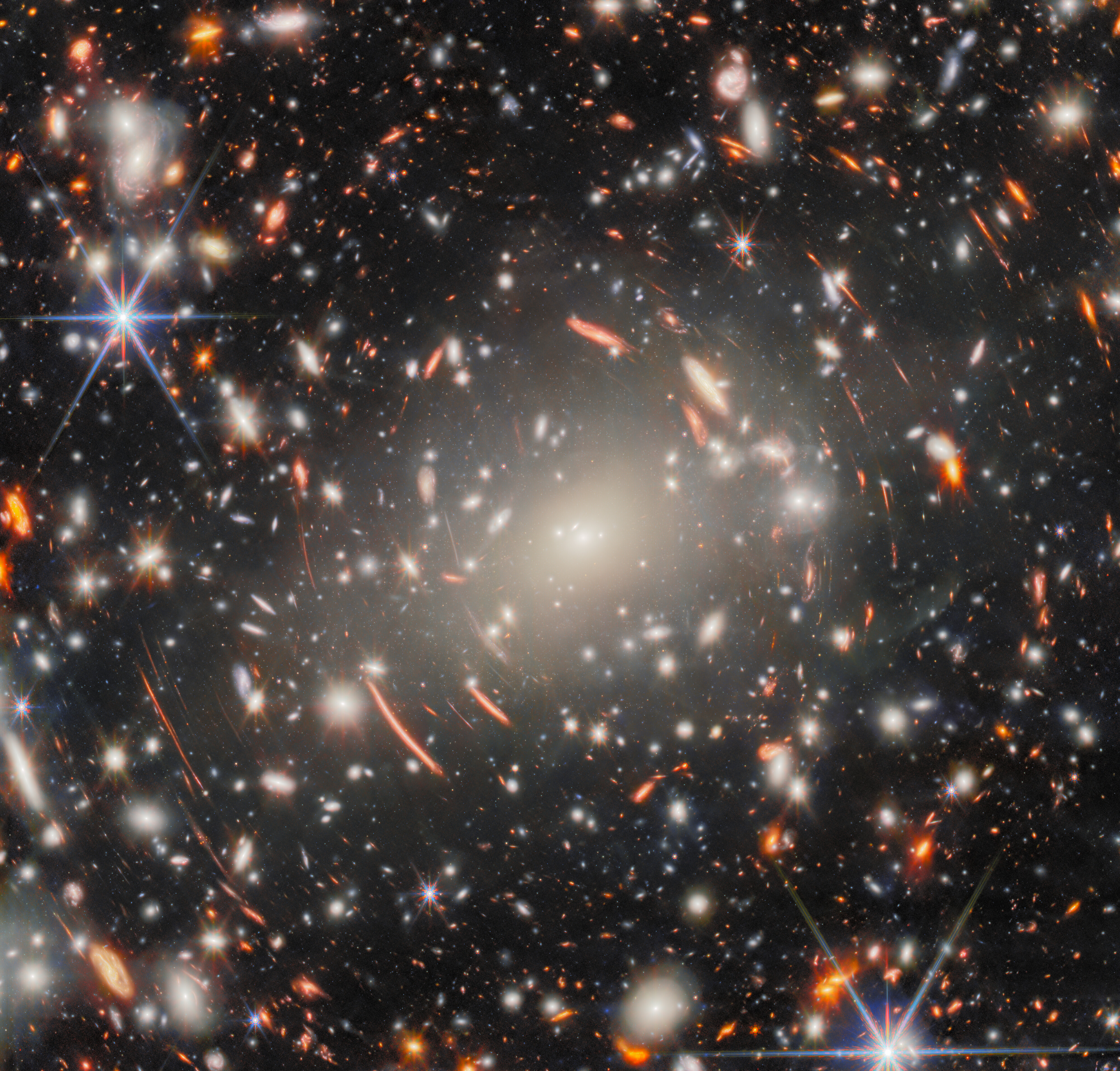
That leaves three main effects that do affect the wavelengths of gravitational waves, potentially causing redshifts (although they can also cause blueshifts, under the right circumstances), and affecting all wavelengths of gravitational waves equally. That last part is important: nearly all of the “intervening matter” effects on electromagnetic radiation lead to what we call dispersion effects, where light of different wavelengths gets altered differently by the intervening material. This happens in many different fashions for light.
- Light of different wavelengths slows down by different amounts, and refracts by different angles, when it leaves one medium and enters another.
- Light of certain short wavelengths gets absorbed by particles of a finite size, but light of certain longer wavelengths passes through those particles unimpeded.
- And light of very great energies experiences interactions — particle creation, Bremsstrahlung radiation, large cross-sections for interactions with charged particles — that lower-energy light does not.
The three effects that hit both all forms of light and all wavelengths of gravitational radiation equally are as follows:
- the relative motion of the source and the observer,
- the net effects of gravitational redshifting/blueshifting,
- and the expansion of the Universe during the duration that the radiation is in transit.
Let’s take a look at each of these three individually to understand their effects.
1.) Relative motion of source and observer.
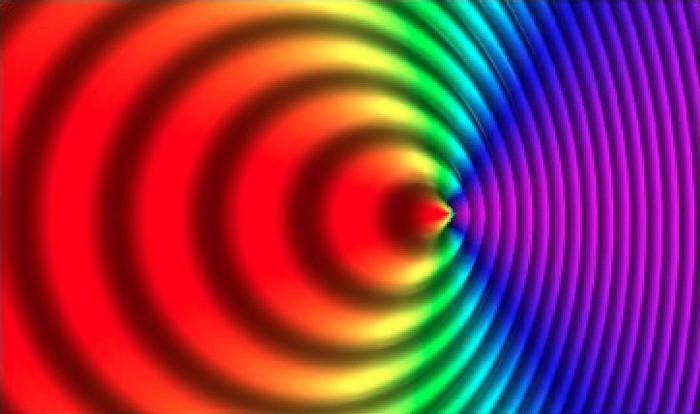
Did you ever, as a kid, listen for the sound of the ice cream truck? If you did, you might have memories that you knew it was getting closer to you if the song it played was higher-pitched than normal, that it remained at the same distance if the song was at its normal pitch, and that it was moving away from you if it was lower-pitched. The same phenomenon happens with police sirens, ambulance alarms, or the roar of an airplane. It’s known as the Doppler effect, and it applies to all forms of waves: sound waves, water waves, light waves, and even gravitational waves.
If the source moves toward you while it emits the sound (right side of the diagram, above), you’ll see the wave as compressed, or blueshifted. If the source moves away from you as it emits the sound (left side of the diagram), you’ll see the wave as rarified, or redshifted. And if you, the observer, are the one in motion rather than the source, the effects are the same: blueshifted if you move toward the source, redshifted if you move away from the source.
For gravitational waves, if the inspiral-and-merger of black holes is from a system that recedes from you, the wavelength that you’ll see is going to be redshifted by that exact factor — dictated by the Doppler shift’s velocity — of the relative motion of that source to you, the observer.
2.) Gravitational redshift.
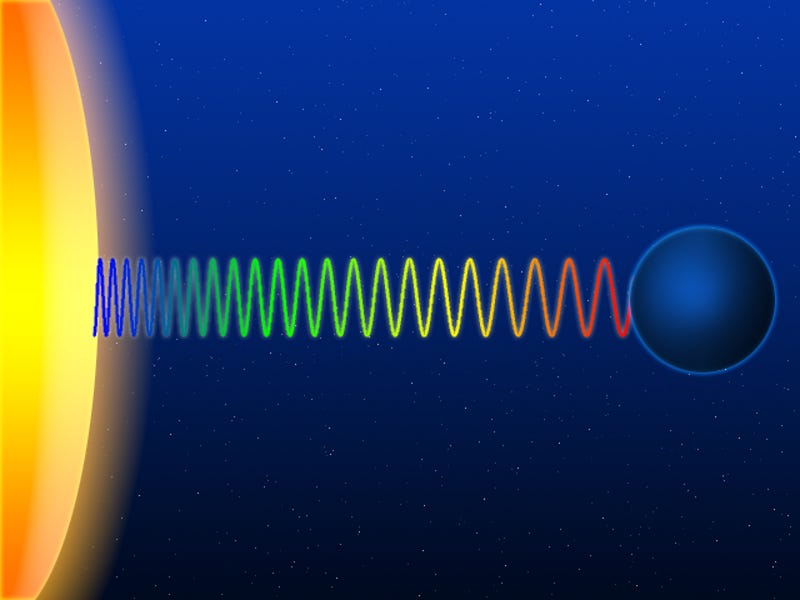
This is another form of redshift: one that affects all forms of radiation equally. When any wave, whether light, a matter wave, or a gravitational wave, moves from a region where the gravitational field is stronger to a region where the gravitational field is weaker, the wave gets redshifted: stretched to longer wavelengths. Similarly, the reverse is true: sending a signal from a gravitationally weaker region into a gravitationally stronger region leads to a blueshift, where the signal is compressed to shorter wavelengths. In most instances, it’s just the difference between the emitting source’s gravitational potential and the observing location’s gravitational potential that matters: determining the amount of redshift or blueshift.
However, there’s one extra factor that comes into play when we’re dealing with cosmic scales: the integrated Sachs-Wolfe effect. As light, gravitational waves, or any other form of radiation enters into a region of space, that region can evolve by:
- pulling more matter into it, where its gravitational potential grows over time,
- giving up the matter that’s in it to the denser regions surrounding it, where its gravitational potential shrinks over time,
- or a combination of the two, where the gravitational potential can increase, decrease, or remain the same overall.
If the potential experiences net growth from the time the wave enters to the time the wave leaves, there’s an additional imprint of a net redshift; if the potential shrinks, there’s an additional imprint of a net blueshift. All of the cumulative regions the wave passes through, with all of the growth and shrinkages that occur, imprint themselves onto the wave, as do the initial and final gravitational potentials. The sum of all of them adds to the net gravitational redshift/blueshift for all waves, including gravitational waves.
3.) The expansion of the Universe.
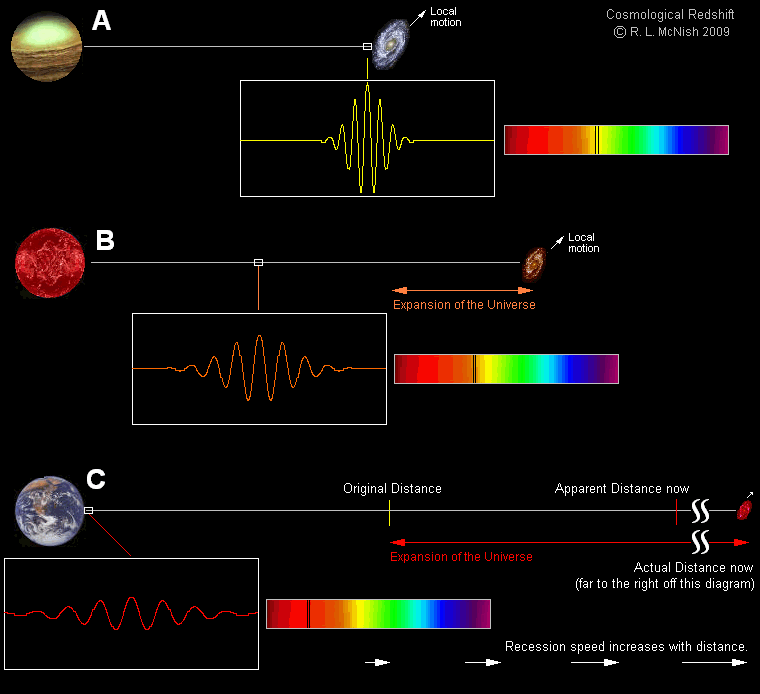
This one is the big one: responsible for the vast majority of the net redshift of nearly all objects in the cosmos. As the Universe expands, the fabric of space itself stretches, as dictated by general relativity. That stretching, or expansion, causes the wavelength of anything that passes through it to stretch as well.
- Electromagnetic waves, or light, with a specific wavelength will expand.
- Particles with kinetic energy will see the kinetic (motion) term of their energy, determined by the relative velocity they move through space with, expand as well, decreasing their energy and effectively slowing them down.
- And gravitational waves, or gravitational radiation, will see its wavelength expand as well: with a factor of wavelength lengthening identical to the wavelength lengthening of photons.
This means that a gravitational wave source that occurs at a redshift of z = 0.5 (emitted about 5.2 billion years ago) will see its wavelength lengthen to 150% of its original wavelength by the time it is observed; one at a redshift of z = 2 (emitted about 10.5 billion years ago) will have an observed wavelength of 300% its original wavelength. If we go all the way to the farthest individual object ever seen, MoM-z14 at a redshift of z = 14.4 (emitted 13.5 billion years ago), its observed wavelength would be 1540% as long as the originally emitted set of waves.
On cosmic scales, it’s the stretching of space, and the expansion of the Universe, that has the dominant effect on a distant source’s observed, final wavelength.
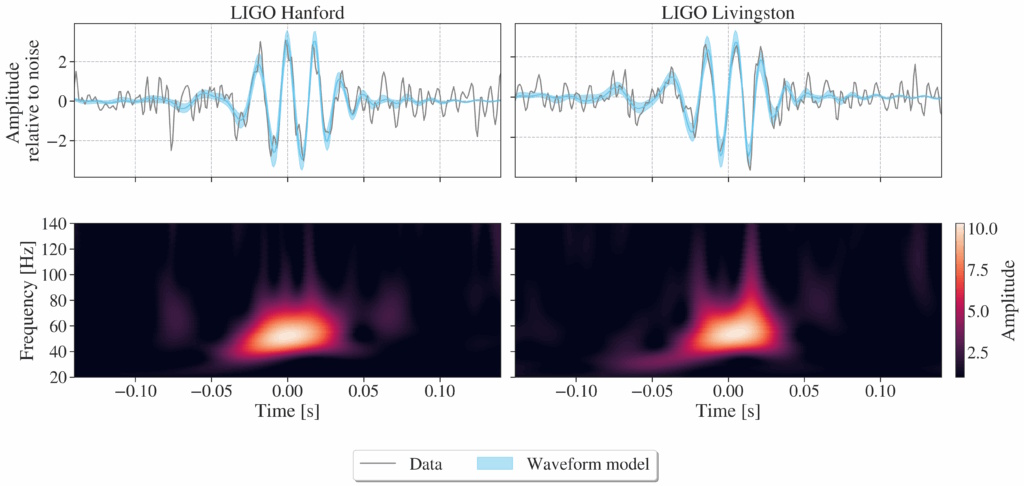
This leads to a type of degeneracy for most of the gravitational wave signals we actually observe. Sure, whenever we see a wave, there are uncertainties to what we can measure.
- We can measure a frequency, but we have to extract that from a noisy background in only a couple of detectors, meaning there’s an uncertainty in it, and that’s what we observe.
- We have to “template match” a model for the system that generated those waves, and we only know how to build templates in general relativity that correspond to two objects merging in the rest-frame of the source.
- And despite the sophistication of our software and modeling, we only know how to extract an estimate for a total redshift: we cannot disentangle how much of that redshift is cosmological and how much is due to Doppler motions or differences in gravitational potentials.
These uncertainties aren’t enormous, but they are present. There’s also some degeneracy with black hole spin and black hole orbital eccentricity: with only two or three detectors, it’s difficult to know how massive a black hole-black hole merger truly was, and therefore, it’s also difficult to know exactly what redshift they occurred at.
For example, just to pick one, the massive black hole-black hole merger event GW190521 has a best-fit source mass of 142 solar masses for the primary and 85 solar masses for the secondary. But there’s an uncertainty of around 20% on each of those figures (and, correspondingly, for the redshift as well), as a lower-mass merger that was closer or a higher-mass merger that was more distant would produce a signal with roughly the same amplitude. Alternatively, a highly eccentric merger with more comparable masses, of ~100 solar masses apiece, could also fit the data.
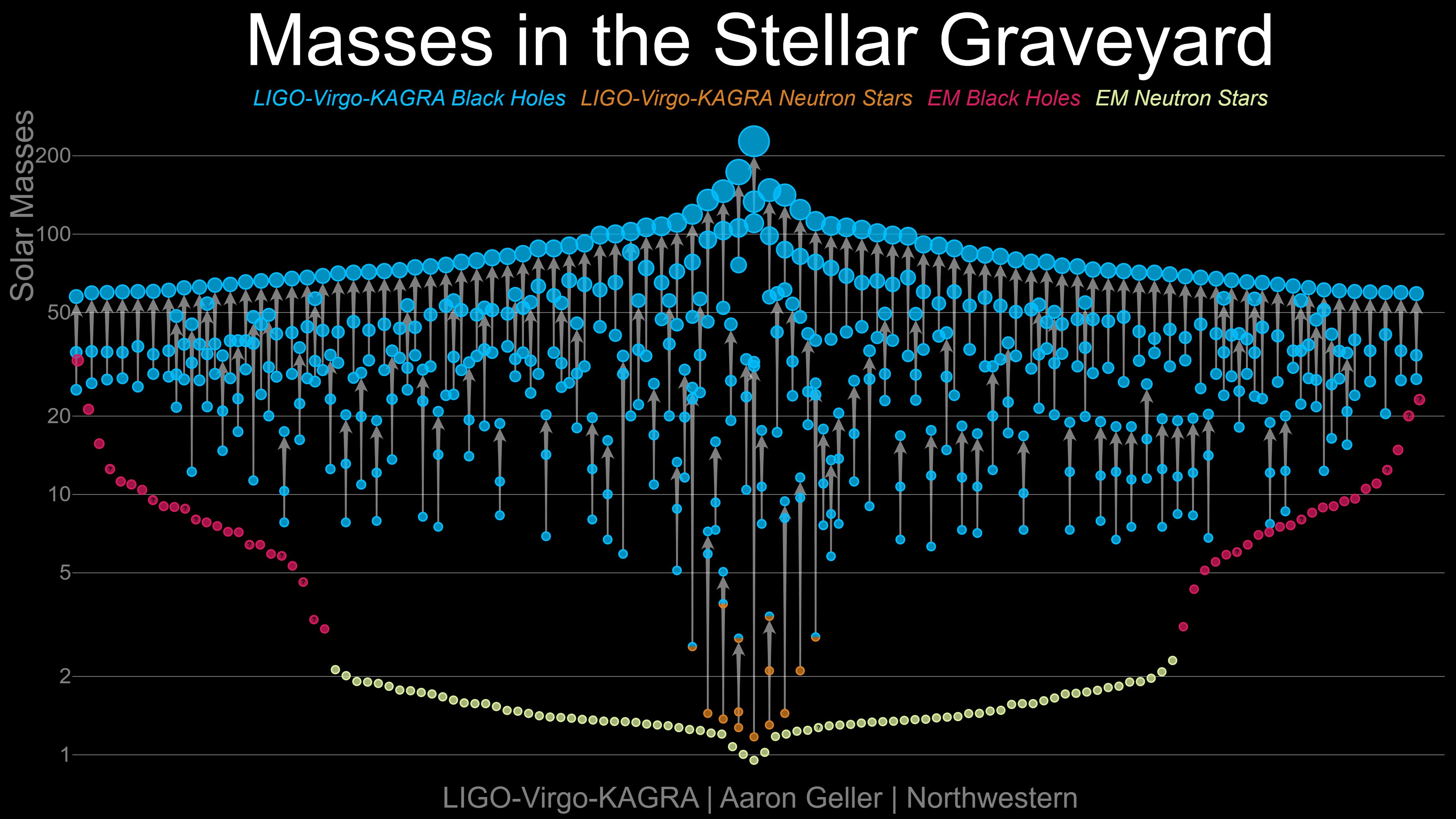
There’s a reason that, if you dive into a gravitational wave paper, you’ll see something like “chirp mass” that defines the gravitational wave’s frequency used so often: it’s a mathematical combination of the two masses that’s easier to measure, to better accuracy, than the two individual masses alone. It appears when the signal is at its maximum amplitude: during the final few orbits before the merger and up through the merger itself. There are legitimate uncertainties in both redshift/distance and in the masses of these objects whose signals we detect, and the only way to do better is with more gravitational wave detectors and with a new, superior generation of gravitational wave observatories.
But it’s truly remarkable, when you think about it, that as recently as 2015, we didn’t know whether gravitational waves could even be directly detected; we hadn’t had a single successful detection yet. Here in 2026, we know of over 200 confirmed gravitational wave events (with over 100 more in the pipeline), have detected them in two fundamentally different ways (with pulsar timing and with laser interferometry), and we even have a simultaneous detection of the same unique event with both light and gravitational waves: confirming the cosmological redshift of gravitational waves beyond a shadow of a doubt.
Yes, gravitational waves get redshifted in the same fundamental way, by the expansion of the Universe, that light does, and as time and science both march forward, we fully expect to test and confirm the similarities and differences between how light and gravitational waves behave to greater precision and accuracy than ever before!
Send in your Ask Ethan questions to startswithabang at gmail dot com!

The Energy Transition