




















Search
History and Society

From high school through the professional ranks, physicists still take incredible lessons away from Newton's second law.

After more than a million years of separation, two branches of humanity reunited around 300,000 years ago, suggests new research.

In "Dinner with King Tut," Sam Kean examines how a burgeoning field is recreating ancient tasks to uncover historical truths.
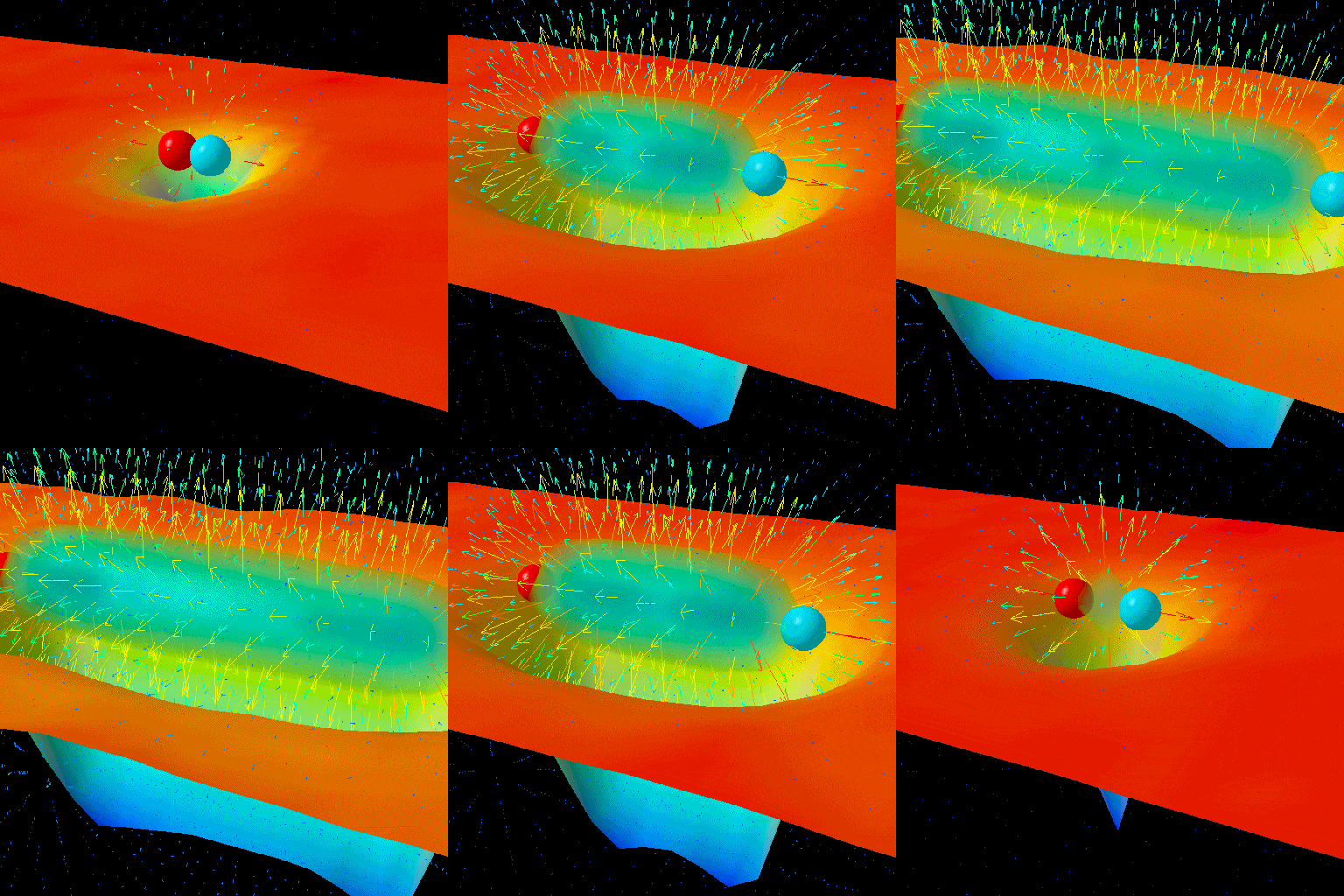
The measured value of the cosmological constant is 120 orders of magnitude smaller than what's predicted. How can this paradox be resolved?

Welcome to The Nightcrawler — a weekly newsletter from Eric Markowitz covering tech, innovation, and long-term thinking.

Can the top quark, the shortest-lived particle of all, bind with anything else? Yes it can! New results at the LHC demonstrate toponium exists.

In "Human History on Drugs," Sam Kelly explores what the research can tell us about one of history’s most brilliant — and troubled — artists.

A mid-flight scare reveals how embracing death can bring purpose and meaning to everyday life.

First 'Oumuamua, then Borisov, and now ATLAS have shown us that interstellar interlopers are real. Here's what the newest one teaches us.

In "The Microbiome Master Key," Brett and Jessica Finlay argue that we need to stop waging war on all germs and start working with the microbes that make us who we are.

Welcome to The Nightcrawler — a weekly newsletter from Eric Markowitz covering tech, innovation, and long-term thinking.

Once every 12 years, Earth, Jupiter, Uranus, and Neptune all line up, opening a window for a joint mission. Our next chance arrives in 2034.

This is my country and this is what we stand for. At least for now.

Over the first half of 2025, the US has cut science as never before. This disaster for American science may be a gift to the rest of the world.

If your world-beating idea is not working you might need to change direction — and Instagram cofounder Kevin Systrom provides the perfect case study.

Originally, the abundance of bright, early galaxies shocked astronomers. After 3 years of JWST, we now know what's really going on.

When organizations focus on finding new markets, the returns can be spectacular — as a case study from Australia perfectly illustrates.

Looking at a dark, night sky has filled humans with a sense of awe and wonder since prehistoric times. But appearances can be deceiving.

Kathryn Harkup, chemist and author of V Is for Venom, joins Big Think to discuss why Christie isn’t just a brilliant writer but a unique science communicator.

Welcome to The Nightcrawler — a weekly newsletter from Eric Markowitz covering tech, innovation, and long-term thinking.

For over 50 years, it’s been the scientifically accepted theory describing the origin of the Universe. It’s time we all learned its truths.

For hundreds of millions of years, a cosmic fog blocked all signs of starlight. At last, JWST found the galaxies that cleared that fog away.

In this excerpt from "Agents of Change," Christina Hillsberg tells the story of Martha “Marti” Peterson, the first female case officer stationed in Soviet Moscow.

Here in 2025, many of us claim to come to our own conclusions by doing our own research. Here's why we're mostly deluding ourselves.

As the closest icy ocean world to
Earth, Ceres may be a promising candidate in the search for signs of ancient life.

In "The Gift of Not Belonging," Rami Kaminski explains why group consensus may hinder the original thinkers who help advance society.

Welcome to The Nightcrawler — a weekly newsletter from Eric Markowitz covering tech, innovation, and long-term thinking.

The ANITA experiment found cosmic rays shooting out of Antarctica. One interpretation claims "parallel Universes," but is that right?

With "Karla's Choice," Nick Harkaway had an impossible mission: maintain his father’s legacy while staying true to his voice.

The corporate world is no cake walk — as a leader you need a framework that can equip you for the cross-pressures.