




















Search
Scientific Progress

Forget about the terawatt lasers we're making on Earth. The Universe makes natural ones thousands of times more powerful than the Sun.

Even the most brilliant mind in history couldn't have achieved all he did without significant help from the minds of others.

Many collaborations have used JWST to take deep-field images: some wider and some deeper than others. Here's how it can surpass them all.

Science isn't absolute. Its truths and discoveries enable us to approximate reality, but we must always remain open-minded to revisions.

There are so many problems, all across planet Earth, that harm and threaten humanity. Why invest in researching the Universe?

What if the first search for life beyond Earth actually succeeded?

16mins
“The messy reality of it is that all of these very smart people, including Isaac Newton, were talking to other people.”

To learn how our Universe grew up, we have to look at large numbers of galaxies at all distances to find out. Good thing we have JWST!

As October begins, thousands of longtime NASA employees are leaving the agency. 4000+ will exit by January 9, 2026, changing NASA forever.

Just because a paper passes peer review doesn't mean that what's written, or what the author asserts, is true. Here's why it still matters.

Going back to 1990, we hadn't even found one planet outside of our Solar System. As we close in on 6000, we now see many of them directly.

In our own Milky Way, a recently deceased star creates a ghostly, hand-like shape in X-rays some 150 light-years wide. Here's how it's made.

A conversation with neuroscientist Erik Hoel about the future of consciousness research.

Science helps us imagine the vastness of space and time — and our small but meaningful place within it.

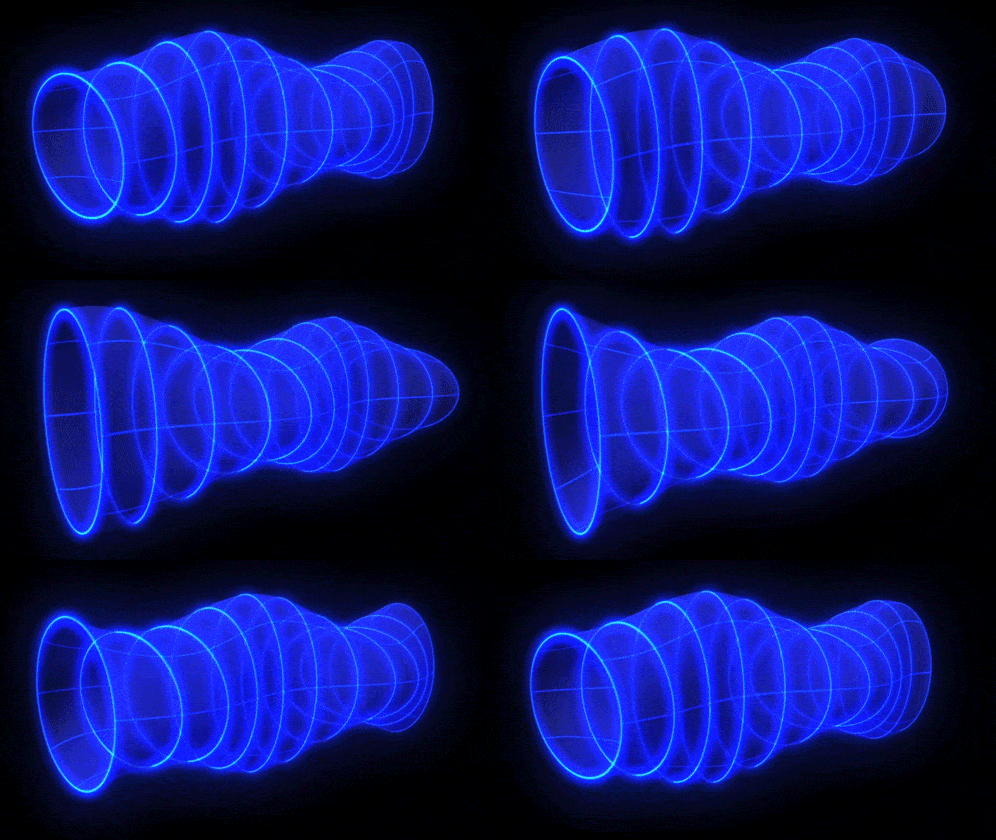
With over 300 high-significance gravitational wave detections, we now have a huge unsolved puzzle. Will we invest in finding the solution?

Can the top quark, the shortest-lived particle of all, bind with anything else? Yes it can! New results at the LHC demonstrate toponium exists.

Over the first half of 2025, the US has cut science as never before. This disaster for American science may be a gift to the rest of the world.

Coming from just 280 million years after the Big Bang, or 98% of cosmic history ago, this new, massive galaxy is a puzzle, but not a mirage.

The Hubble Space Telescope, launched in 1990, was originally seen as a colossal mistake. This one image, taken in 1995, changed everything.

25 years ago, our concordance picture of cosmology, also known as ΛCDM, came into focus. 25 years later, are we about to break that model?
Our scientific instruments are constantly improving, revealing nature's workings as never before. Without them, we'll remain in the dark.
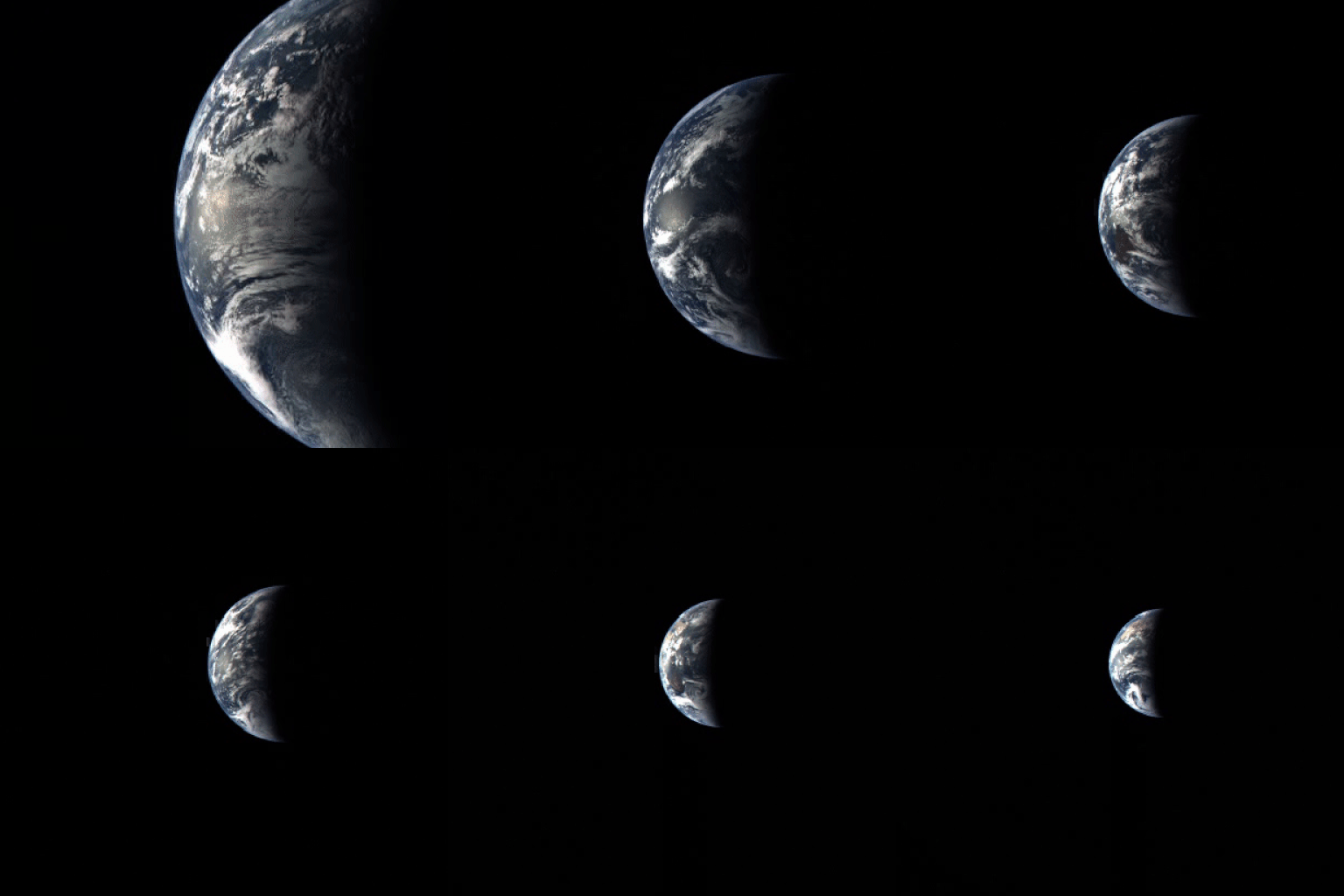
All scientific theories are limited in scope, power, and application, being mere approximations of reality. That's why consensus is vital.

Back in 1970, Sister Mary Jucunda wrote NASA, decrying large investments in science. A former Nazi's legendary response is still relevant.

Astronomers see spiral and elliptical nebulae nearly everywhere, except by the Milky Way's plane. We didn't know why until the 20th century.

Caitlin Rivers wants to tell the story of epidemiology and the public health heroes who keep the world safe and healthy.

“We can build AI scientists that are better than we are… these systems can be superhuman,” says the FutureHouse co-founder.

Why hasn’t matter fallen apart over billions of years? The mystery might start with protons.
Many mavericks look to Einstein as a unique figure, whose lone genius revolutionized the Universe. The big problem? It isn't true.

Comet A3, also known as Comet Tsuchinshan-ATLAS, has sprung to life since 2024's last equinox. Here's how to catch the show for yourself.