




















Search
Space Exploration

Just like animals, galaxies often have bizarre, unusual, or even unique properties. But finding many, all at once, really does raise alarms.

Our view of the world, the Universe, and ourselves can change with just one glimpse of what's out there. It's happened many times before.

Outer space begins just over 100 kilometers up, but what we can see extends for billions of light-years. Here's what all of it looks like.

Even in an expanding Universe, we expect both redshifted and blueshifted galaxies. But nearly every one we see is redshifted. Here's why.

With unprecedented resolution, wavelength sensitivity, and light-gathering power, JWST reveals our cosmos like no other observatory ever.

US science is worth fighting for, but so are the science projects and scientists denied opportunities. Here are 4 paths all worth exploring.

Astronomer Lisa Kaltenegger spoke with Big Think about how "the colors of life" could leave detectable traces on distant planets.

In a galaxy less than 300 million years after the Big Bang, oxygen's presence abounds. That's expected; its absence would truly be profound.

In general relativity, matter and energy curve spacetime, which we experience as gravity. Why can't there be an "antigravity" force?

There will always be "wolf-criers" whose claims wither under scrutiny. But aliens are certainly out there, if science dares to find them.

If you can identify a foreground star, the spike patterns are a dead giveaway as to whether it's a JWST image or any other observatory.

Earth orbits the Sun while spinning on its tilted axis, with two annual occasions marking that maximal tilt. That's where solstices arise.

Big Think and the John Templeton Foundation gathered scientists, artists, and storytellers in Los Angeles to explore the power of awe.

With the observation of SN 2025wny, a lensed superluminous supernova, astronomy's future comes into sharp, exciting focus.

It takes a wide variety of processes in the Universe to make all the elements that populate space today. We're still discovering new ones!

Science isn't absolute. Its truths and discoveries enable us to approximate reality, but we must always remain open-minded to revisions.

Scientific truths remain true regardless of belief. These 10, despite contrary claims, remain vitally important as 2025 draws to a close.

Finding alien Earths requires seeing Earth-sized planets at Earth-like distances from Sun-like stars. A new discovery completes the roadmap.

There are so many problems, all across planet Earth, that harm and threaten humanity. Why invest in researching the Universe?

The far side of the Moon is incredibly different from the Earth-facing side. 66 years later, we know why the Moon's faces are not alike.

One side of the Moon always faces us: the near side. The "dark side" of the Moon began as a mere metaphor, but today, science can weigh in.

From white holes to dark stars and multiverses, James Riordon explores the bizarre exhibits of general relativity's "cryptozoo."

Spirals, ellipticals, and irregulars are all more common than ring galaxies. At last, we know how these ultra-rare objects are made.

Government-spec’d glory projects produce tech demos. Enduring progress demands a better way forward.

We first measured G, the gravitational constant, back in the 18th century. As the least well-known fundamental constant, can it be improved?

NASA’s Caleb Scharf talks with Big Think about life’s long experiment in expansion.

What if the first search for life beyond Earth actually succeeded?

Do aliens speak the same physics that we do, with similar laws, observables, and underlying mathematics. Maybe not, argues Daniel Whiteson.
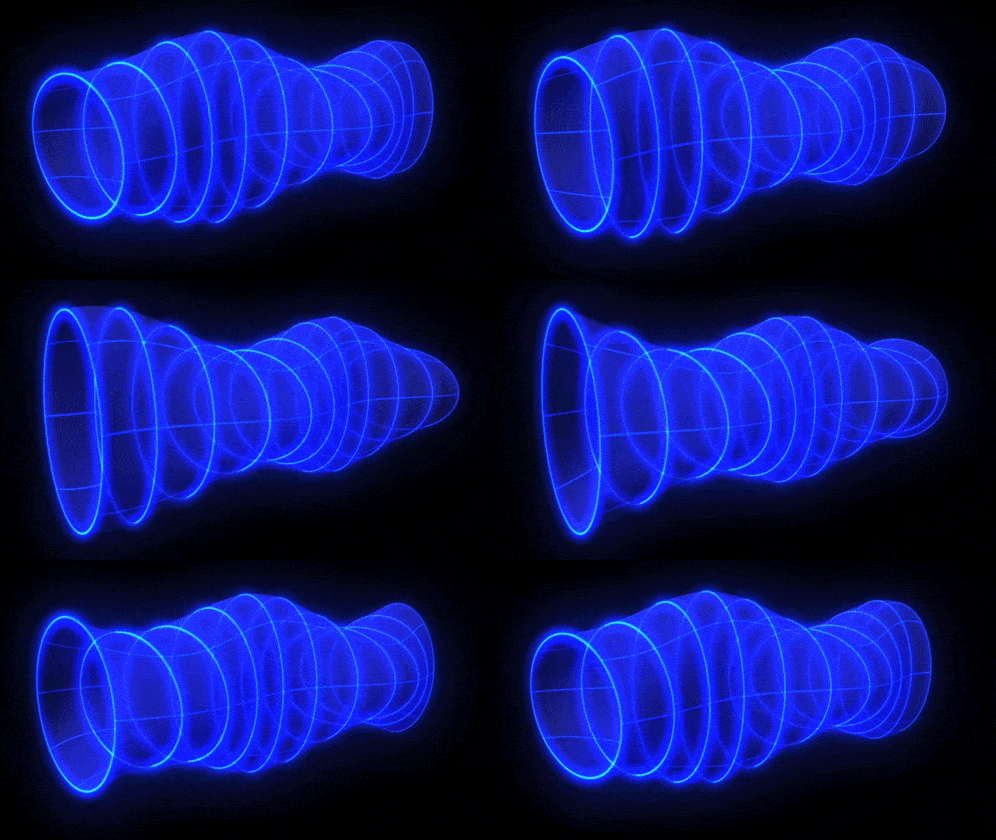
We've now detected hundreds of gravitational waves with LIGO, Virgo, and KAGRA. What if we tried Weber's original method in the modern day?

The first world beyond Earth for human habitability should be the Moon, not Mars. This is why we should terraform our lunar neighbor first.