




















Search
Space Exploration

Earth is the Solar System's only known inhabited planet. Could Venus, if its phosphine signal is real, be our second world with life?

On July 12, 2022, NASA will release the first science images taken with the James Webb Space Telescope. Here's what to hope for.

The James Webb Space Telescope is about to begin science operations. Here's what astronomers are excited about.

Preventing scurvy is not just a problem in the Antarctic.

We've only seen Uranus up close once: from Voyager 2, back in 1986. The next time we do it, its features will look entirely different.

Researchers have discovered 830-million-year-old microbes living inside a salt rock on Earth. Could the same occur on Mars?

A new study of Martian dust gives insights into the ancient Martian climate. The findings hint at a wetter world.

The observable Universe is 92 billion light-years in diameter. These pictures put just how large that is in perspective.

"The pulsar sort of consumes the thing that recycled it, just as the spider eats its mate.”

The answer may lie in the particular way sand forms on Titan.

Atomic clocks keep time accurately to within 1 second every 33 billion years. Nuclear clocks could blow them all away.

In all of human history, only 5 spacecraft have had the right trajectory to exit the Solar System. Will they ever catch Voyager 1?

Data from the Zhurong rover suggests the Red Planet was wet more recently than we thought.

The high pitches from the flute and the harp would reach your ears before the notes from the tuba and the cello.

Do the laws of physics place a hard limit on how far technology can advance, or can we re-write those laws?

Data from NASA, ESA, and Roscosmos suggest that long durations in space cause changes in the brain, some of which are linked to vision problems.

We have long thought that Pluto was completely frozen solid, but the discovery of cryovolcanoes challenges that assumption.

Speculation about the existence of aliens goes all the way back at least to the Greek philosophers. Their arguments will sound familiar.

Could we finally detect the elusive Unruh effect?

Everything that gets heated up has to, somehow, radiate that energy away. Here's what we see when that happens in the Universe.

For a thousand light-years in all directions, there's a "bubble" that the Sun sits at the center of. Here's the story behind it.

Europa may be difficult to access. But if a recent study is correct, its subsurface ocean would be more accessible than previously thought.

Most potentially hazardous asteroids remain unidentified. NEO surveyor could change that, but only if it's funded, and soon.

Was there ever life on Mars? Is there life on Mars now? Did it originate there or here, on Earth? All possibilities are fascinating.

It was supposed to have a 5.5-10 year lifetime, and take 6 months to calibrate. It's performing better than anyone anticipated.
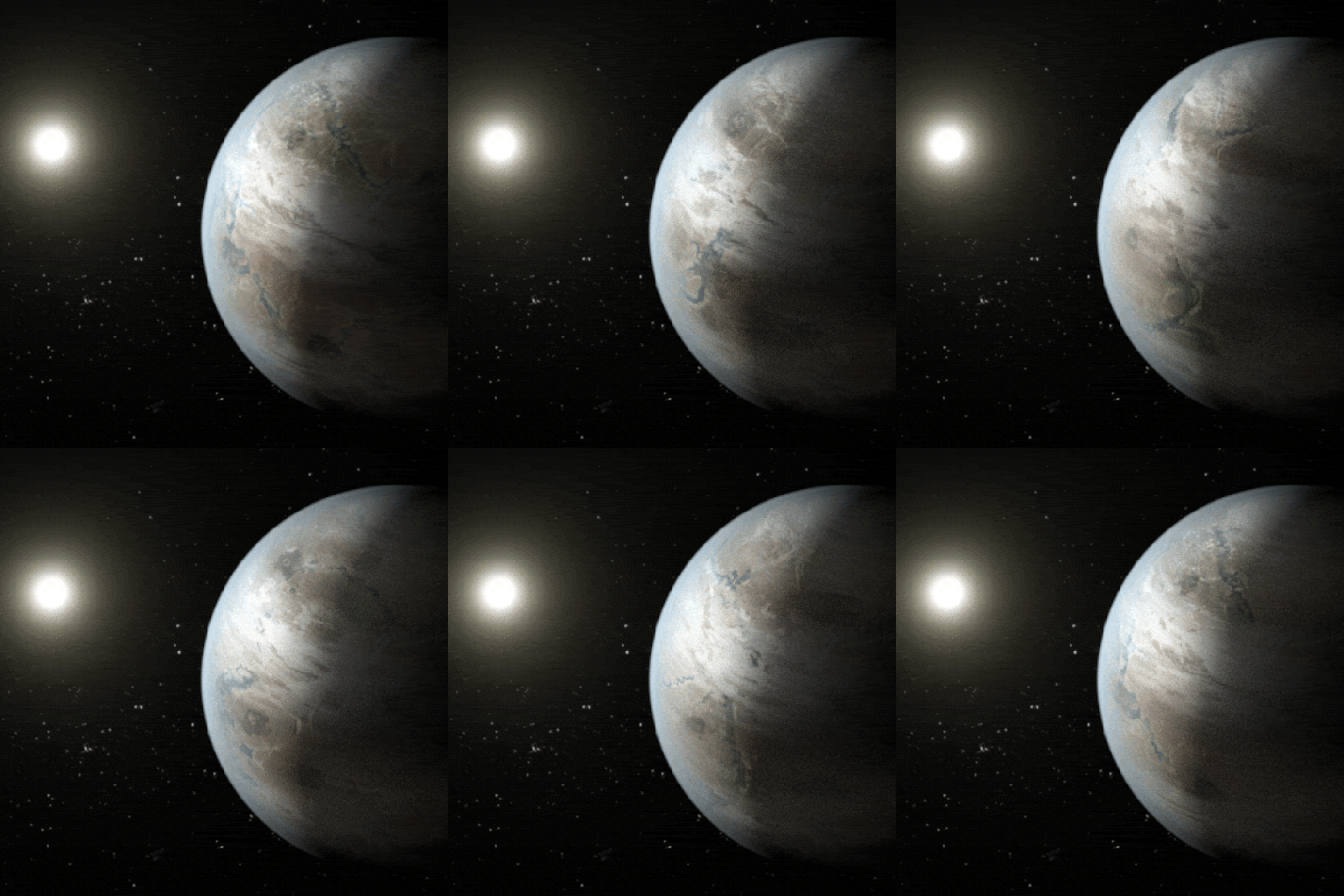
If there are human-sized creatures walking around on other planets, would we be able to view them directly?

There are pros and cons to sending interstellar messages to aliens that may or may not exist.

What lies in store for humanity? Theoretical physicist Michio Kaku explains how different life will be for your descendants—and maybe your future self, if the timing works out.
John Templeton Foundation

Spin, spin, spin — fire! The startup’s radical system could make satellite launches cheaper and cleaner.

Pluto failed to meet the definition of a planet, but some astronomers think there might be a legitimate Planet 9 out there.