




















Search
Space Exploration

Nearly 200 orbital launches are scheduled for 2022.

Yes, the Universe is expanding, but you might wonder, "How fast is it expanding?"

65 million years ago, an asteroid strike caused the 5th great mass extinction. Could we save Earth, today, from a similar event?

As viewed by the MeerKAT telescope, this radio view of the Milky Way blows away every other way we've ever seen our home galaxy.

Space planes could radically lower the cost of spaceflight.

There really might be extraterrestrials out there, attempting to make contact. Here's how science, not fiction, is attempting to find them.

With launch costs dropping and enormous numbers of new satellites filling the sky, can't we just do it all from space?

The Universe is supposed to be the same everywhere and in all directions. So what's that giant "cold spot" doing out there?

Just 12 million light-years away, the galaxies Messier 81 and 82 offer a nearby preview of the Milky Way-Andromeda merger.

Is the Universe finite or infinite? Does it go on forever or loop back on itself? Here's what would happen if you traveled forever.

Besides offering an incredibly cool way to get stuff into space, SpinLaunch promises to reduce the cost of a launch by 20-fold.

From succubi to aliens, stories of abductions or other unsettling encounters have been with us for millennia. What explains them?

Shooting star or piece of space dust?

In terms of the planets we've discovered, super-Earths are by far the most common. What does that mean for the Universe?

It is time to give the Russian cosmologist the credit he deserves.

In 1990, we only knew of the ones in our Solar System. Today, we know of thousands, and that's just the tip of the iceberg.

The massive craft could carry 100 humans to Mars and revolutionize space exploration.

On December 19 1972, astronauts Eugene Cernan, Harrison Schmitt and Ronald Evans splashed down safely in the Pacific Ocean, ending the Apollo 17 lunar mission. They were the last people to travel […]

Coupled with 3D printing, biomining the Moon or Mars with microbes could sustain human colonies without constant re-supply from Earth.

The James Webb Space Telescope finally could answer the age-old question of whether we are alone in the universe.

Some stars burn through their fuel as expected, and die of natural causes. But others, instead, get murdered. Here's their story.

Space missions in 2022 will include massive rockets and asteroid collisions. This is also the year space tourism starts to hit its stride.

A levitating vehicle might someday explore the moon, asteroids, and other airless planetary surfaces.

With advanced laser technology and an appropriate sail, we could accelerate objects to ~20% the speed of light. But would they survive?
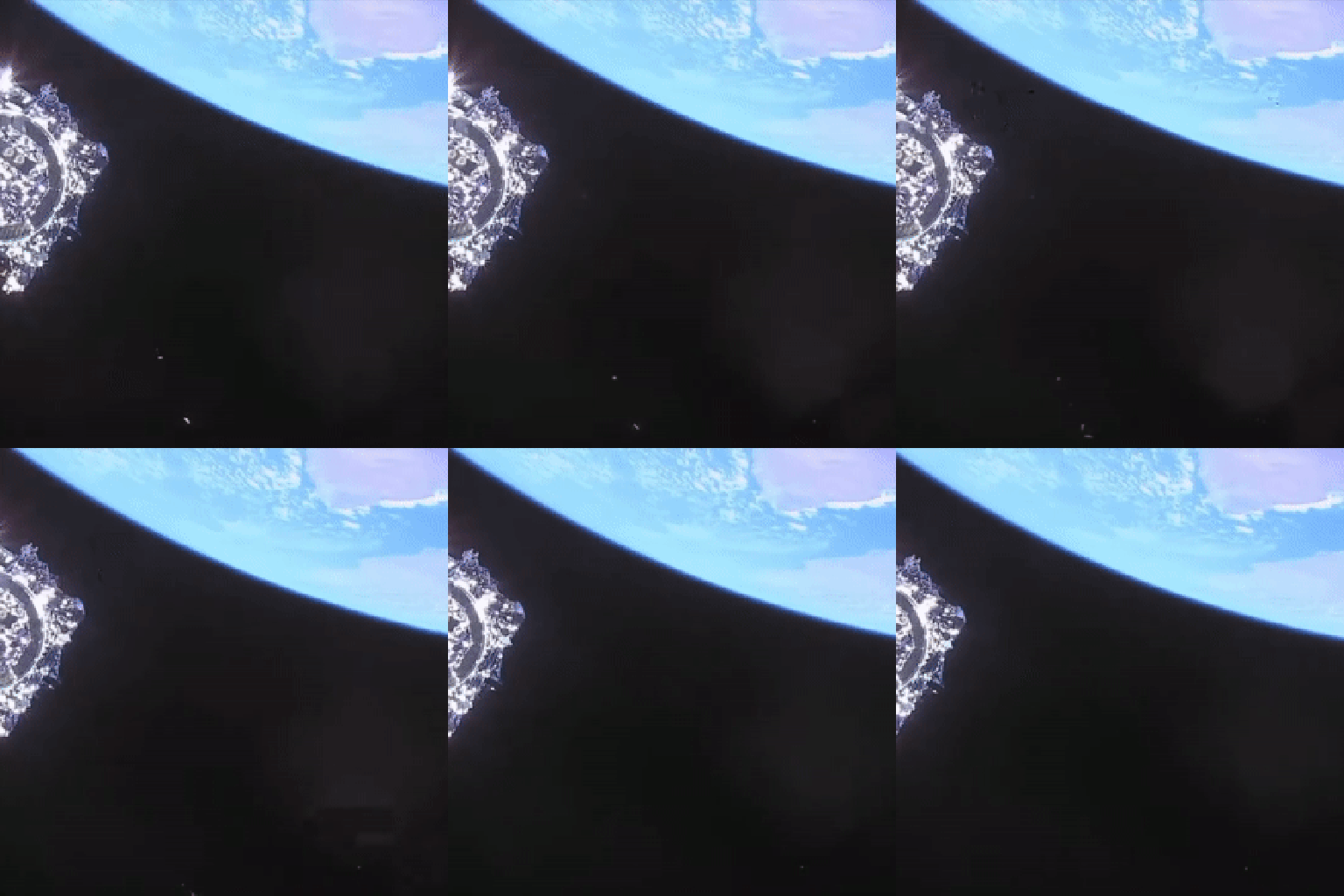
For many, it was just a successful launch like any other. But for scientists around the globe, it was a victory few dared to imagine.

Water on Mars is key for human survival on the Red Planet, not just for drinking but for growing food and making fuel and oxygen.
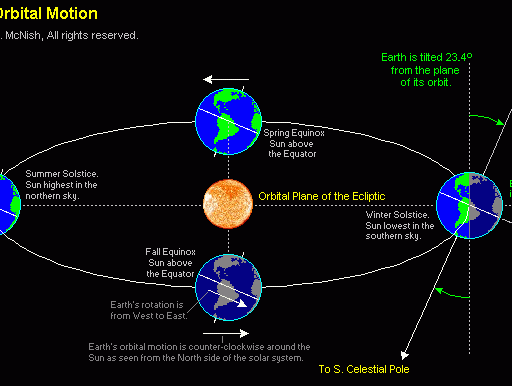
Even with leap years and long-term planning, our calendar won't be good forever. Here's why, and how to fix it.

A wild, compelling idea without a direct, practical test, the Multiverse is highly controversial. But its supporting pillars sure are stable.

Whether or not life exists elsewhere in the Universe, we can be assured of one thing: We are the only human beings in the cosmos.

Whether NASA likes it or not, humans eventually will be having space sex.