




















Search
Space Exploration

As we look to larger cosmic scales, we get a broader view of the expansive cosmic forest, eventually revealing the grandest views of all.
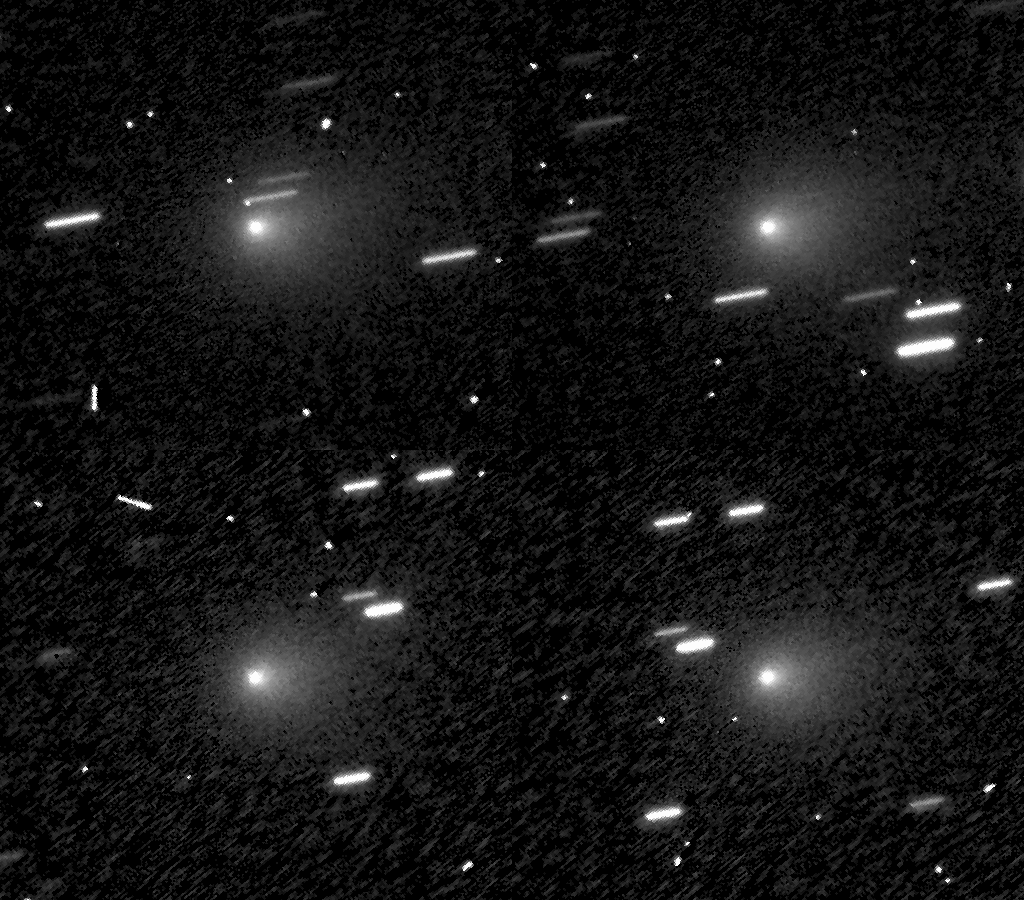
Designed to map galaxies, the SPHEREx mission's first science result is instead about interstellar interloper 3I/ATLAS. No, it's not aliens.

Science helps us imagine the vastness of space and time — and our small but meaningful place within it.

NASA's 1958 charter's top priority was, "the expansion of human knowledge of phenomena in the atmosphere and space." Is this how it ends?

Just 13.8 billion years after the hot Big Bang, we can see 46.1 billion light-years away in all directions. Doesn't that violate...something?

In the search for life in the Universe, the ultimate goal is to find an inhabited planet beyond Earth. How will we know when we've made it?

There are real concerns with long-term power generation on the Moon; nuclear could be the answer. But for NASA, will the cost be too high?

At the end of July, hundreds of scientists convened to plan NASA's upcoming astrophysics flagship mission. Will the US allow it to happen?

Two supermassive black holes on an inevitable death spiral push the limits of Einstein's relativity. New observations reveal even more.

1hr 8mins
“An equation, perhaps no more than one inch long, that would allow us to, quote, 'Read the mind of God.'”

Even just by examining the Moon with the unaided eye, we can learn an incredible amount about the Moon, Earth, and more.

The Big Bang was hot, dense, uniform, and filled with matter and energy. Before that? There was nothing. Here's how that's possible.

When the Hubble Space Telescope first launched in 1990, there was so much we didn't know. Here's how far we've come.

From high school through the professional ranks, physicists still take incredible lessons away from Newton's second law.

1hr 18mins
“Could black holes be the key to a quantum theory of gravity, a deeper theory of how reality, of how space and time works?”

13mins
"We've sent out one or two little messages, but we certainly aren't investing billions of dollars shouting out into the cosmos saying, "Hey, we are here. Come say hi.""

65 million years ago, a massive asteroid struck Earth. Not only did Jupiter not stop it, but it most likely caused the impact itself.

First 'Oumuamua, then Borisov, and now ATLAS have shown us that interstellar interlopers are real. Here's what the newest one teaches us.

Our nearby Ring Nebula, with JWST's eyes, shows evidence for planet formation. Will the Sun eventually destroy, and then replace, the Earth?

Once every 12 years, Earth, Jupiter, Uranus, and Neptune all line up, opening a window for a joint mission. Our next chance arrives in 2034.

Originally, the abundance of bright, early galaxies shocked astronomers. After 3 years of JWST, we now know what's really going on.

In just its first 10 hours of observations, the Vera Rubin observatory discovered more than 2000 new asteroids. What else will it teach us?

For hundreds of millions of years, a cosmic fog blocked all signs of starlight. At last, JWST found the galaxies that cleared that fog away.

As the closest icy ocean world to
Earth, Ceres may be a promising candidate in the search for signs of ancient life.
2mins
We may be close to finding life beyond Earth. But would we even recognize it if we did? Astrobiologist Betül Kaçar explains what signs NASA is looking for.

Massive galaxy cluster Abell S1063, 4.5 billion light-years away, bends and distorts the space nearby. Here's what a JWST deep field shows.
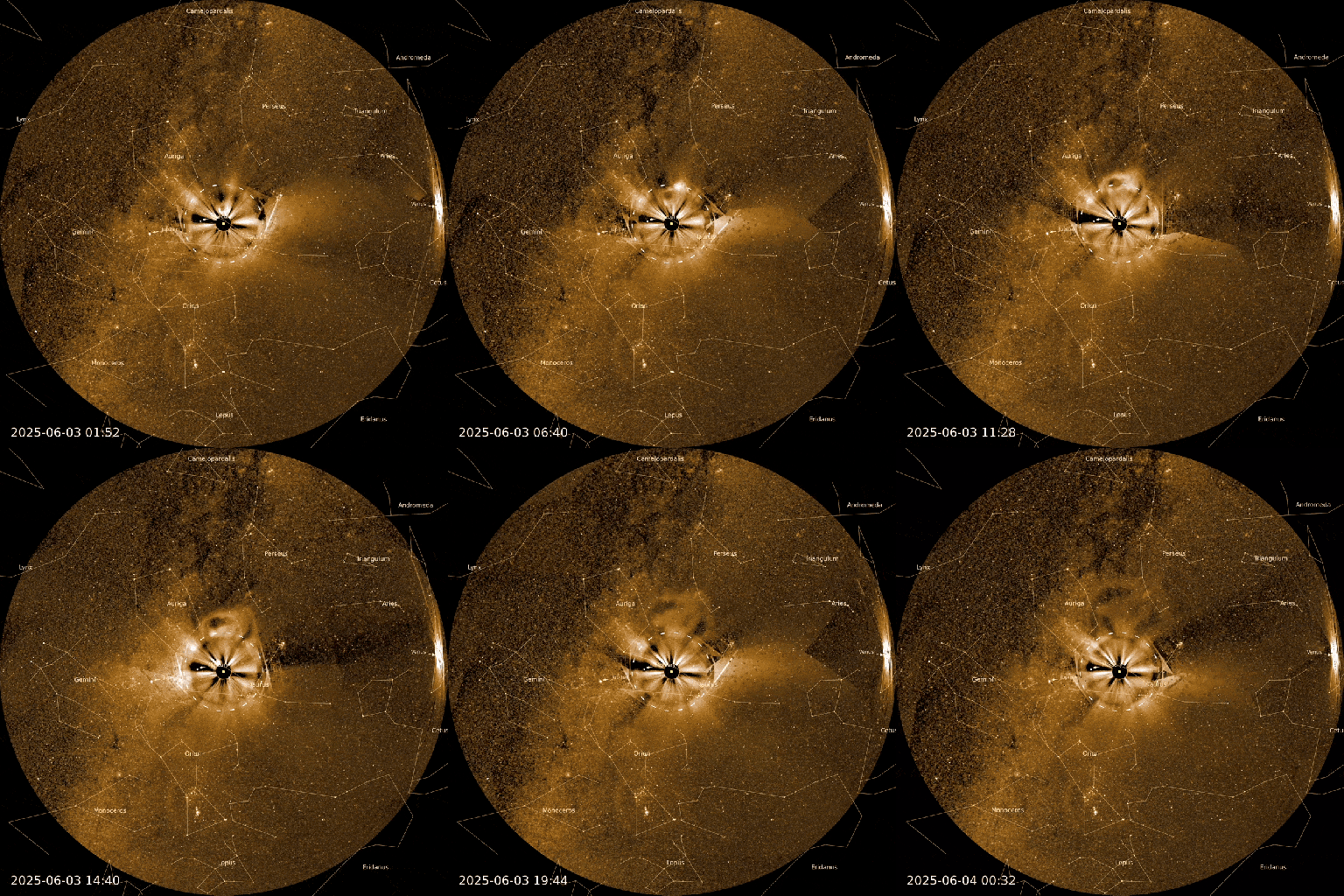
Launched in March, the PUNCH mission has viewed two incredible coronal mass ejections, tracking them farther from the Sun than ever before.

Viewing Uranus's largest moons with Hubble, astronomers hoped to find darkening on the trailing side. They found the exact opposite instead.

The first galaxies were irregular blobs of gas and stars. But modern features, like spiral arms and bars, appeared earlier than expected.

If the Universe is 13.8 billion years old today, but different ages the farther we look back, what does it mean for a star to be the first?