




















Search
Stellar Evolution

Many facts are well-known to professionals, but are unappreciated or even rejected outright by the public. "How stars work" takes the cake.

Although a star's "birth" is well-defined, it doesn't correspond to an ignition event in its core. Here's how stars are actually born.

One parameter, alone, sets the dividing line between rocky planets, gas giants, brown dwarfs, stars, and much more. Here's why mass matters.

By looking at a giant, remarkable, edge-on protoplanetary system, astronomers have found a proto-protoplanet for the first time.

The 1st generation of stars formed, lived, and died very early on. But 2nd generation stars could still persist today. Did we just find one?

In a 13.8 billion year old Universe, a few seconds hardly seems like it matters. But these minuscule changes sure do add up over time.

Over billions of years, fewer stars form, galaxies mutually recede, and the Universe becomes ever darker. Here's how fast it all happens.

Resembling a cosmic brain, the Exposed Cranium Nebula instead shows a dying, massive star, as JWST reveals. Its fate remains uncertain.

Before Sun-like stars die, they transition from AGB red giants into preplanetary nebulae. Here's how Hubble sees the famous Egg Nebula.

13.8 billion years have passed since the Big Bang, but many stars will survive for longer than that. What's the longest-lived a star can be?

Many collaborations have used JWST to take deep-field images: some wider and some deeper than others. Here's how it can surpass them all.

The Sun often produces solar flares and coronal mass ejections, but a rare solar radiation storm made the 2026's first great auroral show.

With unprecedented resolution, wavelength sensitivity, and light-gathering power, JWST reveals our cosmos like no other observatory ever.

Back in 1604, Johannes Kepler discovered the Milky Way's last naked-eye supernova. Here's how NASA's Chandra sees it over the 21st century.

Even the youngest galaxies are often dust-rich, even with very low levels of heavy elements. Nearby dwarf galaxy Sextans A explains why.

If you can identify a foreground star, the spike patterns are a dead giveaway as to whether it's a JWST image or any other observatory.

With the observation of SN 2025wny, a lensed superluminous supernova, astronomy's future comes into sharp, exciting focus.

It takes a wide variety of processes in the Universe to make all the elements that populate space today. We're still discovering new ones!
Planets grow from protostellar material in disks, leading to full-grown planetary systems in time. At last, the final gap has been filled.

When dying, Sun-like stars have binary companions, spectacular sights arise from the ionization. JWST spots the Red Spider Nebula in action!
Red dwarfs are the Universe's most common star type. Their flaring now makes potentially Earth-like worlds uninhabitable, but just you wait.

Our Sun only arose after 9.2 billion years of cosmic history: with many stars living and dying first. How many prior generations were there?

Questions about our origins, biologically, chemically, and cosmically, are the most profound ones we can ask. Here are today's best answers.

Dust is ubiquitous in the modern Universe, appearing in nearly all galaxies. But our cosmos was born dust-free. So where does it originate?
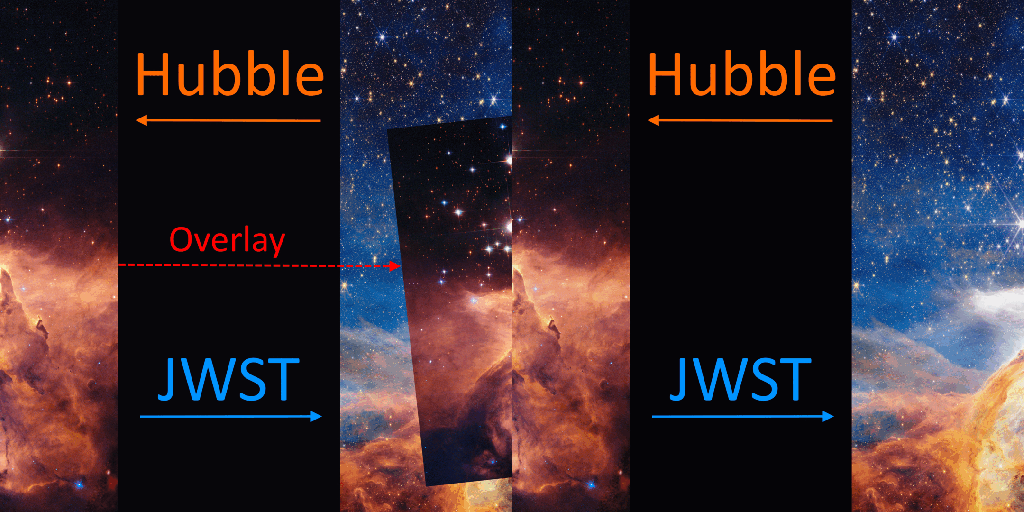
JWST isn't the first telescope to peer into this factory of star-birth some 5500 light-years away, but its views are the most educational.

With several seemingly incompatible observations, cosmology faces many puzzles. Could early, supermassive stars be the unified solution?

In our own Milky Way, a recently deceased star creates a ghostly, hand-like shape in X-rays some 150 light-years wide. Here's how it's made.

Our nearby Ring Nebula, with JWST's eyes, shows evidence for planet formation. Will the Sun eventually destroy, and then replace, the Earth?
Originally, the abundance of bright, early galaxies shocked astronomers. After 3 years of JWST, we now know what's really going on.

Looking at a dark, night sky has filled humans with a sense of awe and wonder since prehistoric times. But appearances can be deceiving.