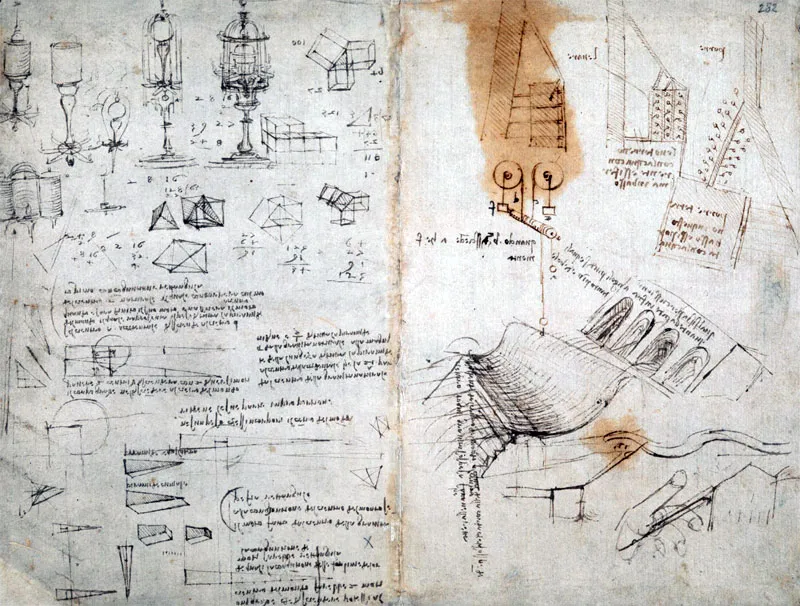
Walking through Progress Conference 2025 in Berkeley felt like flipping through Leonardo da Vinci’s notebooks: that same dizzying surface area, where a sketch of Florentine waterways sits beside anatomical drawings of human musculature, with mathematical theorems scribbled in the margins. Session topics bounced from longevity biotech to nuclear fusion to maritime transportation to why America hasn’t built its own Shenzhen yet.
The sheer variety was striking, yet everything converged under one tent: progress studies, also known as the progress or abundance movement. For one long weekend at the Lighthaven campus, shipbuilding experts stood next to synthetic biologists next to agricultural reformers, all seemingly unconnected until you realized they share a conviction that material progress has stalled in America, and that restarting it requires cultural transformation and physical building.
Among the crowd, I sensed a yearning for what writer Dan Wang calls “physical dynamism,” the tangible acceleration of the material world that makes tomorrow feel radically different from today. This dynamism has largely vanished from America over the past few decades. But at this conference, I saw glimmers of it returning.
Two projects struck me as particularly emblematic of this resurgence: California Forever and Navier. The former aims to build an entirely new city in southeastern Solano County (between Sacramento and the Bay Area). The latter wants to revolutionize water transportation.

As part of Progress Conference 2025’s agenda, I visited Navier’s assembly plant at its headquarters in Alameda. Water puddles glistened under fluorescent lights. Tattooed engineers worked alongside machinists, assembling carbon-fiber hydrofoils that will literally fly across the San Francisco Bay. An American flag hung from the roof.
Navier’s founder, Sampriti Bhattacharyya, emigrated from Kolkata, India, to the U.S. and is now building America’s first all-electric hydrofoil boats — if Navier achieves its vision, these vehicles will slash Bay Area commute times from 90 minutes to less than 10.
During the conference, I met another immigrant attempting something even more audacious. Jan Sramek, a 37-year-old former Goldman Sachs trader born in the Czech Republic, is spearheading California Forever, which has spent nearly $1 billion on acquiring land to build its new city. His diagnosis is that America has forgotten how to build cities at scale. His solution? Well, start from a vast amount of farmland and build a mixed-income city with affordable housing, walkable neighborhoods, and integrated public transit — precisely the kind of urban planning that progressive advocates champion, but that NIMBY (“not in my backyard”) homeowners consistently block. It’s an attempt to prove that the “shining city on a hill” is achievable if you’re willing to bypass decades of accumulated regulatory sclerosis.
Immigrants see not only what America could become, but what it risks losing.
Amid all this intellectual diversity, a pattern emerged that the conference rarely named explicitly: The most audacious physical dynamism projects are led by first-generation immigrants. Look closely at the progress movement’s architecture, and you’ll see immigrants everywhere, including at the foundation.
Patrick Collison, the Irish immigrant who co-founded Stripe, not only launched “progress studies” with Tyler Cowen in 2019, but has since become a kind of Medici figure for the movement, funding ventures ranging from the Roots of Progress Institute to frontier research projects that push the meta-lever of progress.
Heike Larson, who co-founded the Roots of Progress Institute and recruited me as a writing fellow, grew up in divided Germany. During my interview a few months ago, she traced uncanny parallels between Germany’s postwar rebuilding and contemporary China’s development, recognizing in both the psychology of nations determined to prove themselves.
Dan Wang, a Chinese Canadian author of the blockbuster Breakneck, urges American builders to study the advantageous parts of China’s engineering state, not merely as an adversary, but as a mirror and reference point for the state capacity that America has let atrophy.
I write this as a first-generation immigrant from China myself, constantly struck by the sheer ambition of immigrants who come to America to realize their boldest dreams, and by how America has provided that ground for so many years. The founders building most aggressively come from places that followed radically different development paths than America — some spectacularly successful, others failed. They watched Mumbai expand and Shenzhen materialize from fishing villages. They internalized different baselines for what’s possible, and different nightmares of what could go wrong.
That wisdom matters. Immigrants not only bring non-American-centric mindsets and building speed. They carry lived experiences of both progress and collapse, which breeds a particular kind of vigilance. They see not only what America could become, but what it risks losing. Many arrived believing in promises America made to the world, and now they’re trying to hold the country accountable to those promises, to push it to live up to the dream that brought them here.
If anything, this cosmopolitanism grounded in American reality defines what dynamism actually means to me.
China as America’s benchmark
Kevin Kelly — one of my favorite writers — recently published his latest book, 2049: The Next 10,000 Days, in Chinese only. In it, he describes “Cool China”: a future version of the nation that produces cool products with a creativity and charm that others will want to imitate. In my observation, today’s China is already serving as a benchmark, foil, and mirror for the U.S. But here’s what strikes me about Progress Conference 2025’s fixation on China: It’s almost entirely abstract. China functions as a building machine in the American imagination, a proof-of-concept that ambitious infrastructure remains possible, while the actual lived reality of Chinese people is invisible to Silicon Valley’s gaze.
The “Cool China” that captivates the progress movement consists of gleaming subway systems, synchronized drone shows, and EV factories churning out vehicles at impossible speeds. The “real China,” I argue, the economic structures governing most people’s lives, the feminist backlash against the state, the slow-motion real estate collapse, the vivid corners of the Chinese internet, barely registers. China becomes a motivational poster for American builders.
And yet, this abstract China is working and helpful. I’m not objecting. I’m marveling at how it’s catalyzing American ambition in ways that feel almost perverse in their effectiveness.
Jan Sramek told me his California Forever project could be America’s response to Shenzhen — just as Shenzhen was originally China’s response to Silicon Valley’s San Jose. It’s a feedback loop of competitive mimicry, each side using the other as proof that their own institutions could be better. During her talk, Navier founder and CEO Sampriti Bhattacharyya invoked the industrial capacity of Chinese shipbuilding, a sector where China now accounts for over 70% of new ship orders globally.
Dan Wang’s book Breakneck has given people a more grounded context to understand China, as well as the U.S., and has become canonical in the progress community. It reveals new facts about China, but also articulates what American builders already feel viscerally: that the U.S. is trapped in lawyerly procedures while physical dynamism accelerates elsewhere.
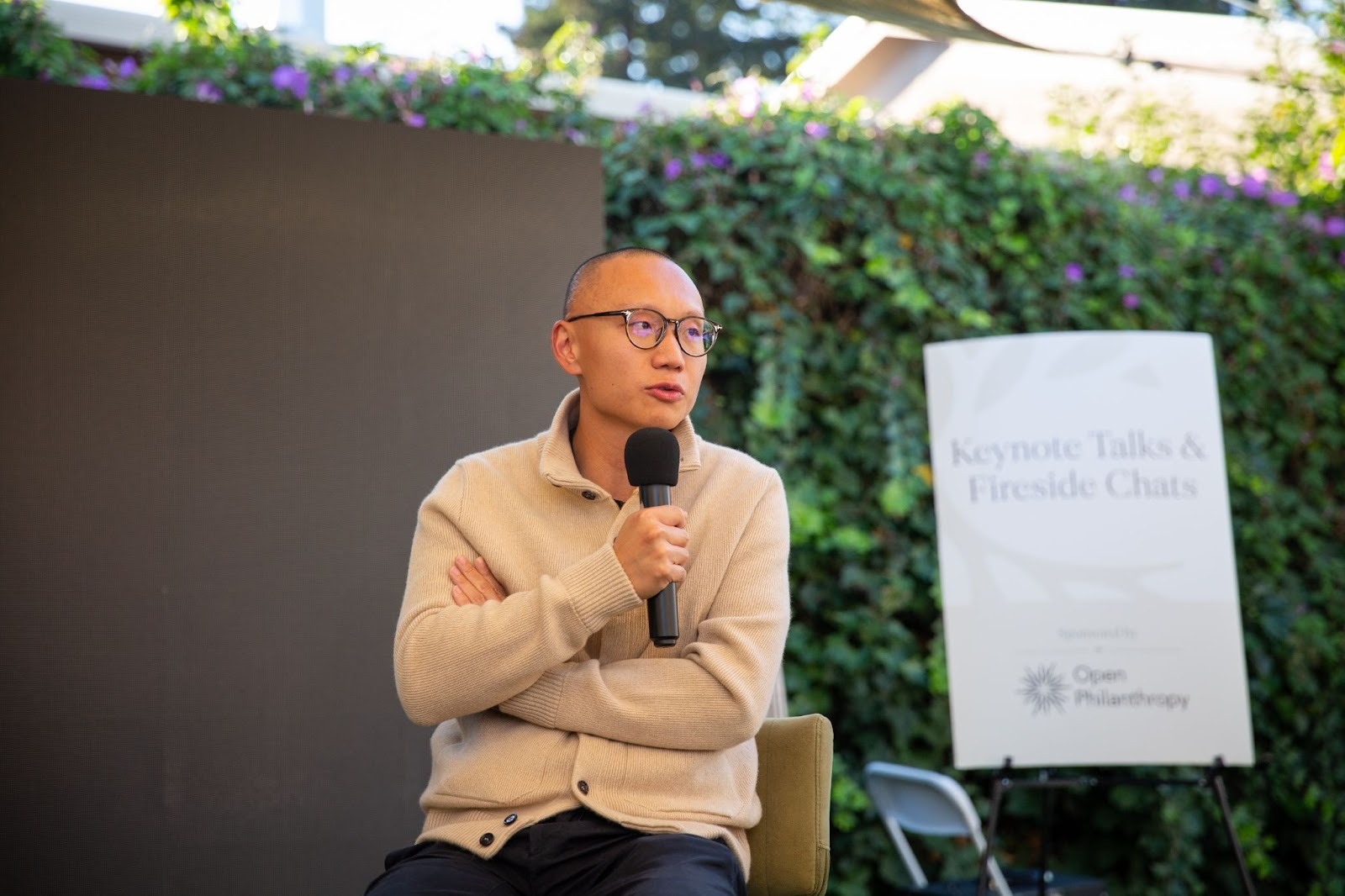
Wang’s keynote drove this home with brutal comparisons. California’s high-speed rail has consumed $120 billion since 2008 without connecting San Francisco to Los Angeles — the completion date keeps receding like a mirage. China, starting from scratch the same year, completed its Beijing-Shanghai line in three years for $40 billion. It has now served 1.4 billion riders. The gap is embarrassing.
The audience, engineers, founders, scientists, policymakers, leaned forward as Wang laid out more examples. Many had spent years watching Chinese companies like BYD and Xiaomi iterate on EVs and consumer electronics with a cadence that makes Detroit and Apple look arthritic. Ford’s CEO recently admitted Chinese EVs are not only better but cheaper — a confession that would have been unthinkable a decade ago. During COVID, America couldn’t manufacture N95 masks or test swabs at scale. The defense industrial base sputters: naval ships arrive years late, while drone production stays glacial and expensive.
In another talk, Derek Thompson traced California’s transformation from builder to blocker through two cities. In 1950, Lakewood, once just a cattle ranch, built 17,000 homes in three years, completing one new house every 7.5 minutes. By 1954, it was California’s 19th-largest city. Then came Petaluma’s 1971 growth-control plan, capping new housing at 500 units annually. That model metastasized. Today, Thompson noted, California is far more Petaluma than Lakewood; regulations designed to protect communities now prevent building the infrastructure those communities desperately need.
One of the problems, according to Wang, is a missing link in America’s elite pipeline. The best engineers flow toward $500K AI jobs at startups. The best lawyers flow toward federal clerkships and partnerships. There’s no Tsinghua-to-Politburo equivalent where technical expertise becomes political power. “Yale Law dominates federal power,” Wang noted in his keynote. “For Stanford engineers? Why would they leave Silicon Valley to navigate bureaucracy?”
In Breakneck, Wang writes that he wants Americans to experience what “many Chinese have felt in the past two decades” — the visceral thrill of watching infrastructure materialize before your eyes, of tomorrow feeling radically different from today. But this requires institutional power change. It requires engineers in positions where they can actually authorize building rather than merely advising lawyers who ultimately make decisions.
Expanding American Dynamism
“American Dynamism” emerged as a venture capital thesis around 2022, coined by Andreessen Horowitz partner Katherine Boyle to describe startups tackling hard problems in physical infrastructure, defense, and manufacturing, sectors that Silicon Valley had long ignored in favor of consumer apps. The term metastasized quickly, spreading beyond VC pitch decks into a broader ideological project: a wager that American entrepreneurship could rebuild the country’s atrophied industrial capacity.
But the term itself occupies awkward ideological territory, one I want to challenge and expand. Born from Silicon Valley techno-optimism and cultivated by venture capitalists, it risks becoming another neoliberal fantasy: deregulation dressed as patriotism, celebrating founders while minimizing workers.
America cannot reindustrialize without immigrants and immigration reform.
The immigrant founders I encountered during Progress Conference 2025 complicate and enrich this narrative. Many articulate social democratic visions rooted in cosmopolitan patriotism: infrastructure investment paired with robust labor protections, immigration reform as an innovation necessity, abundant housing and transit as public goods. Their version of American Dynamism is redistributive, physically dynamic, and has strong building capacity.
And I want to articulate a truth the conference barely whispered: America cannot reindustrialize without immigrants and immigration reform. It also cannot do it alone, without borrowing wisdom from countries like China, Korea, Singapore, etc. I envision a different future: one where immigrants and transnational talent, people carrying know-how and the secret formulas across borders, fluent in multiple systems, fuel this dynamism. Radically pluralistic, ambitious, grounded in the lived experience of people who urge America grow into something it’s never quite been.
This matters because one of America’s most enduring myths is that anyone can become American. As historian Oscar Handlin wrote, “Once I thought to write a history of the immigrants in America. Then I discovered that the immigrants were American history.”
When American identity becomes malleable, absorptive, self-evolving, self-contesting, when it remains a living argument rather than fixed inheritance — its convening power can cut through stagnation. That power depends on keeping the door open, on treating “American” as a verb rather than a noun.
I don’t want to pretend I don’t see the Trump administration’s increasingly draconian immigration policies: the hostile rhetoric, the H-1B visa restrictions weaponized against skilled workers, and ICE raids terrorizing communities. The cruelty is real and accelerating. But what gives me stubborn hope is the resilience both immigrants and the American identity itself have demonstrated.
Injecting “industrial literacy”
Jason Crawford, founder of the Roots of Progress Institute, closed the conference with a keynote that made the cultural project explicit: a new summer program for high school students, marketed as college prep but really an introduction to “industrial literacy,” a term I found so valuable. It means a visceral understanding of how the modern world actually works, from semiconductor fabrication to power grids to container shipping.
Crawford’s vision draws on economic historian Joel Mokyr’s insight that cultural factors determine whether societies innovate or stagnate. In The Gifts of Athena, Mokyr writes, “What matters clearly is culture and institutions. Culture determines preferences and priorities. All societies must eat — but cultural factors decide whether the best and brightest tinker with machines and chemicals, or perfect swordplay or study the Talmud.”
Crawford wants to shift American culture so that building physical infrastructure becomes as prestigious as writing code or filing briefs. “Students should graduate knowing the hockey-stick curves of human development,” he argued, “but also the vast opportunities still ahead.”
There’s something valuable I found everywhere in the conference, this deliberate cultivation of ambition. Reflecting on the entire Progress Conference 2025 and my experience as a Roots of Progress fellow, I felt wrapped in what I can only describe as examined and chosen optimism: a joyfulness and eagerness about progress that felt both strategic and sincere. This optimism is rare in today’s America, where apocalyptic thinking dominates both left and right, where every technological advance gets framed primarily through its dangers. This is a simple yet encouraging belief that progress is good, necessary, and achievable.
As Kevin Kelly says repeatedly: “Over the long term, the future is decided by optimists.” I believe this deeply. Instilling optimism — even willing yourself toward it. I’ve watched the United Kingdom, paralyzed by apologetic guilt over its industrial and colonial past, unable to build anything ambitious. The constant moral self-flagellation produces neither justice nor dynamism; it left the country stagnant, wrapped in ethical language. The progress community’s refusal to apologize for wanting to build is deeply liberating. Progress is good. We need more of it. The refusal to hedge that claim matters.

The Energy Transition