




















Search
Science

"Color" with respect to the strong force is just an analogy. Here's how to understand it without colors, group theory, or any advanced math.

Even though no human has stepped foot on the Moon's surface in 50 years, the evidence of our presence there remains unambiguous.

Is dark energy evolving with at least 99.99% confidence? Despite the quality of recent data, scientists have every reason to be skeptical.

Most massive galaxies are spiral or elliptical shaped. But peculiar galaxies showcase the beautiful violence that helps explain our cosmos.

In theory, the fabric of space could have been curved in any way imaginable. So why is the Universe flat when we measure it?

In traveling through the expanding Universe, particles slow down while light and gravitational waves redshift. What degrades and what won't?

The fundamental building blocks of reality are indivisible: quanta that cannot be split or divided. Our understanding remains incomplete.

A big open question in 21st-century science is how life began here on Earth. The metabolism-first scenario just might be the best one.

At the upper limits of what's energetically possible, cosmic rays still persist. What happens if a human gets hit by the most energetic one?
The seeds of cosmic structure that were planted back during the Big Bang grew into the cosmic web we see today. What is it telling us?

Perhaps the most remarkable fact about the Universe is simply that it, and everything in it, exists. But what's the reason why?

While ice itself is slick, slippery, and difficult to navigate across under most circumstances, skaters easily glide across the ice.

With the observation of SN 2025wny, a lensed superluminous supernova, astronomy's future comes into sharp, exciting focus.

It takes a wide variety of processes in the Universe to make all the elements that populate space today. We're still discovering new ones!

The far side of the Moon is incredibly different from the Earth-facing side. 66 years later, we know why the Moon's faces are not alike.

With new labs, funding models, and institutions, metascience is reinventing the machinery of discovery.

Panpsychist philosopher Philip Goff, PhD on mysticism and the future of faith.
John Templeton Foundation

When dying, Sun-like stars have binary companions, spectacular sights arise from the ionization. JWST spots the Red Spider Nebula in action!

For 13.8 billion years, the Universe has been expanding. But that couldn't have been the case for an eternity, and science has proven it.

Proposed over 2000 years ago by Democritus, the word atom literally means uncuttable. Revived in 1803, today's "atoms" can indeed be split.

Members
In this expert class, writer Maria Konnikova explores how Sherlock Holmes's rational sleuthing techniques can be applied to real-world science, enhancing our understanding of memory, creativity, and problem-solving.

The red planet, Mars, may once have been teeming with life, just as Earth is today. Finding "organics" on Mars, however, doesn't mean life.

When you don't have enough clues to bring your detective story to a close, you should expect that your educated guesses will all be wrong.

The Universe was born incredibly hot, and has expanded and cooled ever since. Could life have begun back when space was "room temperature?"

2mins
Astrobiologist Betül Kaçar on why the simple act of asking questions (without needing a reason) is one of the most powerful things a human can do.

When it comes to our Universe's origins, scientists discuss the Big Bang, cosmic inflation, and other theories. Why doesn't "God" come up?

Somewhere, at some point in the history of our Universe, life arose. We're evidence of that here on Earth, but many big puzzles remain.
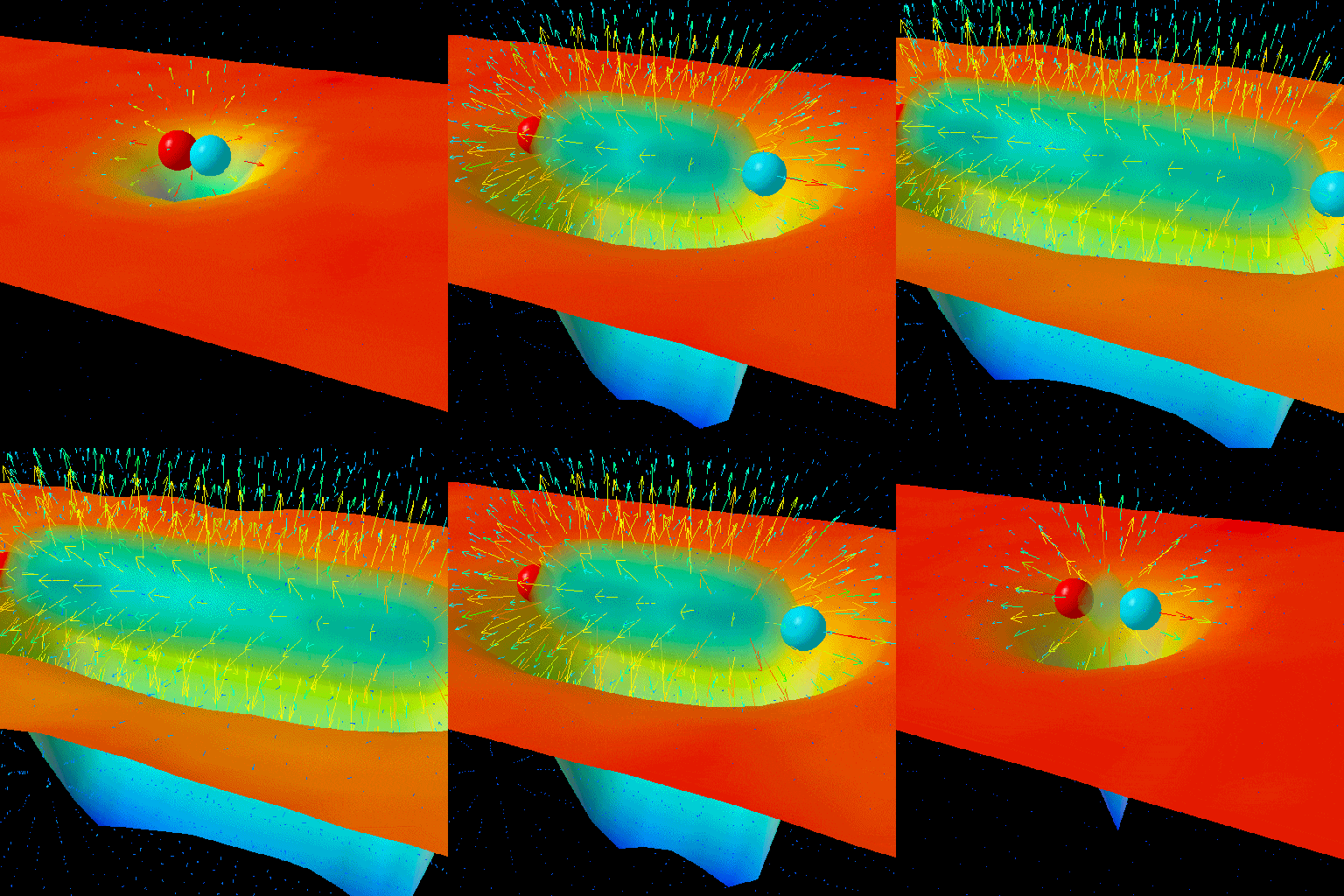
The measured value of the cosmological constant is 120 orders of magnitude smaller than what's predicted. How can this paradox be resolved?

19mins
"It's a very, very beautiful calculation, but it's the best example I know of the relationship between these rather abstract quantities perhaps and something that you can look at in a telescope."

Looking at a dark, night sky has filled humans with a sense of awe and wonder since prehistoric times. But appearances can be deceiving.