




















Search
Scientific Method

Many facts are well-known to professionals, but are unappreciated or even rejected outright by the public. "How stars work" takes the cake.

The distance ladder and the CMB give incompatible values for the expansion rate. A new study shows just how robust the Hubble tension is.

Is dark energy evolving with at least 99.99% confidence? Despite the quality of recent data, scientists have every reason to be skeptical.

Not everyone accepts the scientific consensus; some even make careers out of challenging it. But only a select few do it the right way.

Just like animals, galaxies often have bizarre, unusual, or even unique properties. But finding many, all at once, really does raise alarms.

The highest-energy particles could be a sign of new, unexpected physics. But the simplest, most mundane explanation is particularly iron-ic.

Science isn't absolute. Its truths and discoveries enable us to approximate reality, but we must always remain open-minded to revisions.

Dark matter, dark energy, and the Big Bang are all part of a solid scientific foundation. Here's why popular media often claims otherwise.

What if the first search for life beyond Earth actually succeeded?

There's some, but not overwhelming, evidence that dark energy is evolving. What would it take for a "Big Crunch" to be our cosmic fate?

Dark matter has never been directly detected, but the astronomical evidence for its existence is overwhelming. Here's what to know.

Since the time of Galileo, Saturn's rings have remained an unexplained mystery. A new idea may have finally solved the longstanding puzzle.

Just because a paper passes peer review doesn't mean that what's written, or what the author asserts, is true. Here's why it still matters.

Organic compounds can form through simple chemistry alone — making the search for true biosignatures trickier than it seems.

The fear of unleashing forces beyond control has haunted science for centuries.

"For many people, the idea that consciousness is a set of tricks is offensive," the late philosopher told Big Think in 2012. "I think that's a prime mistake."

Einstein is credited with saying, "If the facts don't fit the theory, change the facts." What he actually said has a very different meaning.

When it comes to our Universe's origins, scientists discuss the Big Bang, cosmic inflation, and other theories. Why doesn't "God" come up?

No matter what it is that we discover about reality, the fact that reality itself can be understood remains the most amazing fact of all.

Can the top quark, the shortest-lived particle of all, bind with anything else? Yes it can! New results at the LHC demonstrate toponium exists.

The CMB has long been considered the Big Bang's "smoking gun" evidence. But after what JWST saw, might it come from early galaxies instead?

Is the Universe's expansion rate 67 km/s/Mpc, 73 km/s/Mpc, or somewhere in between? The Hubble tension is real and not so easy to resolve.

Different methods of measuring the Universe's expansion rate yield high-precision, incompatible answers. But is the problem robustly real?

When theory and experiment disagree, it could mean new physics. This time, they solved the muon g-2 puzzle, and saved the Standard Model.

“It is natural to want to avoid failure. But when we avoid failure, we also avoid discovery and accomplishment."

A paradigm should be elastic enough to accommodate new data and broad enough to explain the world. For Rupert Sheldrake, ours does neither.

Many, from neuroscientists to philosophers to anesthesiologists, have claimed to understand consciousness. Do physicists? Does anyone?

For centuries, even after we knew the Sun was a star like any other, we still didn't know what it was made of. Cecilia Payne changed that.

Our scientific instruments are constantly improving, revealing nature's workings as never before. Without them, we'll remain in the dark.
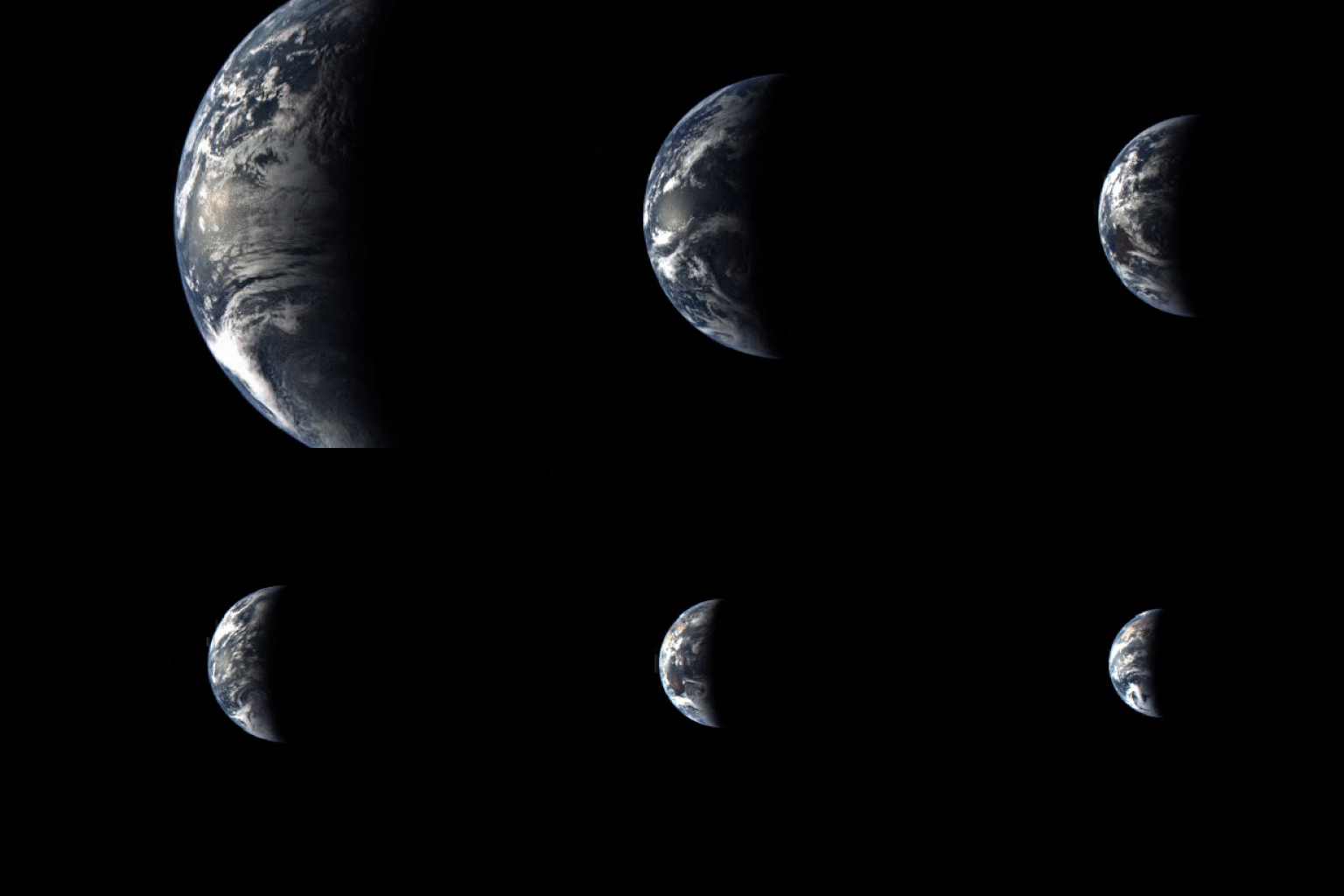
All scientific theories are limited in scope, power, and application, being mere approximations of reality. That's why consensus is vital.