




















Search
Space Exploration

Our dream of journeying to other star systems has a big obstacle to overcome: the vast interstellar distances. Can antimatter get us there?

From 2004 through 2017, Saturn was imaged many times and from many angles up close by Cassini. This new viral image isn't real; it's AI.

By looking at a giant, remarkable, edge-on protoplanetary system, astronomers have found a proto-protoplanet for the first time.

Human beings have now traveled farther from Earth than ever before with Artemis II's flyby of the lunar far side. Here's how it happened.

Mars was warmer and wetter long ago. If anything was alive there, what came next was either a tragedy or a masterclass in survival.

As the world teeters on the brink of nuclear war, distant, advanced civilizations would never know it. Earth appears peaceful from far away.

The 1st generation of stars formed, lived, and died very early on. But 2nd generation stars could still persist today. Did we just find one?

Even though no human has stepped foot on the Moon's surface in 50 years, the evidence of our presence there remains unambiguous.

Instead of hauling heavy building materials across space, future astronauts may grow fungal shelters from spores, waste, and local regolith.

Most massive galaxies are spiral or elliptical shaped. But peculiar galaxies showcase the beautiful violence that helps explain our cosmos.
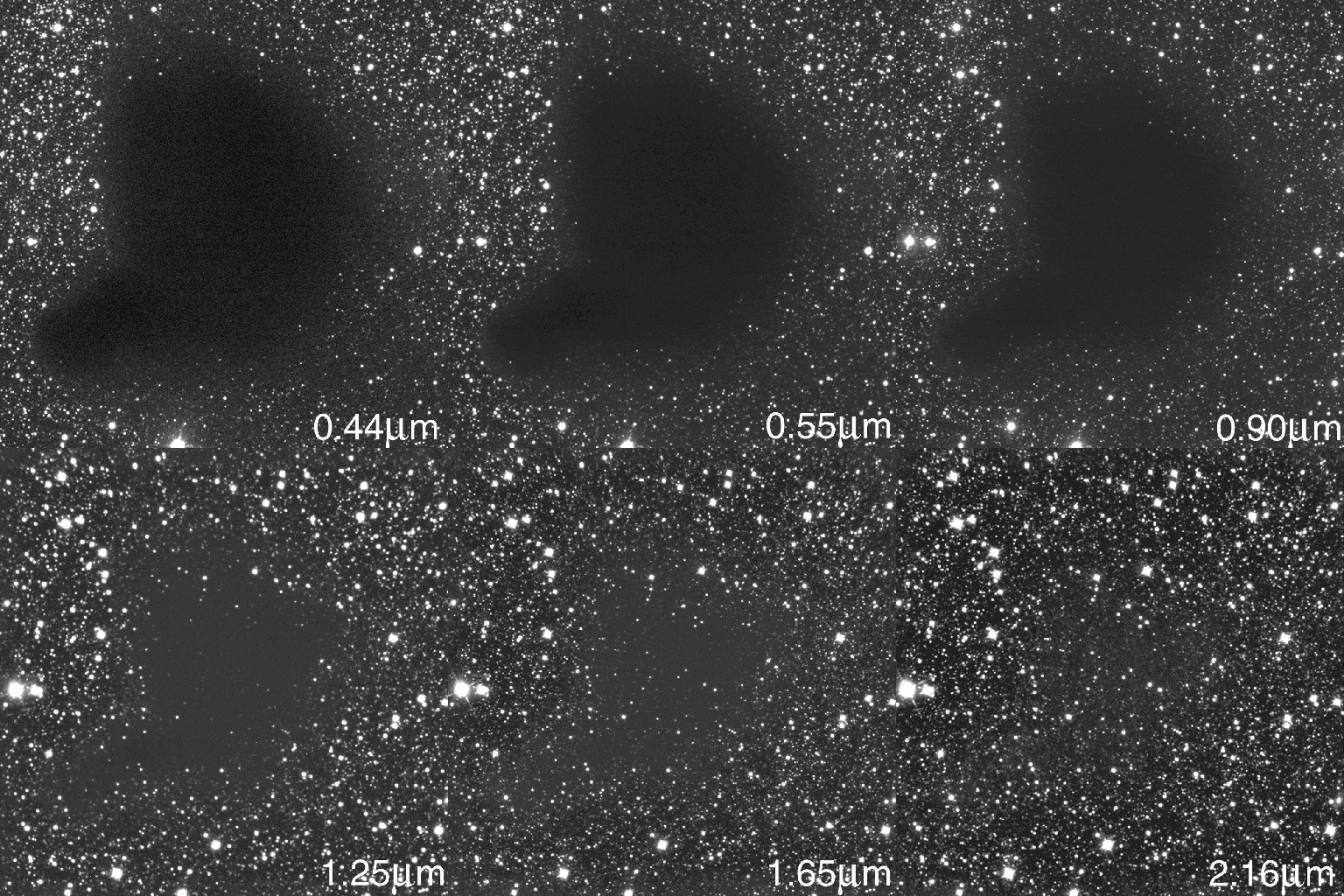
The image you're seeing isn't a hole in the Universe, and the cosmic voids that do exist aren't hole-like at all.

Andy Weir’s novel blends humor, scientific rigor, and human ingenuity to make science fiction feel believable and thrilling.

Looking up at the night sky gives us a glimpse of the Universe beyond our terrestrial concerns. Here's the science of what's out there.

No matter what physical system we consider, nature always obeys the same fundamental laws. Must it be this way, and if so, why?

Nothing lives forever, at least, not in the known Universe. But relativity allows us to get closer than ever: from a physics perspective.

The path to exploring the high-energy Universe was clear and compelling. Here's how 2025's cuts are still causing NASA casualties in 2026.

Resembling a cosmic brain, the Exposed Cranium Nebula instead shows a dying, massive star, as JWST reveals. Its fate remains uncertain.

No civilization, no matter how successful, can last forever. What does the non-detection of intelligent aliens mean for our own longevity?

No human has ever left the Solar System, and only six already-launched spacecraft will ever exit it. Will Voyager 1 remain the most distant?

Forget about the terawatt lasers we're making on Earth. The Universe makes natural ones thousands of times more powerful than the Sun.

There are plenty of engineering obstacles, and those can be overcome. But you cannot change the laws of physics, and those matter too.

Science fiction romanticized Mars as a place of adventure and future settlement; science tells a very different story.

Some sci-fi aliens are wildly implausible. Others aren’t so far-fetched.

One big goal of science is to find an inhabited, Earth-like planet. But if we find an Earth-like world, will we even recognize it?

The unanswered questions about sex, love, and pregnancy in space could shape the future of humanity more than we think.

No claim has even made it halfway up the Confidence of Life Detection (CoLD) scale, but 21st century science is just beginning to unfold.

13.8 billion years have passed since the Big Bang, but many stars will survive for longer than that. What's the longest-lived a star can be?

Even at its faintest, Venus always outshines every other star and planet that's visible from Earth, and then some!

Many collaborations have used JWST to take deep-field images: some wider and some deeper than others. Here's how it can surpass them all.

At the upper limits of what's energetically possible, cosmic rays still persist. What happens if a human gets hit by the most energetic one?