




















Search
Space

Planets grow from protostellar material in disks, leading to full-grown planetary systems in time. At last, the final gap has been filled.

Until the late 20th century, there wasn't a truly universal standard. Under our current definition, everyone agrees on what "one meter" is.

Times dilate and lengths contract near the speed of light. Bizarre and confusing? Sure. But under relativity, it can't be any other way.

Stellar streams are faint trails of stars that appear to "stream" out of galaxies. A new one, escaping galaxy M61, may point to many others.

When dying, Sun-like stars have binary companions, spectacular sights arise from the ionization. JWST spots the Red Spider Nebula in action!

Physicist Daniel Whiteson challenges the notion that all intelligent species would eventually uncover the same laws of nature. Do you agree?

Found by Hubble before JWST's launch, GNz7q looked like a mix of a galaxy and a quasar. Was it actually our first known "little red dot"?

Solar power has the disadvantage that there's no Sun at night. Satellite startup Reflect Orbital wants to change that, but at what cost?

The Orionids meteor shower peaks October 20th/21st here in 2025, coinciding with a new Moon. See the brightest shooting stars of the year!

To learn how our Universe grew up, we have to look at large numbers of galaxies at all distances to find out. Good thing we have JWST!

Since the time of Galileo, Saturn's rings have remained an unexplained mystery. A new idea may have finally solved the longstanding puzzle.

23mins
"Could black holes be the key to a quantum theory of gravity, a deeper theory of how reality, of how space and time works? Well, I think so."

The universe is filled with unlikely events, but it is also full of ways to fool ourselves.

10 years ago, LIGO first began directly detecting gravitational waves. Now better than ever, it's revealing previously unreachable features.

In this excerpt from "Facing Infinity," Jonas Enander examines how John Michell conceived of "dark stars," or massive bodies with enough gravity to trap light, all the way back in 1783.

Going back to 1990, we hadn't even found one planet outside of our Solar System. As we close in on 6000, we now see many of them directly.

Across all wavelengths of light, the Sun is brighter than the Moon. Until we went to the highest energies and saw a gamma-ray surprise.

With several seemingly incompatible observations, cosmology faces many puzzles. Could early, supermassive stars be the unified solution?

Explanations for the cosmic speed limit often conflate mass with inertia.
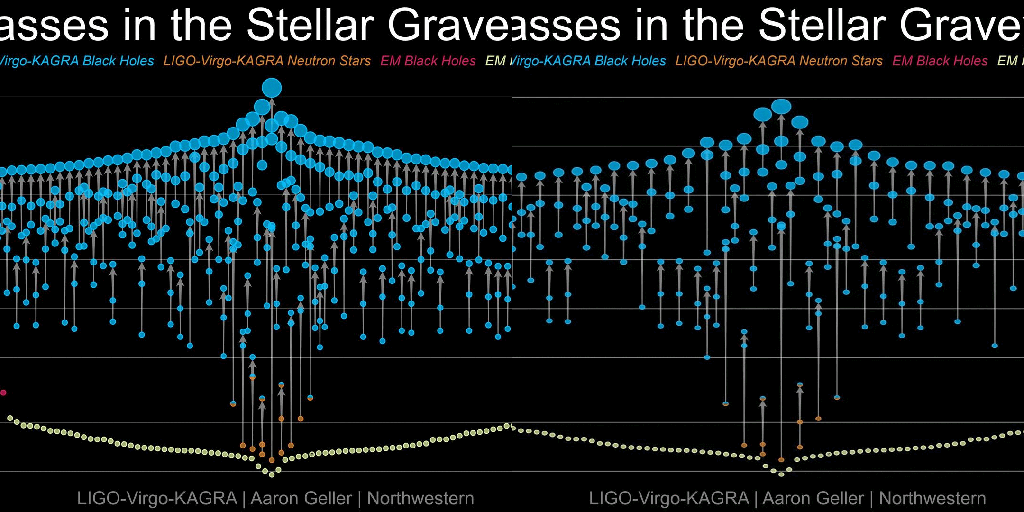
10 years ago, LIGO saw its first gravitational wave. After 218 detections, our view of black holes has changed forever. Can this era endure?
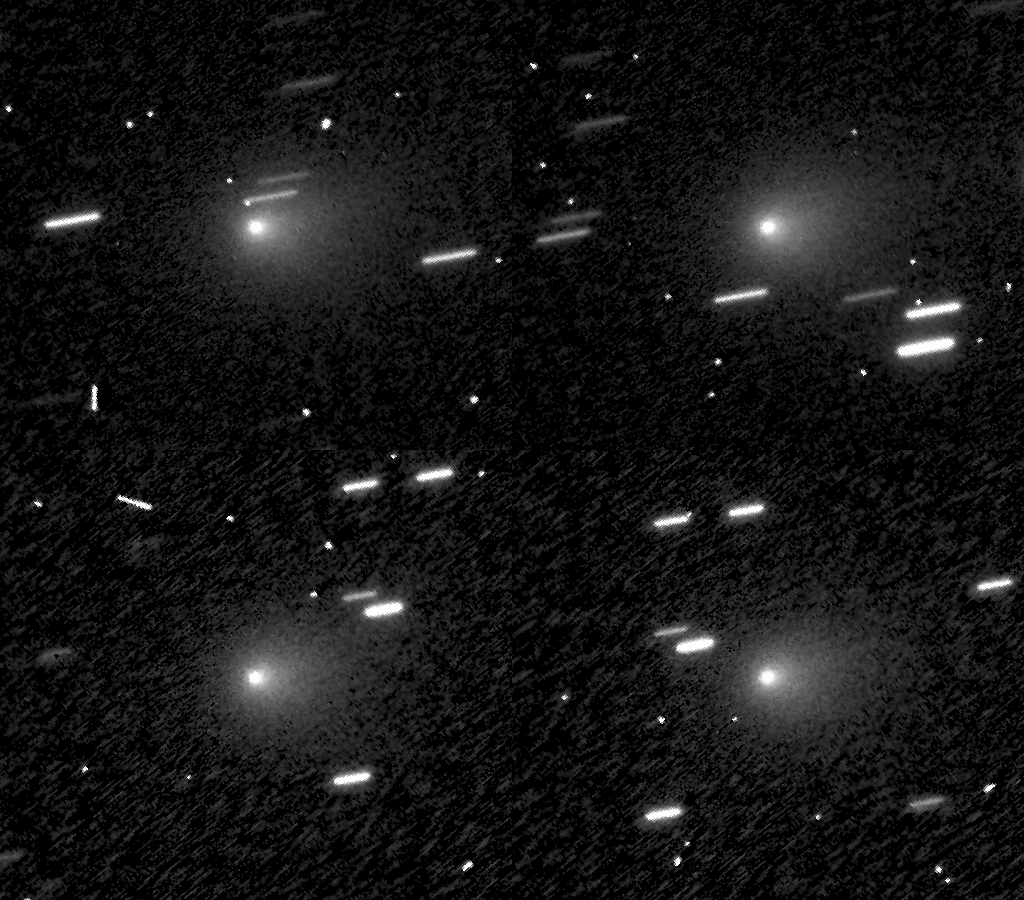
Designed to map galaxies, the SPHEREx mission's first science result is instead about interstellar interloper 3I/ATLAS. No, it's not aliens.

In our own Milky Way, a recently deceased star creates a ghostly, hand-like shape in X-rays some 150 light-years wide. Here's how it's made.

Across planet Earth, dark and pristine night skies are an increasingly rare resource. These photos showcase the best of what we still have.

The Universe was born incredibly hot, and has expanded and cooled ever since. Could life have begun back when space was "room temperature?"

At the end of July, hundreds of scientists convened to plan NASA's upcoming astrophysics flagship mission. Will the US allow it to happen?

Two supermassive black holes on an inevitable death spiral push the limits of Einstein's relativity. New observations reveal even more.

On the largest scales, galaxies don't simply clump together, but form superclusters. Too bad they don't remain bound together.

Even just by examining the Moon with the unaided eye, we can learn an incredible amount about the Moon, Earth, and more.

Once you cross a black hole's event horizon, there's no going back. But inside, could creating a singularity give birth to a new Universe?
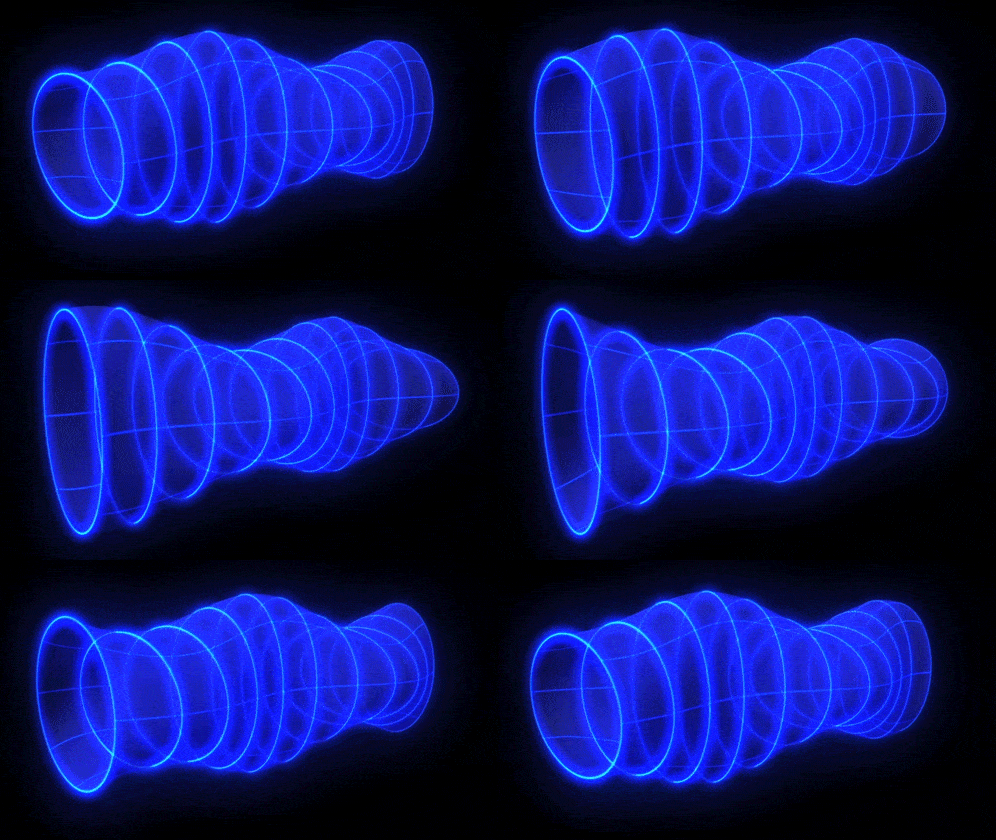
With over 300 high-significance gravitational wave detections, we now have a huge unsolved puzzle. Will we invest in finding the solution?