




















Search
Space

Will we build a successor collider to the LHC? Someday, we'll reach the true limit of what experiments can probe. But that won't be the end.
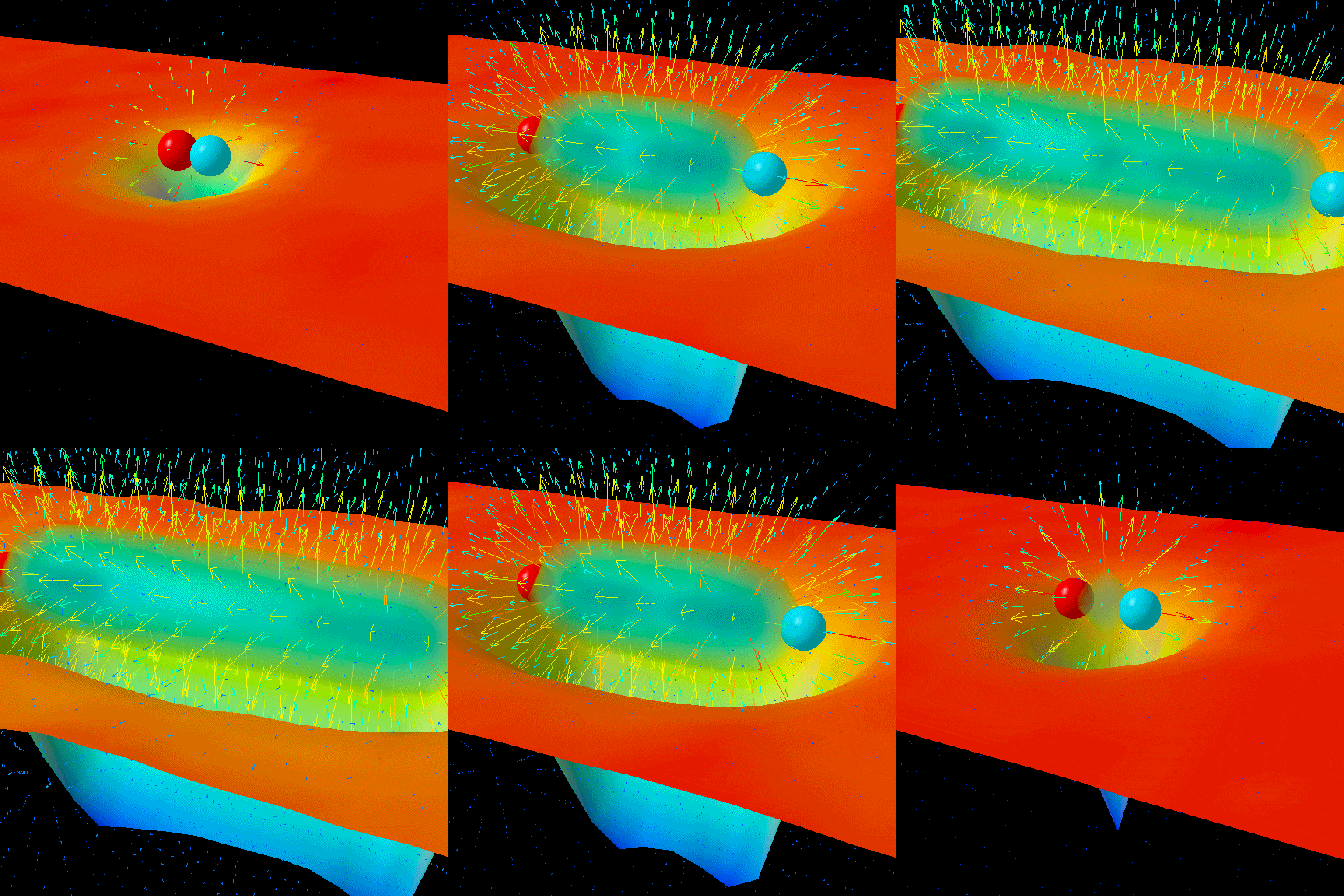
The measured value of the cosmological constant is 120 orders of magnitude smaller than what's predicted. How can this paradox be resolved?

The relic signal that first proved the Big Bang has been known and analyzed for 60 years. Join us at the frontiers of modern cosmology!

Looking at a dark, night sky has filled humans with a sense of awe and wonder since prehistoric times. But appearances can be deceiving.

The tiniest galaxies of all are the most severely dominated by dark matter. Could black holes be the cause of the extra gravity instead?

If you want to understand the Universe, cosmologically, you just can't do it without the Friedmann equation. With it, the cosmos is yours.

On Earth, our particle accelerators can reach tera-electron-volt (TeV) energies. Particles from space are thousands of times as energetic.

The COSMOS-Web has just finalized their release of their full field: larger and deeper than any other JWST program. Here's what's inside.

It rotates on its axis, revolves around the Sun, moves throughout the Milky Way, and gets carried by our galaxy all throughout space.

Just 10 years ago, humanity had never directly detected a single gravitational wave. We're closing in on 300 now, with so much more to come!

It took nearly 400,000 years, after the Big Bang, to first form neutral atoms. The imprints from that early time can now be seen everywhere.

All stars shine due to an internal source of energy. Usually, it's nuclear fusion: converting mass into energy. What makes them most bright?

Photons come in every wavelength you can imagine. But one particular quantum transition makes light at precisely 21 cm, and it's magical.

According to Stephen Hawking, spontaneously emitted radiation should cause all black holes to decay. But we've never seen it: not even once.

If an asteroid hadn't killed off the dinosaurs, humans would almost certainly have never walked the Earth.

After drastic cuts to the NIH, the FDA, the NSF, and the DOE, NASA science faces down its smallest budget ever. All of society will suffer.

The most famous Hubble images show glittering stars and galaxies amidst the black backdrop of space. But more was captured than we realized.

In around 7 billion years, we expect the Sun to run out of fuel, dying in a planetary nebula/white dwarf combination. Is that for certain?

Exoplanets can exist anywhere around their parent stars, even so close that they evaporate or disintegrate. Even the rocky ones.

We understand many things about our Universe, and our home within it, extremely well. The number of stars in the Milky Way isn't among them.

Over a century after we first unlocked the secrets of the quantum universe, people find it more puzzling than ever. Can we make sense of it?

Einstein's general relativity has reigned supreme as our theory of gravity for over a century. Could we reduce it back down to Newton's law?

Our scientific instruments are constantly improving, revealing nature's workings as never before. Without them, we'll remain in the dark.
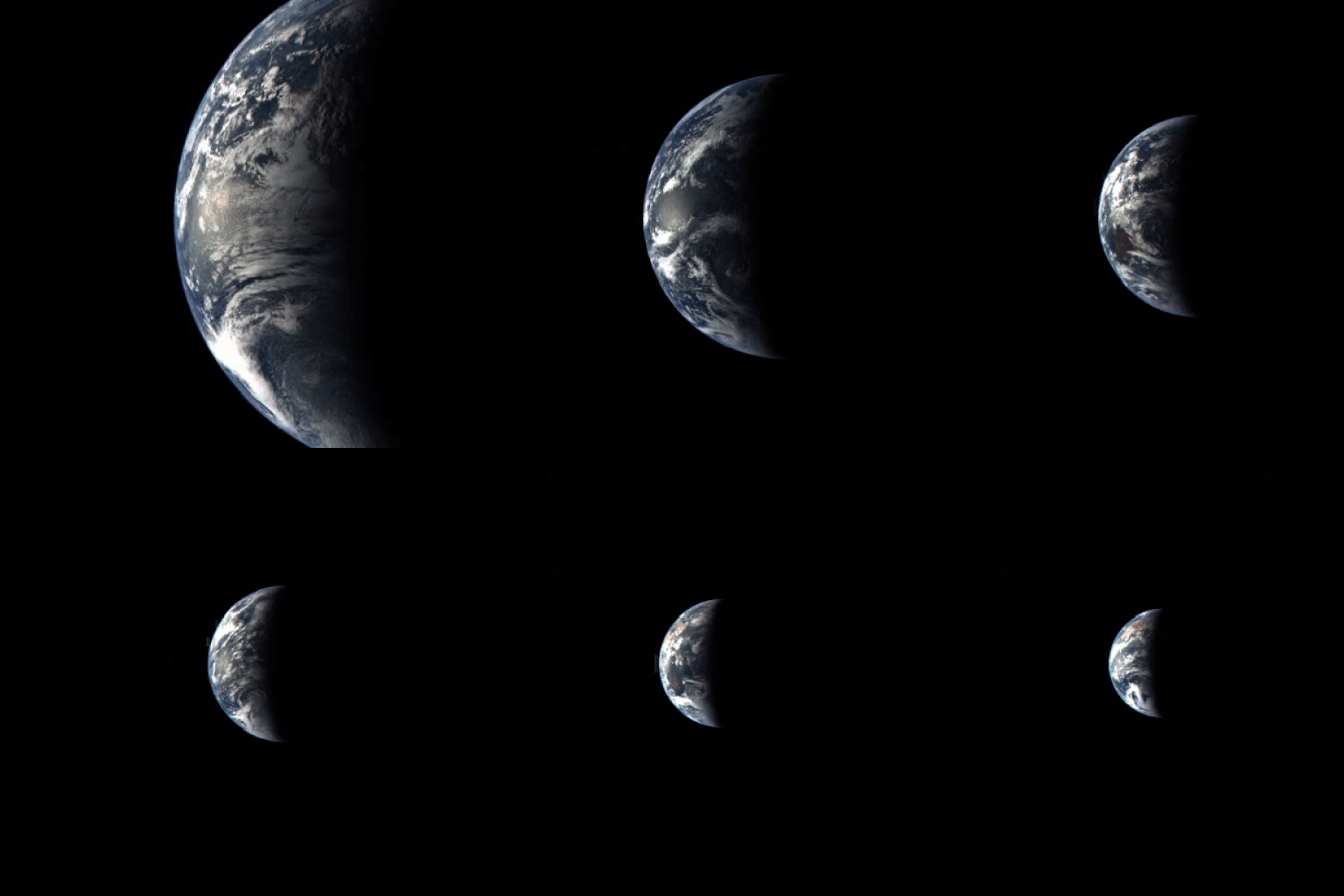
All scientific theories are limited in scope, power, and application, being mere approximations of reality. That's why consensus is vital.

The Universe is expanding, and individual, bound structures are all receding away from one another. How, then, are galaxies still colliding?

Just 165,000 light-years away, the Large Magellanic Cloud is suspected to house a supermassive black hole. At last, evidence has arrived.

There are some 26 fundamental constants in nature, and their values enable our Universe to exist as it does. But where do they come from?

The CMB gives us critical information about our cosmic past. But it doesn't give us everything, and galaxy mapping can fill in a key gap.

"Gyroscope-on-a-chip" technology could soon enable us to navigate over long distances without GPS.

Here in our Solar System, terrestrial bodies get moons from gravitational capture or collisions. The Pluto-Charon system? It was both.