




















Search
Space

Caption:“At this time in Mars’ history, we think CO2 is everywhere, in every nook and cranny, and water percolating through the rocks is full of CO2 too,” Joshua Murray says.

There are a number of factors to consider when choosing where to build a telescope. These 3 locations, on their merits, surpass all others.

Watching for changes in the Red Planet’s orbit over time could be new way to detect passing dark matter.

Interferometry gave us a black hole's event horizon, but that was in the radio. What can we accomplish with a new optical interferometer?

Today, the deepest depths of intergalactic space aren't at absolute zero, but at a chill 2.73 K. How does that temperature change over time?
The Universe has been creating stars for nearly all 13.8 billion years of its history. But those photons can't match the Big Bang's light.

The Parker Solar Probe is about to undergo its seventh encounter with Venus on its journey toward the Sun. Here's how fast it'll go.

Time is relative, not absolute, as gravity and motion both cause time to dilate. Your head and feet, therefore, don't age at the same rate.

With the discovery of Porphyrion, we've now seen black hole jets spanning 24 million light-years: the scale of the cosmic web.

Almost all of the stars, planets, and interesting physics happens in the inner portions of galaxies. Is that conventional wisdom all wrong?

These startups, space agencies, and aerospace giants are building humanity's next off-world homes.

In the expanding Universe, different ways of measuring its rate give incompatible answers. Nobel Laureate Adam Riess explains what it means.

Galactic activity doesn't just arrive when supermassive black holes feast on matter. Before, during, and after all create fascinating signs.

Taught in every introductory physics class for centuries, the parabola is only an imperfect approximation for the true path of a projectile.

The observation that everything we know is made out of matter and not antimatter is one of nature's greatest puzzles. Will we ever solve it?

"When you feel the isolation setting in at times, you have to reframe your mindset."

The Universe isn't just expansion, but the expansion itself is accelerating. So why can't we feel it in any measurable way?

The original principle of relativity, proposed by Galileo way back in the early 1600s, remains true in its unchanged form even today.

These missions will put us one step closer to the ultimate goal: crewed trips to Mars.

More than any other equation in physics, E = mc² is recognizable and profound. But what do we actually learn about reality from it?

The Michelson-Morley experiment of 1887, despite expectations, revealed a null result: no effect. The implications were revolutionary.

Today, the Large Hadron Collider is the most powerful particle physics experiment in history. What would a new, successor collider teach us?

Peaking on the night of August 11/12, up to 100 bright meteors per hour will be visible. Here's how to make the most of it.

Such discoveries help researchers better understand the development of molecular complexity in space during star formation.

Even in the very early Universe, there were heavy, supermassive black holes at the centers of galaxies. How did they get so big so fast?
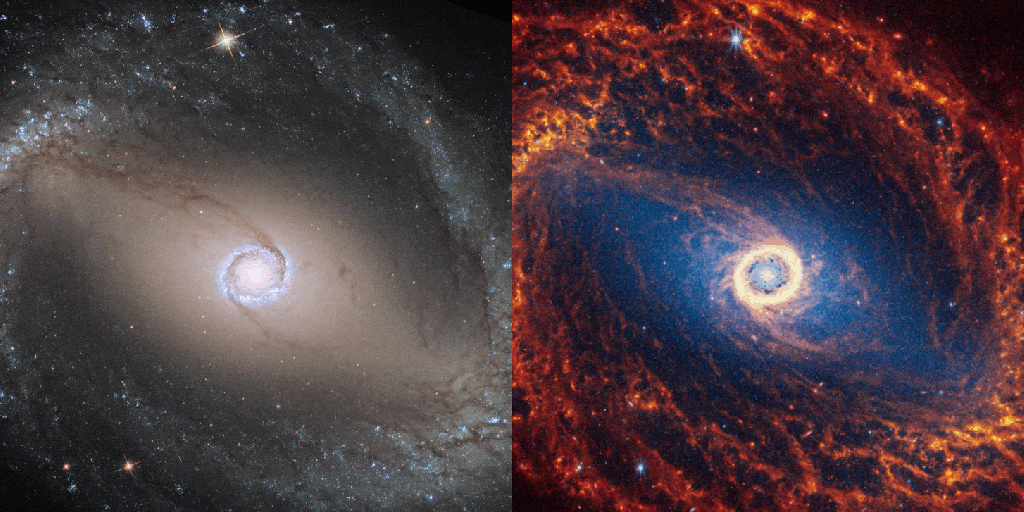
In July of 2022, the first science images from JWST were unveiled. Two years later, it's changed our view of the Universe.

The passage of time is something we all experience, as it takes us from one moment to the next. But could it all just be an illusion?
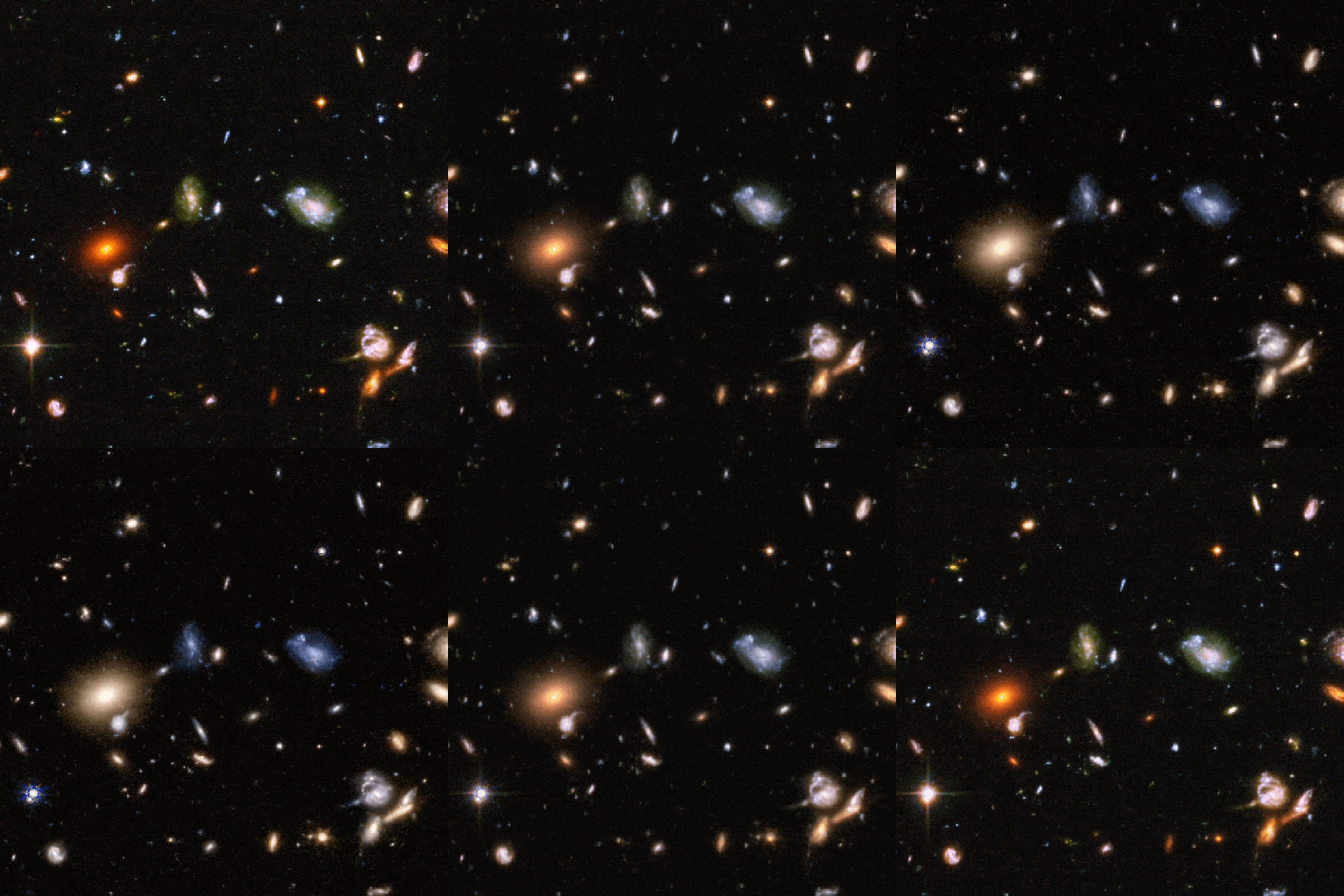
From inside our Solar System, zodiacal light prevents us from seeing true darkness. From billions of miles away, New Horizons finally can.

The Extremely Large Telescope (ELT) will have a light-collecting power 10 times greater than today's best telescope.

Just 13.8 billion years after the hot Big Bang, we can see objects up to 46.1 billion light-years away. No, this doesn't violate relativity.